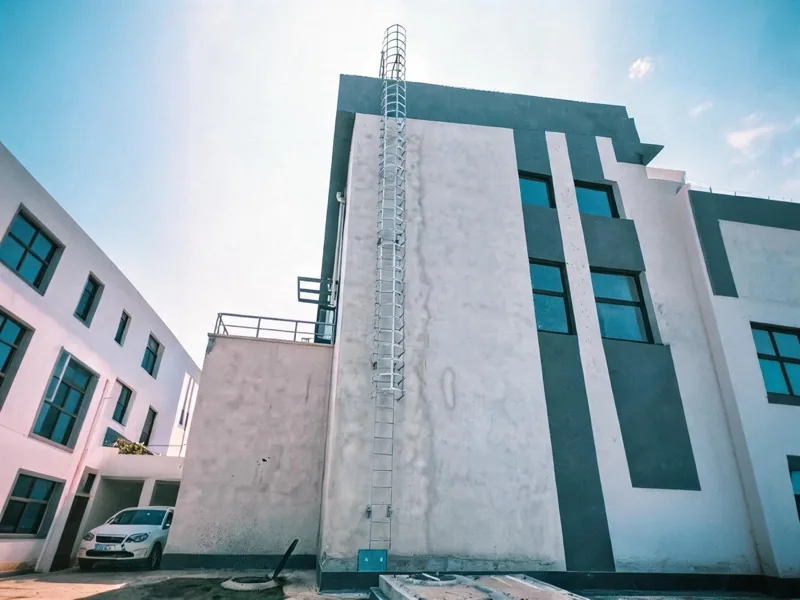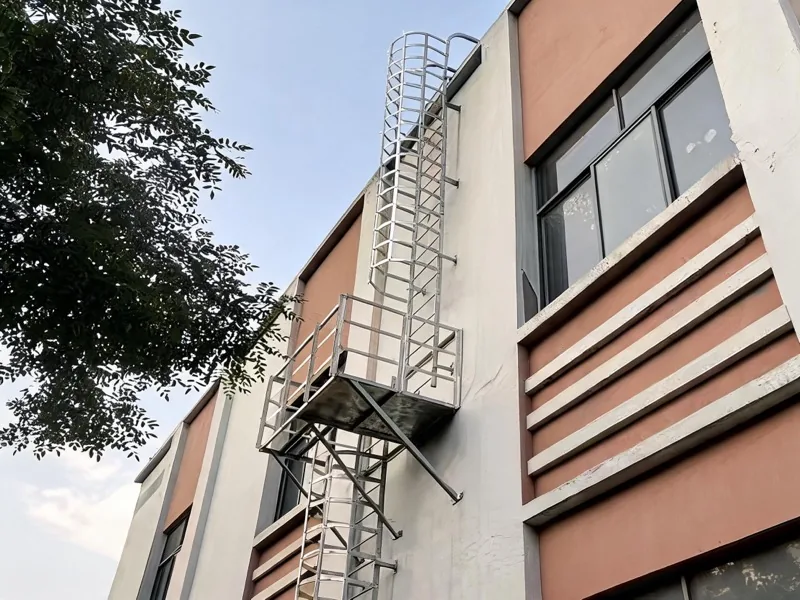
Commercial roof access ladders sit in a world the industrial yard never sees: crowds below, glass overhead, and a facilities manager who answers to both an inspector and the public. A mall, an airport pier, a school block — each one needs a fixed climb that keeps maintenance crews safe and keeps everyone else off it. We have built these for commercial sites since 2003, and the brief is always the same. Code-compliant, lockable, and quiet enough to install without closing the building.
Commercial Building Access Challenges
High foot traffic changes the rules. On an industrial roof you fence the area and move on. In a public building, commercial building roof access ladders share walls with food courts, classrooms, and departure gates, so the design has to defend against curious teenagers and lost passengers as hard as it defends the climber.
- Public safety first. Anyone who can reach the bottom rung is a liability. The base needs a lockable guard or a removable lower section.
- Building-code overlap. Local fire and building codes layer on top of ladder standards. We read both before cutting steel.
- Aesthetics and noise. Architects want the climb tucked away. Powder-coat finishes and bolted (not welded) site joints keep it tidy and low-disruption.
Recommended Ladder Systems
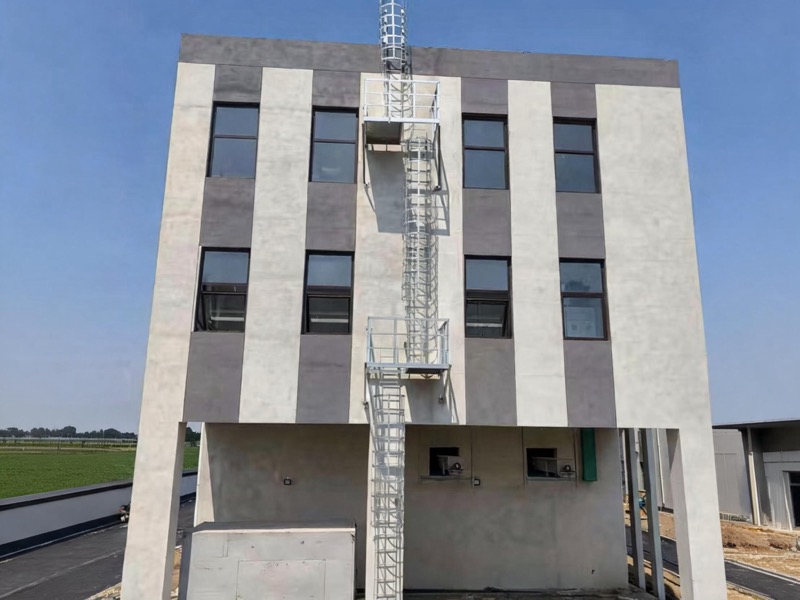
For most jobs we spec a fixed vertical climb with a safety cage, or a cage plus rest platform once the run passes the single-flight limit. The right commercial roof ladder depends on height, exposure, and who will use it.
- Carbon steel, inland. Q235B, hot-dip galvanized to roughly 85 µm for a 20-year coating life on a dry urban roof.
- Stainless, humid or coastal. SS304 for poolside leisure centres and food halls; SS316 where salt air or chlorine attacks the metal.
- Rated to load. Every rung is sized for a 1.5 kN point load to EN ISO 14122-4, with stile spacing and rung pitch held to the millimetre on the drawing.
Compare the build options on our fixed roof access ladder and caged roof access ladder product pages, then browse the wider set on the industry applications hub.
Public-Access Compliance
Three standards govern the work, depending on the market we ship to:
- OSHA 1910.23 for US sites — cage or fall-arrest above the climb-height trigger, fixed rung geometry.
- EN ISO 14122-4 for Europe — rung load, cage dimensions, rest-platform spacing.
- BS 4211 for UK permanent ladders — anti-climb guards and locking arrangements that matter on a public building.
The public-access twist is the lockable base. We fit a hinged, padlockable guard or a swing-up lower gate so the climb is open to a trained technician and closed to a passer-by. In our factory, we usually mock this guard up on the test frame before shipping, because a guard that fouls the cage is useless.
Installation & Maintenance in a Busy Building
Downtime is the hidden cost on a public site. A commercial fixed ladder has to go up around opening hours, not through them. We pre-assemble sub-frames in Shijiazhuang, hot-dip galvanize them, then ship bolt-together kits so the on-site crew skips hot work near sprinklers and the public.
- Phased install. Sections crane in overnight; the cage and lockable base bolt on at dawn.
- Scheduled checks. A quick visual every quarter, a full inspection once a year against OSHA 1910.23 and EN ISO 14122-4 criteria.
- Proof, not promises. We pull a sample from each production batch for a tensile test, so the steel grade on the cert is the steel on the roof.
Factory-Direct Procurement
Buying straight from the plant removes the middleman markup, and the paperwork that protects you comes in the box: material certificates, weld reports, and load-test data on every order. We are ISO 9001:2015 certified, run third-party inspection through SGS, TÜV, or Bureau Veritas on request, and ship to 50+ countries. Facilities teams are welcome to audit the factory before they commit.
Send us the climb height, the governing standard, and whether the site is inland or coastal. Our engineers return a stamped drawing, a steel-grade call, and factory-direct pricing — usually inside one working day.