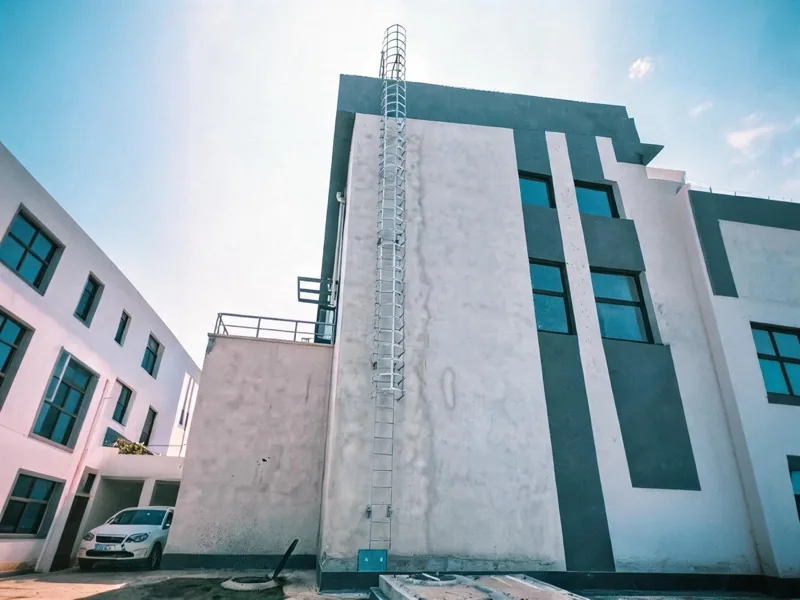
A cat ladder outdoor unit is a fixed steel ladder bolted to a roof slope or parapet, so a worker reaches roof level safely — again and again, for the life of the building. It is not a leaning ladder you carry up. Most buyers shopping for roof cat ladders hit the same five questions: which material, which standard, what size, what it costs, and who to trust. This guide answers all five from the factory floor.
We are Dengtai, a factory-direct steel ladder manufacturer in Shijiazhuang. ISO 9001:2015 certified, an 8,000 m² floor, building for export since 2003. The notes below come from the engineers who cut, weld, and pull-test the steel — not from a brochure.
How to Choose a Roof Cat Ladder
Five decisions settle the whole spec. Get them right and the ladder outlasts the roof. A cat ladder outdoor on an exposed roof also faces wind, rain, and UV, so the grade matters more than buyers expect.
- Roof slope and angle — a near-vertical parapet climb and a 30° pitched roof need different mounting feet. Measure the angle first.
- Material grade — Q235B carbon steel for dry inland sites, SS304 for coastal or wet exposure, SS316 where salt is heavy.
- Climb height and cage trigger — height decides whether you need a cage, a rail, or a ladder safety system under your governing standard.
- Mounting substrate — concrete, steel purlin, and timber each take a different anchor. Tell us what you are fixing into.
- Documentation — if the site is audited, you need material certificates and load test data, not just a ladder.
New to the product? Start with What Is a Roof Cat Ladder, then the field method in How to Install a Cat Ladder on a Sloped Roof.
Material Options: Aluminium vs Q235B Steel vs SS304/SS316
The grade you pick drives both lifespan and price. Here is how the four common options compare on the jobs we quote.
| Material | Best for | Corrosion resistance | Relative cost |
|---|---|---|---|
| Aluminium | Light loads, fast handling | Good, but soft on impact | Mid |
| Q235B carbon steel (hot-dip galvanized) | Most dry inland roofs | Good with 85–140 µm zinc | Low |
| SS304 stainless | Coastal, humid, food plants | High | High |
| SS316 stainless | Marine, chemical, heavy salt | Highest | Highest |
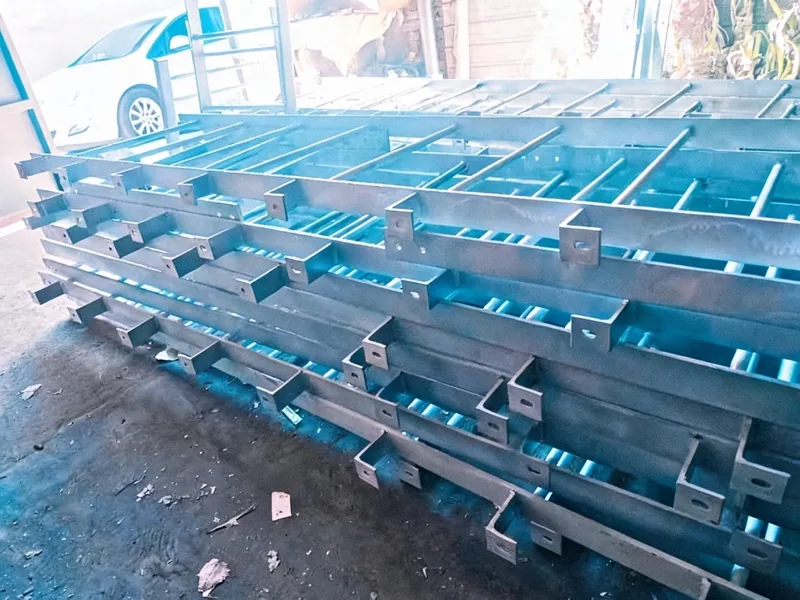
We galvanize Q235B after fabrication, so every cut edge and drilled hole stays sealed. For salt air we move straight to SS304 or SS316. A quick rule from the shop: if you can taste the sea, skip carbon steel.
Safety and Compliance for Sloped Roofs
This is where a cheap ladder gets a site shut down. Three standards cover most of our export work:
- OSHA 1910.23 — the US rule for fixed ladders, rung strength, and fall-protection triggers.
- EN ISO 14122-4 — the European standard for permanent access, rung spacing, and clearances.
- BS 4211 — the UK specification for permanently fixed ladders, common on British projects.
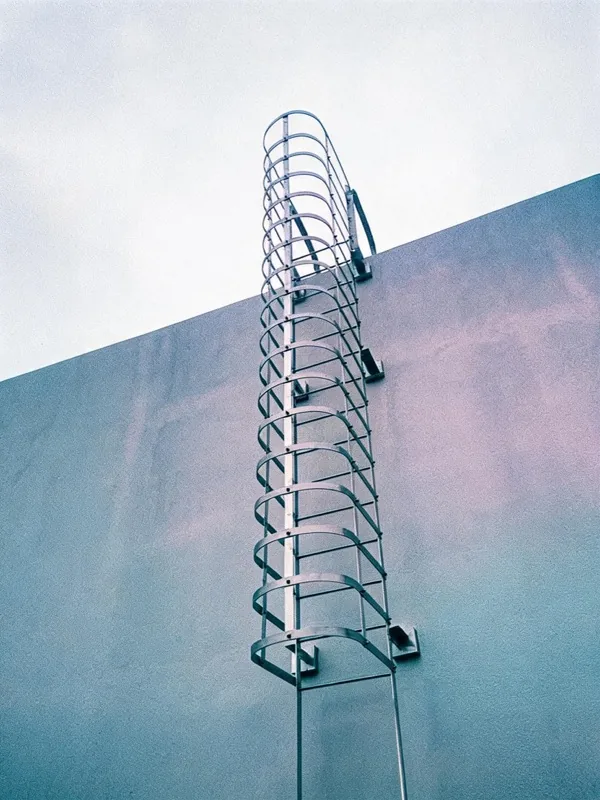
Cage rules differ by region, which trips up a lot of buyers. OSHA 1910.23 now leans toward ladder safety systems on new fixed ladders over 24 ft, while EN ISO 14122-4 still uses a height threshold for hoops. We build to whichever rule governs your site. To weigh a cat ladder against a full fixed run, read Cat Ladder vs Fixed Roof Ladder, and use the wider roof ladder guide for the full picture.
On proof: Dengtai is ISO 9001:2015 certified and ships to 50+ countries. SGS, TÜV, and Bureau Veritas witnessed tests are available when a project needs third-party sign-off.
Sizing, Load and Slope
The numbers are not preference. They are set by the standard, then checked on our rig.
- Rung spacing — 250–300 mm on centre per EN ISO 14122-4.
- Width — typically 380–450 mm between stiles, sized to the climb.
- Top bracket load — designed to hold 6 kN, a 2:1 margin over the 3 kN minimum we test to.
- Coating — hot-dip galvanizing at 85–140 µm, above the 85 µm floor most specs ask for.
- Slope feet — adjustable mounts handle roof pitches from near-vertical up to about 45°.
We sample pull-test each batch to failure on our own rig and keep the load test data on file. Every unit ships with that record. Questions on capacity? The wider roof ladder hub covers load tables in depth.
Cat Ladder Price and Factory-Direct Buying
Three things move the cat ladder price: material grade, climb height, and whether you need a cage or rail. A short galvanized Q235B unit is the budget end. A tall SS316 caged run sits at the top.
You buy from the people who cut the steel. No trading company, no distributor markup, no hidden margin between the drawing and the dispatch. That factory-direct model shows up twice: in the price, and in the paperwork. Every order ships with material certificates, weld inspection reports, and load test data. Clients are welcome to audit the line in person before they commit.
Send a drawing or a rough spec through the contact page and you get a buildable quote with a load table.
Our Roof Cat Ladders: Range and Where to Buy
Browse the roof cat ladders below. Each is built to order in carbon or stainless steel, and these are the cat ladders for sale today direct from the factory.
- Roof Cat Ladder — straight vertical access to OSHA 1910.23 and EN ISO 14122-4.
- Fixed Roof Access Ladder — Q235B or SS304, brackets pre-drilled to your roof pitch.
- Caged Roof Access Ladder — hoop protection for tall exposed climbs.
- Roof Hatch Ladder — internal access through a roof hatch opening.
See the full lineup on the products overview, common questions on the FAQ page, and every engineering guide in our blog. The articles linked above — install, comparison, and the product primer — were all written by the engineers who build the ladders.