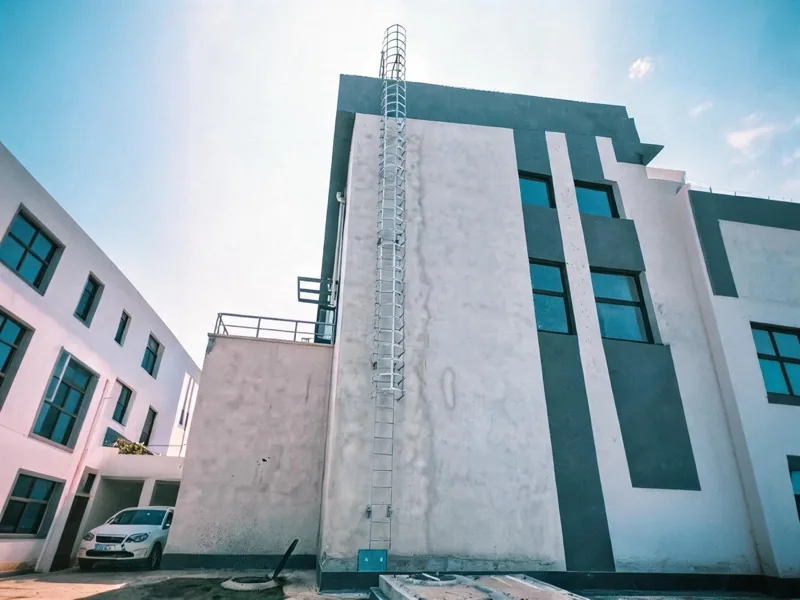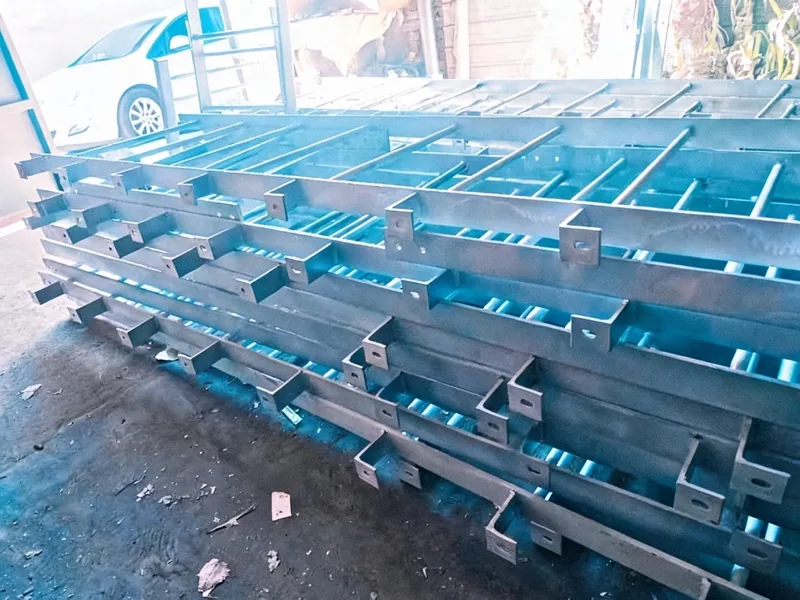
Installing a pitched roof ladder on a sloped roof is methodical work, not guesswork. Get the pitch read, the anchors, and the load test right, and the climb is safe for twenty years. Get them wrong and the first storm finds the weak rung. This guide walks the job the way our installation engineers run it on site. Tools first, then the pitch read, the step-by-step fit, anchoring, load testing, and the final safety checks. For the wider picture on types and selection, start with our cat ladder guide, then come back here to fit one.
We weld these ladders in Shijiazhuang and ship them to 50+ countries, so the steps below come from the welding bay, not a catalogue. Every job follows ISO 9001:2015 procedure. The same kit also fits flat and low-slope decks, but the pitch changes how you anchor it — that is where most installs go wrong.
1. Tools and Materials for Cat Ladder Construction
Good cat ladder construction starts with the right kit on the roof. Lay it all out before you climb. Here is what we send with a pre-engineered roof kit, and what you supply on site.
- The ladder sections. Galvanized Q235B for inland roofs, SS304 for humid or coastal-edge sites, SS316 within a few kilometres of salt water. Aluminium where weight is the priority.
- Roof anchors and ridge hooks. Stainless anchor bolts sized to the substrate, plus a ridge hook that carries load over the apex.
- Fasteners. M10–M12 anchor bolts, washers, and lock nuts rated for the rung load.
- Standoff brackets. To hold the stringer clear of the roof skin and keep water moving.
- Tools. Impact driver, torque wrench, hammer drill, chalk line, a 600 mm spirit level, and a tape.
- Fall protection. A certified harness and anchor line — non-negotiable on any pitch.
Match the steel grade to the site, not the budget. For the full grade-by-environment breakdown, see our note on cat ladder materials. On our factory floor we batch-test each steel lot with a tensile pull before it reaches the welding bay, so the metal you bolt down is already proven.
2. Assess the Roof Pitch and Substrate First
The pitch decides everything that follows. Measure it before you order fixings. Use a pitch gauge or a level and tape against a 300 mm run, then read the angle.
Three things matter here:
- Roof angle. A low slope under 20° lets you work close to flat-roof rules. A steep pitch past 45° needs extra anchor points and a tighter rung spacing.
- Substrate. Metal purlins, timber rafters, and concrete decks each take a different anchor. Probe to find the structural member, not just the skin.
- Walking limits. OSHA 1910.23 and EN ISO 14122-4 set the angle bands where a fixed ladder, not a stair, is the right access. Stay inside them.
Anchor into the structure every time. A bolt in roof skin alone will pull out under load. If your roof is steeper than a cat ladder suits, a fixed roof access ladder may fit better — our roof ladder guide covers that case.
3. Step-by-Step: Fitting Cat Ladders for Roofs
Fitting cat ladders for roofs follows a fixed order. Work top-down so the load path is set before you trust a rung.
- Set the ridge hook. Seat it over the apex and bed it on the ridge, so the hook carries the pull, not the lower fixings.
- Mark the anchor points. Snap a chalk line down the fall line. Mark each bracket over a purlin or rafter, evenly spaced.
- Drill and set anchors. Drill for the M10–M12 bolts, fit the standoff brackets, and seat each anchor into the structural member.
- Lay the stringers. Lower the sections onto the brackets from the ridge down. Keep the stringer parallel to the fall line.
- Bolt from the top down. Torque each anchor to the drawing spec. Even tension spreads the load across every fixing.
- Check rung spacing. EN ISO 14122-4 sets 250–300 mm between rung centres, with at least 150 mm clearance behind each rung. Keep it even end to end.
/images/product_cat-ladders_gallery03_crane_work.webp
Engineer's note: we lower long runs with a crane on bigger jobs, as shown above, so the stringer lands square. No one drags steel up a wet slope. On a house-scale install two people and a roof ladder do the same job.
4. Anchoring and Load Testing the Pitched Roof Ladder
A pitched roof ladder is only as safe as its anchors. This is the step you never rush. Once every bolt is torqued, you prove the fixing before anyone climbs.
- Distribute the load. Spread fixings so no single anchor carries the climb. The ridge hook takes the top pull; the brackets share the rest.
- Torque to spec. Use the drawing figure, not feel. Re-check each bolt after the first load.
- Pull-test the anchors. Apply a test load to a sample of fixings and confirm they hold. We rate brackets to a stated kN and load-test to that number.
- Log the result. Record the test against the unit, so the inspector sees proof, not a promise.
In our factory, every batch gets a sample pulled to its rated load before it ships, and the weld report travels with the order. Coating matters too: hot-dip galvanizing at 70–85 µm is the outdoor baseline, and thinner zinc means a shorter life. Third-party verification through SGS, TÜV, or Bureau Veritas is available on request. The measured rung rating for this kit is.
5. Common Cat Ladder DIY Mistakes and Safety Checks
Most cat ladder DIY failures repeat the same handful of errors. Run this list before you sign the job off.
- Anchoring to skin, not structure. The bolt holds for a week, then works loose. Always reach the purlin or rafter.
- Walking the slope unprotected. Clip to a certified anchor line on every pitch. A wet slope gives no second chance.
- Uneven rung spacing. Out-of-spec gaps fail an audit and trip a tired climber. Keep to 250–300 mm.
- Smooth rungs. Use serrated or grooved rungs so a wet boot still grips.
- No load test. An untested anchor is a guess. Pull-test before first use.
- Skipping the safety gate. A self-closing gate at the landing closes the gap where most falls happen.
For the full fall-prevention checklist, read our guide to cat ladder safety. A DIY fit can be sound, but it stands or falls on the anchor and the test — the two steps people skip.
6. Why Factory-Direct Pre-Engineered Kits Beat a DIY Cat Ladder Build
A pre-engineered kit takes the maths off the roof. The pitch, anchor pattern, and rung load are worked out before the steel ships, so the fit on site is bolt-and-go. That is the real gap between a kit and a from-scratch cat ladder DIY build.
- Engineered for your pitch. We cut the stringer angle and bracket spacing to your roof, not a generic length.
- Documents included. Material certificates, weld reports, and load-test data ship with every order — at no extra charge.
- Factory-direct pricing. No middleman, no reseller margin. You buy at mill and fabrication cost.
- ISO 9001:2015 behind the line. The quality system covers cutting, welding, and testing.
- Audits welcome. Come walk the welding bay before you commit — we host factory audits.
See the kit itself on our roof cat ladder page, or send your roof height, pitch, and standard for a same-day quote. A like-for-like galvanized Q235B kit typically lands at before freight; stainless moves up from there.
From a recent job: a facilities contractor in ordered galvanized cat ladder kits for pitched warehouse roofs. We pre-cut each to the surveyed pitch, shipped weld reports per unit, and the lot cleared their third-party audit on the first pass.
Pitched Roof Ladder FAQs
What angle counts as a sloped roof for a cat ladder?
Anything with a noticeable pitch — roughly 10° and up. Below that you work to flat-roof rules; above 45° you add anchor points and tighten rung spacing.
How do you anchor a cat ladder on a sloped roof?
Fix into the structure — purlin, rafter, or concrete deck — never the roof skin. Set a ridge hook over the apex, then share the load across standoff brackets and pull-test a sample.
Can I install a cat ladder DIY?
Yes, if you anchor into structure, keep rung spacing to 250–300 mm, and load-test before first use. Skip those and a DIY fit is a fall risk.
What standard should a roof cat ladder meet?
OSHA 1910.23 in the US, EN ISO 14122-4 in the EU, or BS 4211 in the UK. Match the code to the destination market.