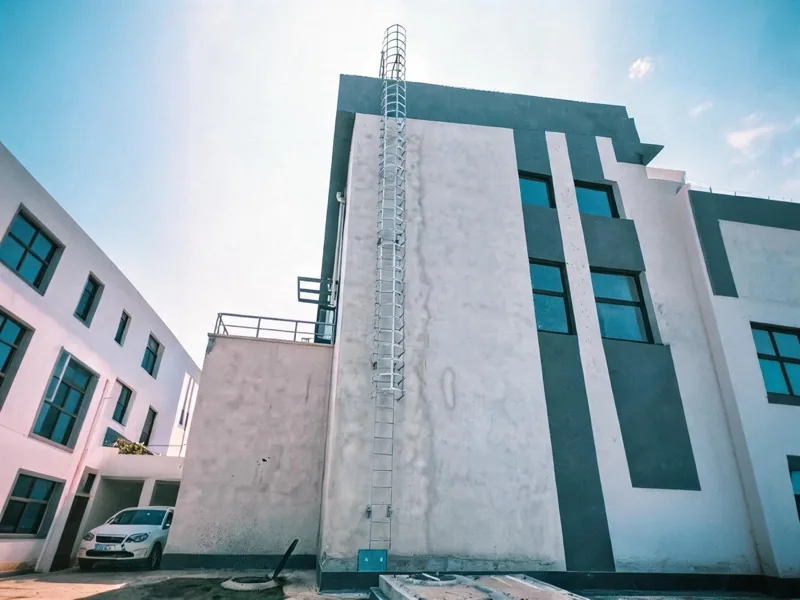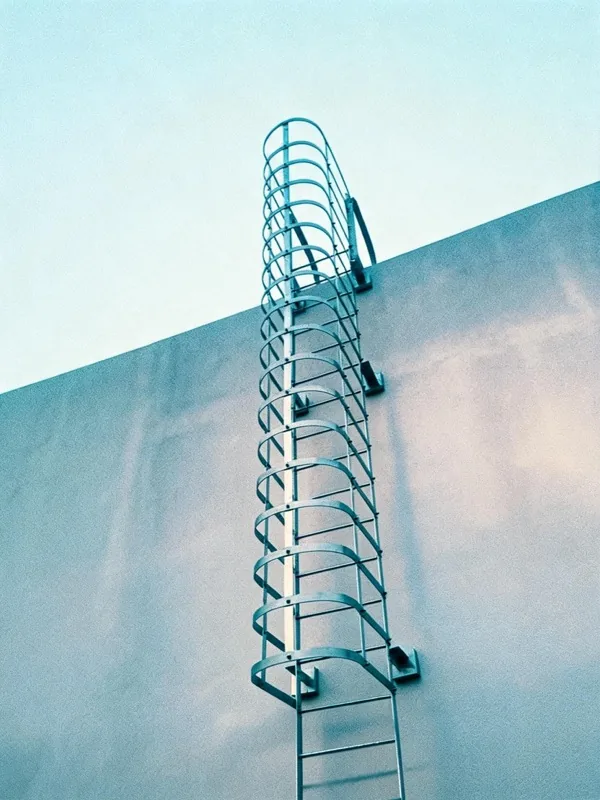
A cage ladder is a fixed vertical access ladder fitted with a welded safety cage — a set of steel hoops and vertical bars that surround the climber and catch a backward fall. It is the workhorse of industrial roof, tank, and silo access. This hub gathers what our engineers get asked most: what a cage ladder is, the types we build, the standards that govern the cage, the materials, and how a cage stacks up against a guardrail or a fall-arrest line.
We build these units for export. Dengtai is a factory-direct steel ladder manufacturer in Shijiazhuang, ISO 9001:2015 certified, running an 8,000 m² floor since 2003. The notes below come from the people who cut and weld the steel — no middleman, no distributor markup.

What Is a Cage Ladder
A cage ladder is a fixed ladder with a guard cage built around it. The cage — sometimes called a ladder cage — is a cylinder of hoops and longitudinal bars. It does not stop a fall on its own. It limits how far a climber can pitch backward, then funnels the body toward the rungs.
Picture a refinery, a water tank, or a warehouse plant deck. Someone climbs 6 metres to service the kit. A bare vertical ladder leaves nothing behind the worker, and that is where people get hurt. The ladder and cage together turn an exposed climb into a contained one. Choosing the right cage for ladder access starts with the climb height and the governing standard. For a full primer, see What Is a Cage Ladder.
Types of Cage Ladders and Safety Cage Systems
Three configurations cover most industrial cage ladder jobs we quote. Each one suits a different mounting or retrofit need.
| Type | Best for | Notes |
|---|---|---|
| Caged Fixed Access Ladder | New vertical access on walls, tanks, and silos | Cage welded as one assembly with the stiles |
| Ladder Safety Cage System | Retrofitting a cage onto an existing ladder | Bolt-on hoops sized to the rung pitch |
| Roof Access Ladder with Cage | Tall exposed climbs to roof level | Cage plus a step-through landing at the top |
Need a caged climb built into a roof-access package? See the Caged Roof Access Ladder too. A safety cage is not always the right call on its own. Taller climbs often pair it with a rail or a running line, which the next section covers.
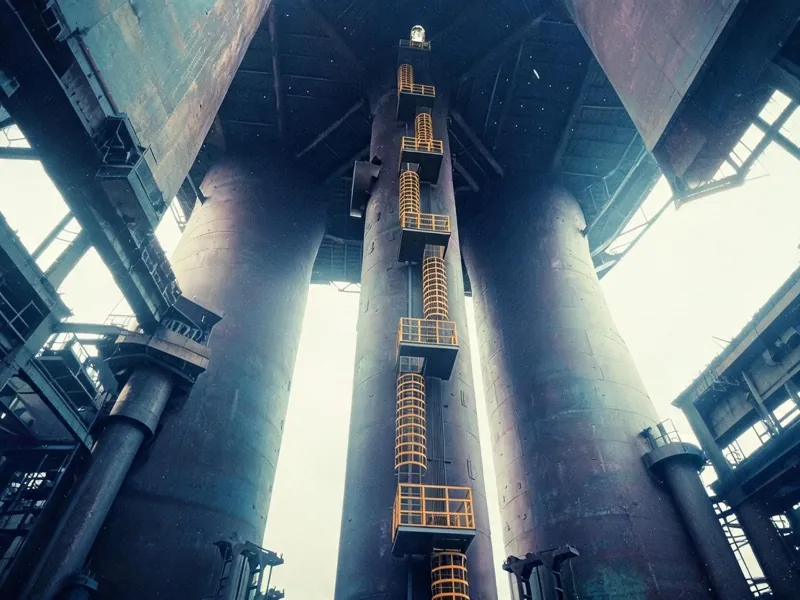
Cage Ladder Safety Standards: OSHA 1910.23 and Ladder Safety Cage Rules
This is where buyers trip up, because the rules diverge by region. Two standards govern most of our export work.
- OSHA 1910.23 — the US rule, and it is phasing cages out. Any new fixed ladder over 24 ft must carry a ladder safety system or a personal fall-arrest system. By 2036, all such ladders must drop the cage. A ladder safety cage alone no longer satisfies OSHA on tall new ladders.
- EN ISO 14122-4 — the European standard for permanent access. It still works on a height threshold, so a hooped cage stays compliant on many European jobs.
We build to whichever rule governs your site. The numbers are not negotiable. Cage hoops sit at 1,500 mm maximum vertical spacing, with the bottom hoop 2,100–2,400 mm above the base. Internal cage diameter runs 680–760 mm, so the climber is caught but not cramped. Read the detail in OSHA Cage Ladder Requirements and EN ISO Cage Ladder Requirements, then check fit on site with our Cage Ladder Inspection Checklist.
Cage Ladder Materials and Specifications
Material grade decides how long the unit lasts. We match it to the environment, not to a price list.
- Q235B carbon steel, hot-dip galvanized — the default for dry indoor and sheltered sites.
- SS304 stainless — for coastal air and washdown areas.
- SS316 stainless — for heavy salt, chlorine, and chemical exposure.
Every top bracket is designed to hold 6 kN, a 2:1 margin over the 3 kN minimum we test to. Rung spacing runs 250–300 mm on centre. Hot-dip galvanizing lands at 85–140 µm, above the 85 µm floor most specs ask for. We coat after fabrication, so every cut edge stays sealed. On our line, we sample pull-test each batch to failure on our own rig and keep the load test data on file. SGS, TÜV, or Bureau Veritas witness tests are available when a project needs third-party proof.
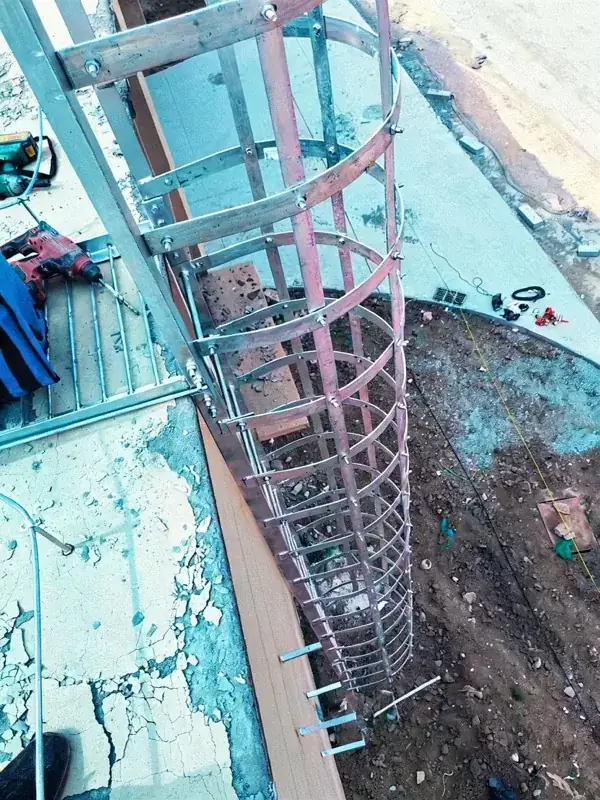
How to Choose: Cage vs Guardrail vs Fall Arrest
The cage is one option, not the only one. Match the protection to the climb.
| Method | Best fit | Trade-off |
|---|---|---|
| Safety cage | Existing ladders, EN ISO sites, moderate climbs | Limits a fall, does not arrest it |
| Guardrail / handrail | Stepped access and walkways, not vertical runs | Wrong tool for a true vertical climb |
| Fall-arrest line | Tall new US ladders under OSHA 1910.23 | Needs a harness, training, and inspection |
Get the substrate, the grade, and the climb height right and the ladder outlasts the building. The full trade-off is laid out in Cage Ladder vs Guardrail vs Fall Arrest. When you are ready to fit one, walk through How to Install a Cage Ladder and budget with the Cage Ladder Cost & Buying Guide.
Our Cage Ladder Range and Resources
Browse the cage ladders we build to order, in carbon or stainless steel:
- Caged Fixed Access Ladder — welded cage for new vertical access.
- Ladder Safety Cage System — bolt-on hoops to retrofit an existing ladder.
- Roof Access Ladder with Cage — cage plus step-through landing for roof access.
- Caged Roof Access Ladder — caged climb built into a roof-access package.
Every order ships with the paperwork that proves the build — material certificates, weld inspection reports, and load test data. We export to 50+ countries and welcome factory audits before you commit.
The full set of cage ladder guides answers the install, standards, sizing, and cost questions that come up on real export jobs:
- What Is a Cage Ladder
- How to Install a Cage Ladder
- Cage Ladder Cost & Buying Guide
- OSHA Cage Ladder Requirements
- EN ISO Cage Ladder Requirements
- Cage Ladder Inspection Checklist
- Cage Ladder vs Guardrail vs Fall Arrest
See the complete lineup on the products overview, common questions on the FAQ page, and every engineering guide in our blog. Send a drawing or a rough spec to our engineers through the contact page and you will get a buildable quote with a load table.