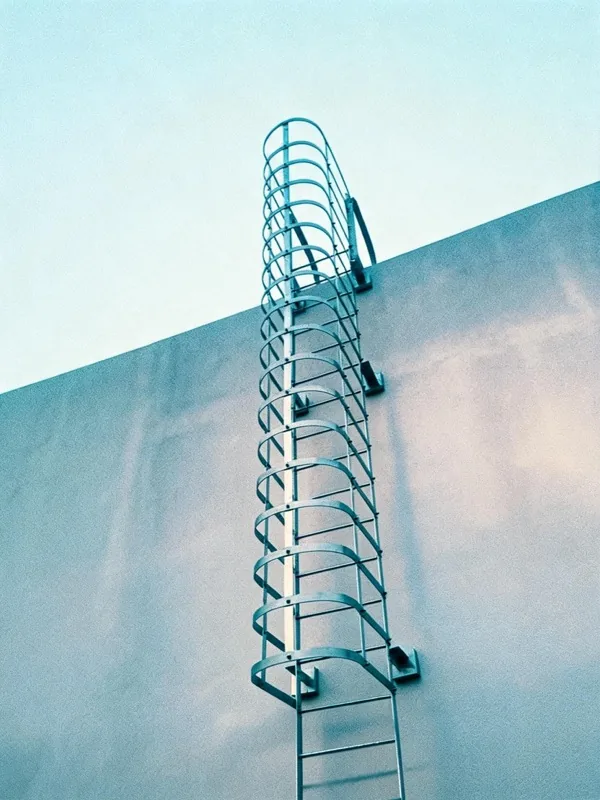
OSHA ladder cage rules trip up a lot of buyers. The short version: a cage is no longer your fall-protection answer on a new tall ladder. We weld caged fixed ladders every week at our 8,000 m² Shijiazhuang factory. So this guide gives you the clauses, the cage dimensions, and the dates that actually bind.
Every figure here comes in inches and millimetres. Where a date matters, we flag it. This is a comparison guide, not a primer — for the basics, read our cage ladder explainer first.

OSHA Code at a Glance: Which Clauses Govern an OSHA Ladder Cage
Two clauses do the heavy lifting. Construction sits in 29 CFR 1910.23(d). Fall protection sits in 1910.28(b)(9). Together they form the OSHA ladder cage rules a buyer must meet.
An osha fixed ladder is a permanent ladder bolted to a structure, climbed without it moving. When that ladder carries a hooped enclosure, you have a fixed ladder with cage. The cage rings the climber and was the old default for tall climbs.
Here is the part most buyers miss. 1910.23(d) tells you how to build a cage. 1910.28(b)(9) tells you when a cage counts as fall protection — and since 2018, the answer changed. Read both together. A cage can be built to spec yet still fail an audit on fall protection.
For the European equivalent, the matching code is EN ISO 14122-4. We compare the two side by side in our EN ISO 14122-4 guide. The US trigger is height; the EU code leans toward guided fall-arrest over cages too.
OSHA Ladder Cage Dimensions and Spacing Rules
Where a cage is used, the geometry in 1910.23(d) is exact. Build to these numbers or the cage fails inspection. Inches first, millimetres in brackets.
- Hoop spacing — horizontal bands sit no more than 4 ft (1,219 mm) apart.
- Vertical bars — spaced no more than 9.5 in (241 mm) apart, set evenly around the hoops.
- Clearance — the cage stands 27 to 28 in (686 to 711 mm) clear of the rung centreline.
- Bottom of cage — starts 7 to 8 ft (2,134 to 2,438 mm) above the base.
- Top extension — the cage runs at least 42 in (1,067 mm) above the top landing.
Engineer's note: the 42 in top extension is the one people skip. It lines the cage up with a standard guardrail height, so the climber stays enclosed while stepping off. We jig this on the bench, not on site.
OSHA Ladders and Fall Protection: The 2018 Cage Phase-Out
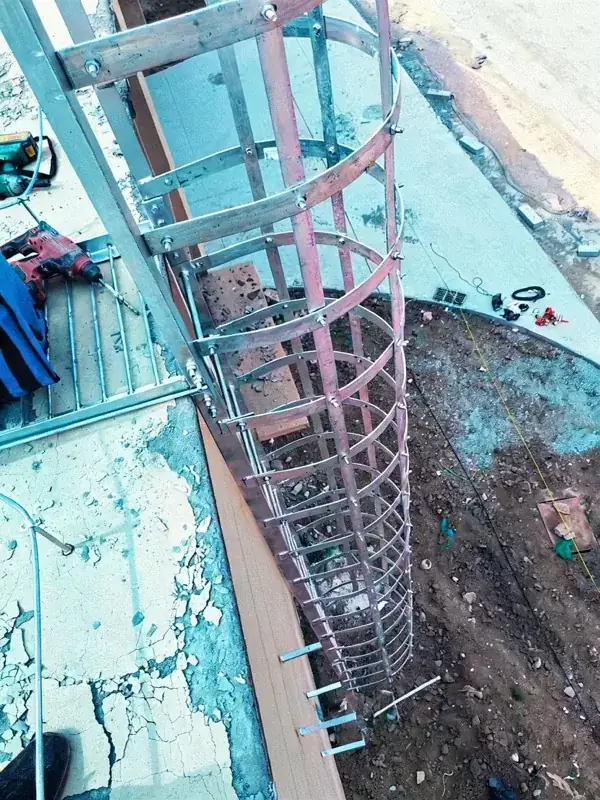
This is the section that changes how you spec. A cage is not mandatory today. It is being phased out. The 2018 OSHA caged ladder changes set that direction.
The line that matters is 24 ft (7.3 m). Below it, the rungs and rails carry the safety case. Above it, the ladder needs real fall protection under 1910.28(b)(9).
Since 19 November 2018, a new fixed ladder over 24 ft can no longer use a cage as that fall protection. New builds need a personal fall arrest system (PFAS) or a ladder safety system. The cage alone does not count.
Existing ladders get a runway. A fixed ladder with cage built before that date stays legal until 18 November 2036. After that date, every fixed ladder over 24 ft must use a PFAS or a ladder safety system. The phase-in is written into 1910.28(b)(9)(i)(A) through (D).
| Fall-protection method | What it is | New ladder (on/after 19 Nov 2018) | Existing ladder (before 19 Nov 2018) |
|---|---|---|---|
| Cage or well | Hoops or an enclosure around the climber | Not accepted as fall protection | Allowed until 18 Nov 2036 |
| Personal fall arrest system (PFAS) | Harness, connector, anchorage | Accepted | Accepted |
| Ladder safety system | Rail or cable with a sliding sleeve that tracks the climber | Accepted | Accepted |
So the honest answer on OSHA ladders and fall protection is this. A cage may still satisfy an old asset for now. It will not pass a new one. Plan the swap to a ladder safety cage system or a fixed ladder safety system before the deadline bites.
US Compliance Checklist for a Caged Fixed Ladder
Run this checklist before you sign off a drawing. Each line maps to a clause an inspector can cite.
| Check | Requirement | Clause |
|---|---|---|
| Height trigger | Over 24 ft (7.3 m) needs fall protection beyond rails | 1910.28(b)(9) |
| New-build cage | Cage not accepted as fall protection on a new ladder | 1910.28(b)(9)(i)(B) |
| 2036 deadline | All over-24-ft ladders on PFAS or ladder safety system by 18 Nov 2036 | 1910.28(b)(9)(i)(D) |
| Hoop spacing | Horizontal bands no more than 4 ft (1,219 mm) apart | 1910.23(d) |
| Cage clearance | 27 to 28 in (686 to 711 mm) from rung centreline | 1910.23(d) |
| Top extension | Cage at least 42 in (1,067 mm) above landing | 1910.23(d) |
| Rung spacing | 10 to 14 in (254 to 356 mm), uniform | 1910.23(d) |
| Clear width | At least 16 in (406 mm) between rails | 1910.23(d) |
One case from our records. A US food-and-beverage plant asked us to retrofit caged fixed ladders ahead of the 2036 deadline. We swapped cages for guided ladder safety systems on the tall runs, kept SS304 for washdown zones, and shipped batch load-test reports with each unit. The site cleared its fall-protection audit on the first visit.
How Our Caged Ladders Meet OSHA Spec
Material is where factory choice shows. We cut side rails and hoops from Q235B structural steel for most jobs. For washdown lines we switch to SS304. For coastal or chloride-heavy sites we move up to SS316.
- Rung load — each rung takes a 250 lbf (1.1 kN) concentrated load. We proof-test rungs to 1.5 kN.
- Coating — hot-dip galvanizing at 70 to 85 µm, with powder coat over zinc when colour matters.
- Tolerance — hoop pitch and bar spacing jigged to within a few mm, not eyeballed.
Every batch is sample-pulled for weld strength on a tensile rig. Each order leaves with material certificates, weld reports, and load-test data — the paperwork an inspector asks for. The factory holds ISO 9001:2015. Third-party inspection by SGS, TÜV, or Bureau Veritas is available on request, and we have shipped to 50+ countries since 2003.
Buying direct means no middleman markup. You talk to the engineers who weld the ladder. Buyers are welcome to audit the plant in person. Browse the caged fixed access ladder and roof access ladder with cage ranges to start a spec.

OSHA Ladder Cage FAQ and Common Misquotes
"Does OSHA require a cage above 20 feet?" No. That was the old rule. The current trigger is 24 ft, and the cage is no longer the accepted answer on new ladders.
"Is my existing caged ladder illegal?" Not yet. A pre-2018 fixed ladder with cage is fine until 18 November 2036. After that, it needs a PFAS or a ladder safety system.
"Can I add a cage instead of a fall-arrest system on a new build?" No. On a new over-24-ft ladder, a cage does not satisfy 1910.28(b)(9). Spec a guided system from the start.
"Cage or ladder safety system — which is cheaper long term?" The system usually wins past 2036, because a cage will need replacing anyway. We model both on request.
Specifying an OSHA cage ladder? Send your height, the standard, and the fall-protection method. We return a drawing, a load rating, and a factory-direct quote. Talk to our engineers, or compare the OSHA 1910.23 fixed ladder guide for the full code.