EN ISO 14122-4 fixed ladder requirements set how a permanent fixed ladder must be built for access to machinery in Europe. The full title is Safety of machinery — Permanent means of access to machinery — Part 4: Fixed ladders. We weld to it every week at our 8,000 m² Shijiazhuang factory. This guide reads it clause by clause, in millimetres.
Use it to specify a compliant EU ladder the first time. Where the standard gives a figure, we give it. Where a value needs checking against the 2016 text for your build, we flag it.
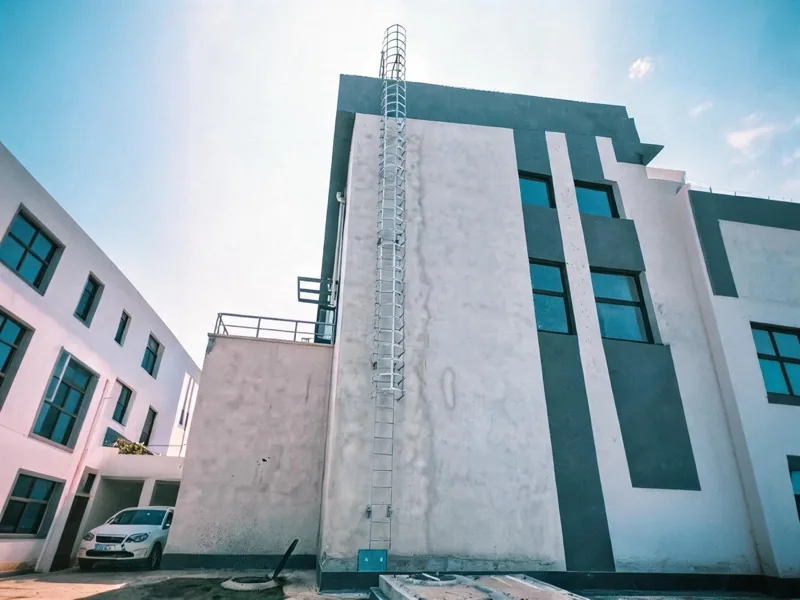
What EN ISO 14122-4 Covers
EN ISO 14122-4 is Part 4 of a four-part family. The family covers permanent means of access to machinery.
- Part 1 — choice of access and general requirements (EN ISO 14122-1).
- Part 2 — working platforms and walkways.
- Part 3 — stairs, stepladders and guard-rails.
- Part 4 — fixed ladders. This is the one you cite for a vertical ladder.
The standard is harmonised under the Machinery Directive 2006/42/EC. Build to Part 4 and you get a presumption of conformity for the access route. That feeds the CE mark and the Declaration of Conformity when the ladder forms part of machinery.
Engineer's note: read Part 1 first. Part 1 tells you whether a fixed ladder is even the right choice. Above certain heights or angles, a stair under Part 3 is the safer call. We raise this on the first drawing, not after fabrication.
The US counterpart is OSHA 1910.23. The two align on many figures but split on triggers and dates. Our OSHA 1910.23 fixed ladder requirements guide runs that code clause by clause for export to North America.
Dimensional Requirements for a Fixed Ladder in Europe
The dimensional rules are the backbone of fixed ladder requirements in Europe. Get the millimetres right and the ladder passes on geometry. Here are the core figures.
| Parameter | EN ISO 14122-4 value | Dengtai standard build |
|---|---|---|
| Rung pitch (spacing) | 225 to 300 mm, uniform | 300 mm pitch |
| Clear width between stiles | 400 to 600 mm | 400 mm |
| Clearance behind rungs (to wall) | min 200 mm | ≥ 200 mm |
| Climbing space in front of rungs | min 600 mm | ≥ 600 mm |
| Rung diameter | 20 to 35 mm, non-slip | Ø 30 mm serrated |
The rung pitch is the figure buyers check first. It stays uniform top to bottom, between 225 and 300 mm. We set 300 mm as our default.
Clear width runs 400 to 600 mm between the stiles. Narrower than 400 mm and a worker is cramped. Wider than 600 mm and the cage geometry stops working.
One more rule matters. The rungs must be level and slip-resistant. We serrate or knurl the rung face on every export ladder, not just on request.

Safety Cage and Guard Hoop Rules: The EN ISO 14122-4 Cage Requirement
The EN ISO 14122-4 cage requirement turns on one number. The fall height.
Where the fall height is more than 3000 mm, the ladder needs fall protection. That means a guard cage (safety cage) or a guided fall-arrest system. Below 3000 mm, the rungs and stiles carry the safety case alone.
Worth knowing: the standard treats a cage as a guard, not a true fall-arrest device. A cage limits a fall. It does not stop one the way a guided sleeve does. For tall climbs we often steer buyers to a guided fall arrester to EN 353-1 instead.
Where a guard cage is used, the hoop geometry is fixed:
- Hoop vertical spacing — max 1500 mm apart.
- Cage start height — the hoops begin between roughly 2200 and 3000 mm above the base.
- Hoop clearance from rungs — the cage stands clear of the climbing line so a worker fits without scraping.
This is where EU and US codes part ways. OSHA 1910.23 ties its trigger to a 24 ft (7.3 m) height and is phasing cages out for new ladders. EN ISO 14122-4 triggers at 3000 mm and keeps the cage as an option. Same ladder, two rule sets.
Landings, Rest Platforms and Maximum Climbing Height
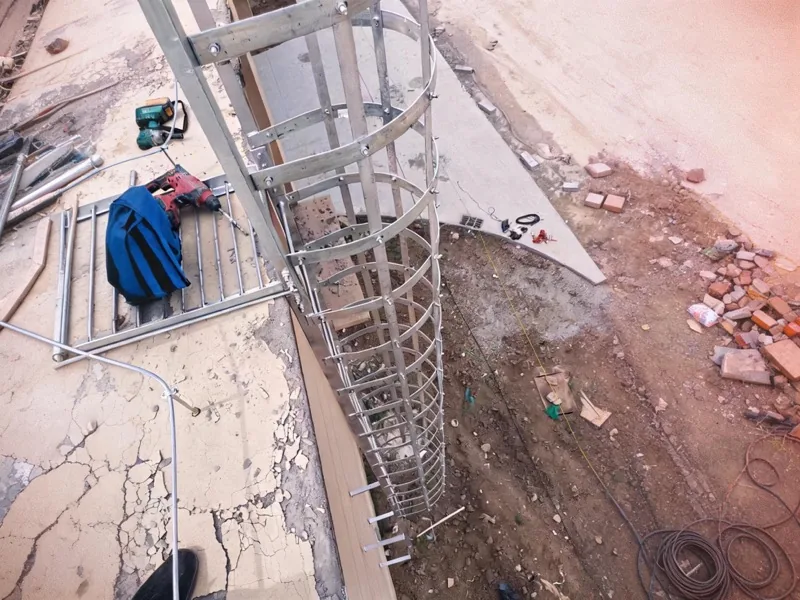
A tall ladder is not one unbroken run. EN ISO 14122-4 breaks long climbs with rest platforms, also called landing platforms.
The maximum climbing height in a single flight is capped. Past that, an intermediate rest platform splits the run. The common figure is 6000 mm (6 m) between platforms.
Each rest platform gives a worker somewhere to pause and recover grip. Platforms carry guard-rails to Part 3, with a top rail near 1100 mm. The platform also offsets the climb line, so a fall on one flight does not run the full height.
Engineer's note: plan the platforms early. Bolting a rest platform into a finished structure is costly. We mark platform levels on the first general-arrangement drawing, against your floor-to-floor heights.

Fall Protection Systems and Load Requirements
Above 3000 mm, fall protection is not optional. EN ISO 14122-4 accepts two routes.
- Guard cage — hoops that ring the climber, used within the height limits above.
- Guided type fall arrester — a rigid rail or cable up the ladder with a sliding sleeve that follows the climber and locks on a fall. These are certified to EN 353-1.
Loads are where fabrication shows. Each rung must take a point load without permanent deformation. The design value is around 1.5 kN at mid-rung. We proof-test rungs to 1.5 kN on a rig, sampled per batch.
The anchorage matters as much as the rung. A guided fall arrester is only as strong as the bracket carrying its load into the structure. We size and stamp those anchor loads on the drawing. The rail bolts into the structure, not just into the ladder. Get the anchorage wrong and the system is decoration.
Site case: a chemical plant in the EU ordered vertical fixed ladders with guided fall arresters for a tank farm. We supplied SS316 throughout for chloride resistance, with batch load-test reports. The site cleared its CE access audit on the first visit.
Materials, Coating and Compliance Documentation
EN ISO 14122-4 sets the geometry. Material and finish are where a factory earns its keep.
- Q235B structural steel — our default for most EU industrial jobs.
- SS304 — for washdown, food, and damp sites.
- SS316 — for coastal and high-chloride exposure.
Coating follows the material. Hot-dip galvanizing runs 70 to 85 µm as our standard. Powder coat goes over zinc when colour or a finish spec calls for it. The coating thickness is gauged, not guessed.
Compliance is more than a CE sticker. A fixed ladder that forms part of machinery needs a Declaration of Conformity and a technical file under 2006/42/EC. Every order leaves our plant with material certificates, weld reports, and load-test data — the paperwork an EU inspector asks for.
The factory holds ISO 9001:2015. Third-party inspection by SGS, TÜV, or Bureau Veritas is available on request. We have shipped to 50+ countries since 2003. Every batch is sample-pulled for weld strength on a tensile rig, not just eyeballed.
Buying direct means no middleman markup and no guesswork. You talk to the engineers who weld the ladder. Buyers are welcome to audit the plant in person.
EN ISO 14122-4 Ladder, the European Standard and CE Marking
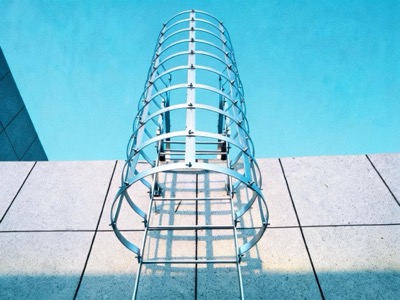
An EN ISO 14122-4 ladder is more than a geometry spec. The standard is the European standard for permanent fixed-ladder access to machinery, harmonised under the Machinery Directive 2006/42/EC.
That harmonisation is what links the European standard to CE marking. When a fixed ladder forms part of machinery, building to EN ISO 14122-4 gives a presumption of conformity that feeds the CE marking and the Declaration of Conformity. In our factory, every EN ISO 14122-4 ladder ships with material certificates, weld reports, and load-test data — the technical-file evidence an EU inspector expects.
One caveat from the floor: CE marking covers the machine, not the ladder on its own. We supply the access route to the European standard and the paperwork to prove it; your integrator then carries the CE marking for the finished machinery.
Specifying an EN ISO 14122-4 fixed ladder? Send your height, the fall-protection method, and the material. We return a drawing, a load rating, and a factory-direct quote. Talk to our engineers, or compare the fixed ladder safety system and vertical fixed access ladder ranges. New to the topic? Start with what a fixed ladder is.