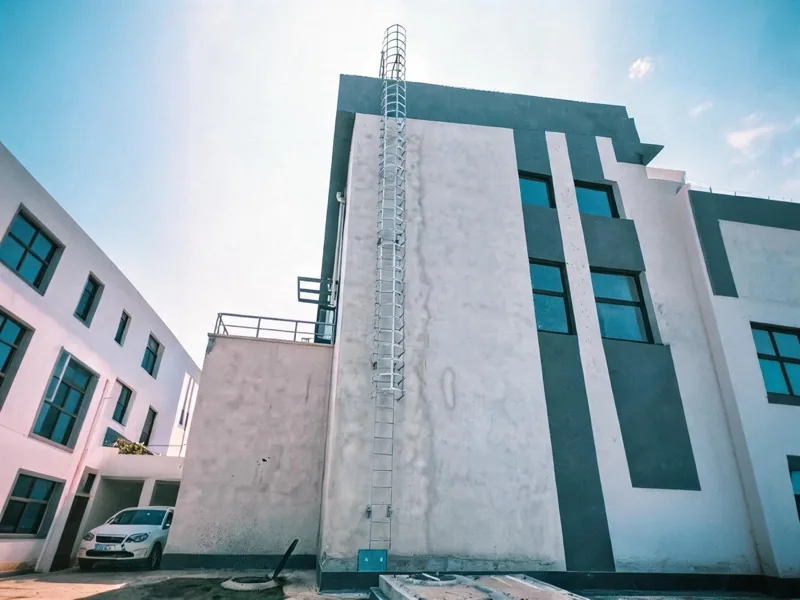
Fixed ladder dimensions decide whether a climb is legal, safe, and comfortable. Get them wrong and an inspector can stop the job. We build these ladders every week at our 8,000 m² factory in Shijiazhuang, so the numbers below come from the shop floor.
This guide is a sizing reference. It pairs OSHA 1910.23 (United States) with EN ISO 14122-4 (Europe), in inches and millimetres, with load values in kN. Use the tables to spec, check, or audit a ladder before you order.
/images/product_fixed-steel-ladders_gallery01_stacked.webpStandard Rung Dimensions
Start with the fixed ladder rungs. Spacing, diameter, and width are the first things an auditor measures.
| Parameter | OSHA 1910.23 (US) | EN ISO 14122-4 (EU) |
|---|---|---|
| Rung spacing / pitch | ≤ 12 in / 300 mm o.c. | 225–300 mm |
| Rung diameter (metal) | ≥ 3/4 in / 19 mm | ≥ 20 mm |
| Clear rung length / width | ≥ 16 in / 406 mm | 400–600 mm |
| Uniformity | uniform within ladder | uniform within ladder |
OSHA caps rung spacing at 12 in (300 mm) on centre. EN ISO 14122-4 allows 225 to 300 mm. The osha ladder rung diameter is at least 3/4 in (19 mm) for metal; EN ISO asks for 20 mm. For osha ladder rung clearance, keep every rung uniform and unobstructed across the full width.
Engineer's note: in our factory we jig the rungs at a fixed 300 mm pitch. A uniform pitch reads cleaner on a load test and on an audit.
Ladder Width & Climbing Clearance
Width and clearance set how the body moves on the ladder. Two climbers cannot share a narrow stile safely.
| Parameter | OSHA 1910.23 | EN ISO 14122-4 |
|---|---|---|
| Clear width between side rails | ≥ 16 in / 406 mm | 400–600 mm |
| Toe clearance behind rung | ≥ 7 in / 178 mm | ≥ 150 mm |
| Climbing space in front | ≥ 30 in / 762 mm | ≥ 600 mm free |
| Side-rail to wall standoff | per design | ≥ 150 mm |
Clear width between side rails is 16 in (406 mm) minimum under OSHA. EN ISO 14122-4 works to 400–600 mm. Behind the rungs, leave toe room: 7 in (178 mm) for OSHA, 150 mm for EN ISO. In front, OSHA wants 30 in (762 mm) of climbing space.
Height Thresholds & Fall-Protection Transition
Height is where the rules change hardest. The key US trigger is fixed ladders over 24 feet.
| Climb height | OSHA 1910.23 (new builds) | EN ISO 14122-4 |
|---|---|---|
| Up to 24 ft / 7.3 m | ladder alone may suffice | cage if fall height > 3 m (legacy) |
| Over 24 ft / 7.3 m | PFAS or ladder safety system; no new cages | guided-type fall arrest preferred |
| First / bottom rung | within one pitch of grade | first step ≤ pitch from base |
For fixed ladders over 24 feet (7.3 m), OSHA 1910.23 requires a personal fall-arrest system or a ladder safety system on new builds. Cages no longer satisfy this rule for new installs. Existing caged ladders carry a conversion deadline.
The osha fixed ladder first rung height matters too. It should sit within one rung pitch of the lower landing or grade, so the first step stays modest. In our drawings we set the first rung at 300 mm from the base to match the pitch.
Cage / Safety Well Dimensions
Where a cage or a fixed ladder well is retained, the geometry is fixed too. Hoops and wells both guard a falling climber.
| Parameter | OSHA legacy cage | EN ISO 14122-4 |
|---|---|---|
| Cage depth from rung centreline | 27–30 in / 686–762 mm | 650–800 mm |
| Hoop vertical spacing | ≤ 4 ft / 1,200 mm | ≤ 1,500 mm |
| Bottom of cage above grade | 7–8 ft / 2,130–2,440 mm | per access design |
| Well opening clear span | shoulder + tool-bag clearance | ≥ rung width |
A legacy OSHA cage stands 27–30 in (686–762 mm) deep from the rung centreline, with hoops no more than 4 ft (1,200 mm) apart. EN ISO 14122-4 hoops run 650–800 mm deep, spaced 1,500 mm or less. A fixed ladder well is the walled alternative: a recess or shaft that guards the climber in place of hoops. Keep the well opening clear for shoulders and a tool bag.
/images/product_fixed-steel-ladders_specs_steel_detail.webpRung-to-Landing & Top Extension
The top is where most step-off accidents happen. Size the fixed ladder extension correctly and the step-off is easy.
| Parameter | OSHA 1910.23 | EN ISO 14122-4 |
|---|---|---|
| Side-rail / grab-bar extension above landing | ≥ 42 in / 1,070 mm | ≥ 1,100 mm |
| Top rung to landing | level with landing | level with landing |
| Step-through opening | per platform | per platform |
Side rails or grab bars extend at least 42 in (1,070 mm) above the top landing under OSHA. EN ISO 14122-4 lands near 1,100 mm. That fixed ladder extension gives a hand-hold while the feet leave the rungs. Align the top rung with the landing so there is no awkward reach.
Material Gauges & Tolerances
Dimensions mean nothing without the right steel behind them. Material choice drives load and life.
| Item | Specification |
|---|---|
| Side rails (stringers) | Q235B flat bar; SS304 / SS316 for washdown & marine |
| Rungs | round or serrated bar, ≥ 20 mm |
| Hot-dip galvanizing | 70–85 µm |
| Powder coat over zinc | — |
| Rung proof load | 1.5 kN point load (EN ISO 14122-4); 250 lb / ≈1.1 kN (OSHA) |
| Rung-pitch tolerance | — |
We cut side rails from Q235B structural steel for dry indoor runs. For coastal or washdown sites we switch to SS304, and SS316 where chlorides are heavy. We hot-dip galvanize to 70–85 µm as standard, and powder coat over zinc when colour matters.
On load, each rung is proof-tested to a 1.5 kN point load per EN ISO 14122-4. OSHA sets a 250 lb (about 1.1 kN) single-rung load. Every batch is sample-pulled for weld strength before it leaves the floor.
/images/home_project_04_factory_ladder.webpSpecify With Confidence
Buy direct and you talk to the engineers who weld the ladder, not a middleman. That is how we have shipped to 50+ countries since 2003. The factory holds ISO 9001:2015, and third-party inspection by SGS, TÜV, or Bureau Veritas is available on request. Buyers are welcome to audit the plant in person.
Need the wider picture? Read our fixed ladder guide, then compare numbers in our fixed ladder specifications and weight and load capacity articles.
For the hardware itself, view the Vertical Fixed Access Ladder, the Fixed Ladder Safety System, and the Warehouse Fixed Ladder.
Send your height and code, and our team returns a drawing, load rating, and factory-direct quote. Talk to our engineers or check the FAQ.
/images/home_qc_img_inspection.webp