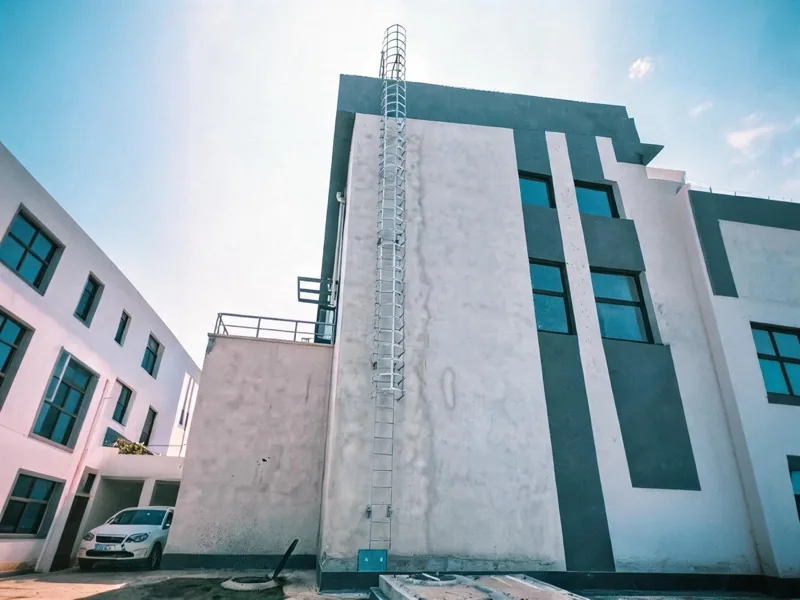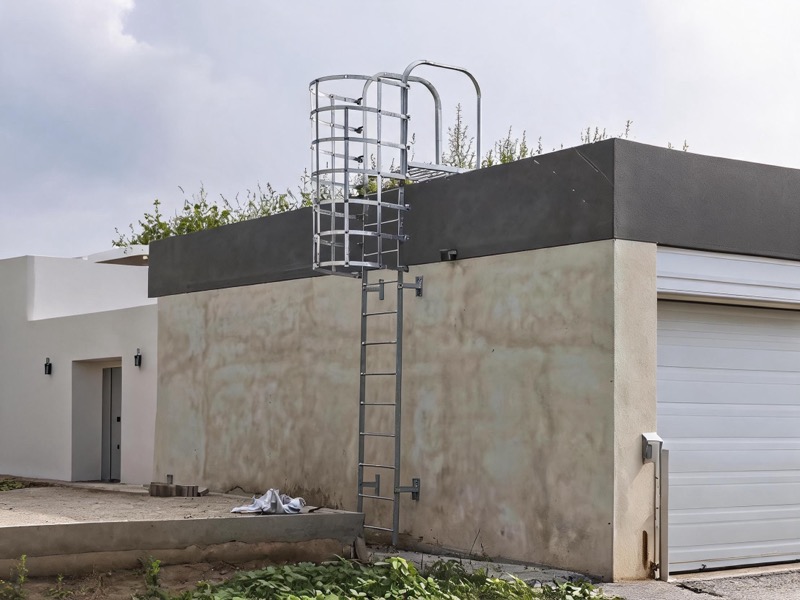
This guide shows you how to install a fixed ladder that meets OSHA 1910.23 and EN ISO 14122-4. We build these ladders ourselves. Dengtai is a factory-direct manufacturer, ISO 9001:2015 certified since 2003, and our crews fit them on real export jobs across 50+ countries. The six steps below come from our installation engineers, not a generic checklist. Get the anchor load, the clearance, and the coating right, and the ladder will outlast the building it serves.
/images/product_fixed-steel-ladders_features_factory_scene.webp1. Tools and Site Preparation: Fixed Ladder Installation Requirements
Sort the kit before anyone climbs. Good fixed ladder installation starts on the ground.
- Cordless drill with the correct masonry or steel bit for the substrate - M12 anchor bolts in SS304, or hot-dip galvanized Q235B for dry interiors - Calibrated torque wrench - Spirit level, chalk line, and tape - Full-body harness, lifeline, and edge protection
Check what you are fixing into first. Concrete, a steel beam, and brickwork each need a different anchor. The fixed ladder installation requirements depend on that substrate and on the climb height. Measure the full run, then mark every fixing point before you lift a section. In our factory we pre-mark and dry-fit each ladder on the floor; it saves an hour of re-drilling on site.
Standard material is Q235B carbon steel. For coastal or chemical plants we switch to SS304, or SS316 where salt exposure is heavy.
2. Step-by-Step Mounting and Anchoring
This is the step most installs get wrong. Here is how to mount a fixed ladder so the anchors carry real load.
OSHA 1910.23 and EN ISO 14122-4 both set a defined point load at every fixing. Each wall bracket on our fixed ladders is rated to hold 6 kN, a 2:1 margin over the 3 kN minimum we test to. Use M12 through-bolts. Torque them to the value on the drawing, not by feel — 60 N·m is typical for M12 into structural concrete.
Set the standoff brackets first, then offer up the ladder and bolt from the top down. We sample pull-test every batch to failure on our own rig, and we keep the load test data on file. SGS-witnessed pull tests are available when a client needs third-party proof.
For a unit that bolts flat to a wall, see our [wall-mounted fixed ladder](/products/wall-mounted-fixed-ladder/). For a straight vertical run, the [vertical fixed access ladder](/products/vertical-fixed-access-ladder/) ships with brackets pre-drilled.
/images/product_fixed-steel-ladders_specs_steel_detail.webp3. Rung Spacing and Dimensional Compliance
Spacing is fixed by the standard, not by preference. Fixed ladder clearance is the part inspectors check first.
| Dimension | Value | Reference | |---|---|---| | Rung spacing (centres) | 250–300 mm | EN ISO 14122-4 | | Climbing clearance behind rung | 150 mm min | fixed ladder clearance | | Side clearance each side | 75 mm min | OSHA 1910.23 | | Clear ladder width | 400–600 mm | EN ISO 14122-4 |
Keep the rung spacing even from the first rung to the last. An uneven top rung is a trip point. Hold the fixed ladder clearance behind every rung so a boot lands flat. Clear the climb line of cable trays and pipe runs before sign-off.
4. Cage or Fall-Protection Installation
Height decides this step. Read the standard for your market, then fit the right system.
Under OSHA 1910.23, new fixed ladders over 24 ft need a personal fall arrest or ladder safety system. Cages no longer count as compliant fall protection on new installs. EN ISO 14122-4 and BS 4211 set their own rest-platform and guard rules for the EU and UK. When the climb runs past the trigger height, we fit a certified rail system rather than a hoop.
For the rail-and-shuttle option, see our [fixed ladder safety system](/products/fixed-ladder-safety-system/). Not sure which ladder type you need? Start with [what a fixed ladder is](/fixed-ladder-what-is/).
5. Anti-Corrosion and Coating Protection
A fixed ladder lives in rain, frost, and UV for decades. Protect it.
Hot-dip galvanizing gives a coating of 85–140 μm, above the 85 μm floor most specs ask for. We coat after fabrication, never before, so every cut edge and drilled hole stays sealed. When you drill on site you break that layer. Brush zinc-rich paint over each scratched zone the same day. For SS304 or SS316 ladders, passivate any welds ground on site.
6. Final Safety Check and Commissioning
Walk the finished ladder before you sign it off.
- Torque-check every anchor bolt against the spec - Confirm each rung sits level and the spacing holds - Hand-load the top anchors to feel for movement - Confirm the cage or rail system is continuous
Every order ships with the documents that prove the build: material certificates, weld inspection reports, and load test data. No middleman sits between you and the line, so the paperwork comes direct. Clients are welcome to audit the factory in person.
Project example
For warehouse mezzanines and racking, our [warehouse fixed ladder](/products/warehouse-fixed-ladder/) is built to your floor-to-platform height. For the full definition, types, and standards, read [what is a fixed ladder](/blog/fixed-ladder-what-is/).