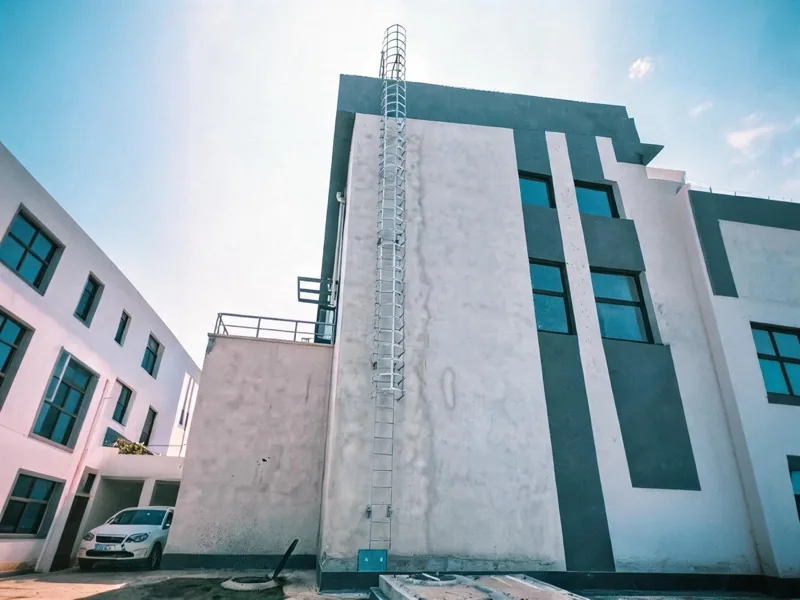
Roof ladder dimensions are the first thing we pin down before any steel gets cut. Get the rung spacing, width, and pitch right and the ladder clears inspection; get them wrong and it fails an audit no matter how clean the welds are. This page lists the standard sizes in millimetres, shows where you can go custom, and explains how to measure your own roof before you order.
We size these every week at our 8,000 m² factory in Shijiazhuang, and the figures below follow OSHA 1910.23 and EN ISO 14122-4 — the two standards most of our 50+ export markets ask for. UK projects usually add BS 4211.
Standard Dimensions (mm)
Most roof access ladders share the same critical dimensions. The table below sets the published code requirements next to our standard factory build. The Dengtai column is being confirmed against our current catalogue and drawing set.
| Dimension | OSHA 1910.23 | EN ISO 14122-4 | Dengtai standard |
|---|---|---|---|
| Rung spacing (pitch) | Uniform, verify exact range | 225–300 mm, equal | precise mm |
| Clear width between rails | ≥ 406 mm (16 in) | 400–600 mm | precise mm |
| Foot clearance behind rung | ≥ 178 mm (7 in) | ≥ 150 mm | precise mm |
| Walk-through handrail above landing | ≈ 1,070 mm (42 in) | ≈ 1,100 mm | precise mm |
| Cage / fall-arrest threshold | > 7.3 m (24 ft) | Per risk assessment | confirm policy |
Side rails are cut from Q235B structural steel as standard, or SS304 / SS316 stainless for coastal and washdown sites. Each rung is proof-tested to a 1.5 kN point load, and we hot-dip galvanize to 70–85 µm before powder coat. Those numbers do not change with size; the dimensions in the table do.
Custom Sizing
Standard sizes cover maybe four roofs in five. The fifth needs something specific — an awkward parapet, a tall silo, a hatch in the wrong place. In our workshop we treat custom as routine: send the height and the fixing points, and we cut the rails to suit.
Custom does not mean off-code. A bespoke ladder still has to hold rung spacing, width, and clearance inside the OSHA 1910.23 or EN ISO 14122-4 limits. What changes is the overall climb length, the number of intermediate rest platforms, and the bracket spacing — all sized from the calculated load, not guessed. confirm Dengtai maximum single-flight height and platform interval.
Rung Spacing
Rung spacing, or pitch, is the dimension inspectors check first. It must be uniform from bottom to top — one odd gap and a climber's rhythm breaks, which is how falls happen. EN ISO 14122-4 sets the pitch between 225 mm and 300 mm and demands it stay equal along the run. OSHA 1910.23 also requires uniform spacing for fixed ladders. verify the exact OSHA min/max against the current 1910.23(d) text.
Rungs are round or serrated bar, anti-slip on every step, welded square to the rails. We sample-pull one rung from every batch for weld strength before the ladder leaves the floor, and the test result goes in the file that ships with it.
Width Options
Width is measured clear, between the inner faces of the two rails. OSHA 1910.23 sets a floor of 406 mm (16 in); EN ISO 14122-4 allows 400 mm up to 600 mm. Most maintenance ladders sit near the lower end — wider rails cost more steel for no safety gain on a single-person climb.
Where two people pass, or where a stretcher rescue is planned, we build to the wider end of the range or supply a double-width run. Caged versions add hoop diameter on top of the rail width; the cage clear envelope follows the standard so a climber is never boxed too tight or left too loose. precise Dengtai standard widths and cage hoop diameters.
How to Measure for a Roof Ladder
You do not need an engineer to take the four numbers we work from:
- Climb height — from the standing surface at the base to the landing edge, in mm.
- Fixing centres — where the brackets land on the wall or structure, and what they bolt into.
- Landing detail — hatch, parapet, or open edge, and how far the handrail must rise above it.
- Offset — any obstruction (gutter, pipe run, cladding) the ladder has to clear on the way up.
Send those and a rough photo, and our team returns a dimensioned drawing, a load rating, and a factory-direct quote — no middleman, no markup. One example from our records: a Southeast Asian food-processing group needed 28 roof ladders to fit existing hatch openings. We worked from their measurements, supplied SS304 throughout for washdown resistance, and shipped material certificates, weld reports, and load-test data per batch. The line passed its local safety audit on the first visit.
The factory holds ISO 9001:2015, and independent inspection by SGS or Bureau Veritas is available on request. Specifying a project now? Talk to our engineers, read the complete roof ladder guide, or arrange a factory audit — buyers are welcome on site.