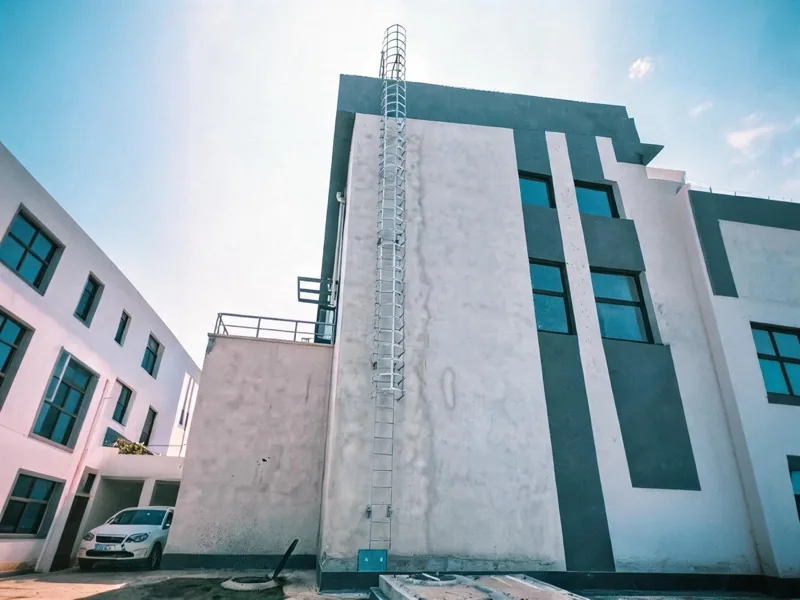
So, what is a roof ladder? A roof ladder is a permanently fixed steel ladder that gives workers safe, repeatable access to a rooftop, plant deck, or elevated platform for maintenance and inspection. Unlike a portable ladder you lean against a wall, a fixed roof access ladder is bolted to the structure and engineered to a published safety standard such as OSHA 1910.23 or EN ISO 14122-4.
We build these every week at our 8,000 m² factory in Shijiazhuang, China, and the question buyers ask most is simple: which type do I actually need? This guide answers that, then walks through the parts, the applications, and what to check before you order.
What Is a Roof Ladder, Exactly?
A roof ladder is a vertical or steeply inclined access ladder fixed to a building so people can reach a roof safely and return the same way. In our workshop we cut the side rails from Q235B structural steel, or SS304 stainless when the site is coastal or corrosive, then weld the rungs at a fixed pitch. The result is a load-rated route, not an improvised one.
Two details separate a compliant roof ladder from a generic one. First, the geometry follows a standard — OSHA 1910.23 in North America, EN ISO 14122-4 across Europe, BS 4211 in the UK. Second, every weld and coating is documented, so an auditor can trace the ladder back to its material certificate.
Types of Roof Ladders
Four configurations cover almost every roof we supply. Pick by height, fall-protection rules, and how the roof is entered.
- Cat ladder — a plain vertical ladder for short climbs, typically under 3 m. Light, quick to install, lowest cost.
- Fixed steel ladder — the workhorse: a bolted vertical or inclined ladder rated for daily use and repeat loads.
- Caged ladder — adds a safety cage of hoops once the climb passes the OSHA 1910.23 threshold of about 24 ft (7.3 m) to a cage or fall-arrest system. Common on tanks and silos.
- Roof hatch ladder — a ship's-style ladder landing at a roof hatch, with walk-through handrails extending 1,070 mm above the opening for a safe transfer onto the deck.
Not sure which applies? Our full product range lists load ratings side by side, and the roof ladder pillar guide compares them in depth.
Key Components
Strip a roof ladder down and you get a short, predictable parts list:
- Side rails (stiles) — Q235B steel flat bar, or SS304/SS316 for marine and washdown sites.
- Rungs — round or serrated bar at 300 mm pitch, anti-slip on every step.
- Cage hoops — spaced no more than 1,200 mm apart on caged versions.
- Walk-through handrails — extending 1,070 mm above the landing for a safe transfer.
- Mounting brackets — wall- or floor-fixed, sized for the calculated load.
On load, a typical rung is proof-tested to a 1.5 kN point load, and the full assembly to its rated duty. We hot-dip galvanize to 70–85 µm by default, and powder coat over zinc when colour matching matters. Every batch is sample-pulled for weld strength before it leaves the floor.
Typical Applications
Roof ladders turn up wherever someone needs reliable access to a height. Factories and warehouses use them to service HVAC and roof plant. Water utilities fit caged ladders to storage tanks. Telecom and solar crews reach rooftop equipment the same way.
One example from our records: a food-processing group in Southeast Asia ordered 28 caged roof ladders for a new plant. We supplied SS304 throughout for washdown resistance, with material certificates and load-test reports per batch. The line passed its local safety audit on the first visit — no rework, no delay.
Why Choose a Factory-Direct Roof Ladder Manufacturer
Buying a roof ladder direct from the factory removes the trading-company markup and the guesswork. You talk to the engineers who weld it, not a middleman reading a catalogue. That is how we have shipped to 50+ countries on 500+ projects since 2003.
Every order ships with the paperwork an inspector asks for: material certificates, weld reports, and load-test data. The factory holds ISO 9001:2015, and independent third-party inspection by agencies such as SGS or Bureau Veritas is available on request.
Specifying a project? Send your roof height and standard, and our team returns a drawing and quote. Talk to our engineers, browse the roof ladder FAQ, or arrange a factory audit — buyers are welcome on site.