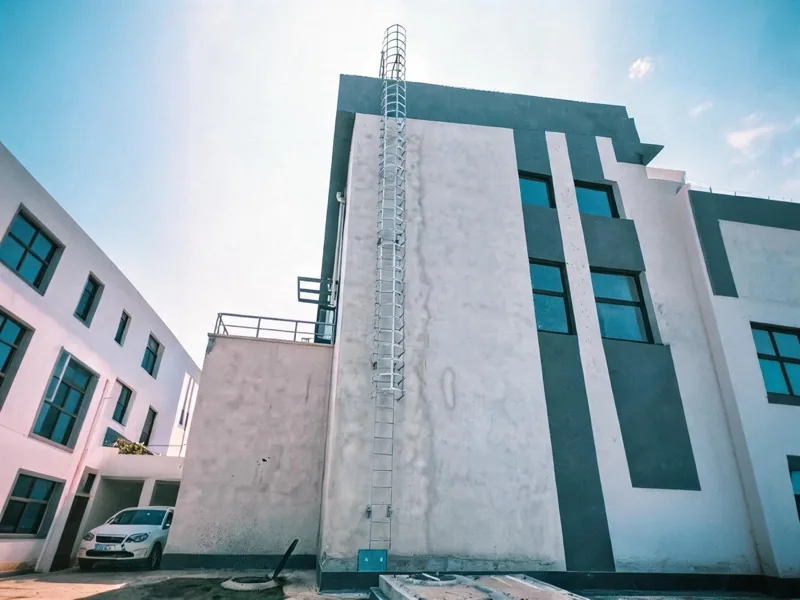
OSHA fixed ladder requirements live in 29 CFR 1910.23(d), with fall protection set out in 1910.28(b)(9). We weld to this code every week at our 8,000 m² Shijiazhuang factory. So this guide reads it clause by clause. No filler — just the numbers, the dates, and what they mean on a real ladder.
Use it to specify a compliant ladder the first time. Where the code gives a figure, we give it in inches and millimetres. Where a date matters, we flag it.
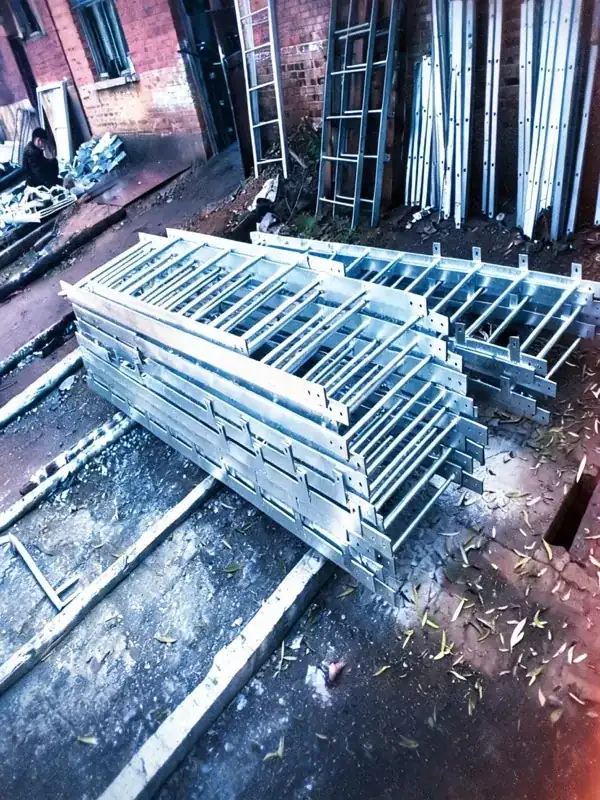
What OSHA 1910.23 Covers
OSHA 1910.23 sets the rules for ladders in general industry. Section (a) fixes the scope. Section (d) covers fixed ladders — the permanent kind bolted to a structure.
A fixed ladder is one attached to a structure, with side rails and rungs, that a worker climbs without it moving. The standard splits the duties two ways. Construction detail sits in 1910.23(d). Fall protection sits in 1910.28(b)(9), and the system specs sit in 1910.140.
Engineer's note: read all three together. A ladder can pass on rung spacing yet still fail an audit on fall protection. We check both before a drawing leaves our desk.
OSHA Maximum Ladder Height and Rest Platforms
There is no single OSHA maximum ladder height. A fixed ladder can run tall, but height triggers duties. The line that matters is 24 ft.
Above 24 ft (7.3 m) measured to the next level, the ladder needs fall protection beyond the rails themselves, under 1910.28(b)(9). Below that, the rungs and side rails carry the safety case on their own.
Long climbs are broken by rest, or landing, platforms. On caged runs these platforms split a tall climb into shorter sections and give a worker somewhere to pause.
OSHA Ladder Cage Rules and the 2018 Phase-Out
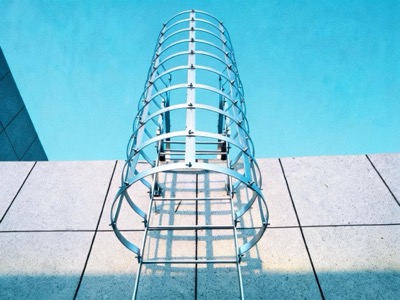
A fixed ladder with cage was the old default for tall climbs. The cage is a set of hoops that ring the climber. OSHA still allows it on some ladders, but the rules changed in 2018.
Cage geometry, where used, is tight. Hoops sit no more than 4 ft (1,219 mm) apart. The cage stands 27 to 30 in (686 to 762 mm) clear of the rungs, and starts about 7 ft (2.1 m) above the base.
Here is the part buyers miss. Since 19 November 2018, a new fixed ladder over 24 ft can no longer use a cage as its fall protection. New builds need a personal fall arrest system or a ladder safety system instead. The cage alone does not count.
| Fall-protection method | What it is | New ladders (built on/after 19 Nov 2018) | Existing ladders (built before 19 Nov 2018) |
|---|---|---|---|
| Cage or well | Hoops or an enclosure around the climber | Not accepted as fall protection | Allowed until 18 Nov 2036 |
| Personal fall arrest system (PFAS) | Harness, connector, anchorage | Accepted | Accepted |
| Ladder safety system | Rail or cable with a sliding sleeve that follows the climber | Accepted | Accepted |
One date closes the file. By 18 November 2036, every fixed ladder over 24 ft must use a PFAS or a ladder safety system. Cages and wells will no longer satisfy OSHA on their own. The phase-in steps are written into 1910.28(b)(9)(i)(A) through (D).

OSHA Ladders and Fall Protection
OSHA ladders and fall protection now lean on two systems. Both tie the worker to the structure as they climb.
- Personal fall arrest system (PFAS) — a harness, a connector, and an anchorage. Under 1910.140, each anchorage holds 5,000 lbf (22.2 kN) per worker, or is engineered to a safety factor of 2. The system caps arresting force on the body at 1,800 lbf (8 kN).
- Ladder safety system — a rail or cable run up the ladder with a sliding sleeve. It tracks the climber and locks on a fall, with no manual repositioning.
We size anchor points to the rated load and stamp them on the drawing. Bolt-down brackets carry that load into the structure, not just into the ladder. Get the anchorage wrong and the harness is decoration.
Rung, Width, Clearance and Material Specs
The construction figures in 1910.23(d) are exact. Build to them and the ladder passes on geometry alone.
- Rung spacing — 10 to 14 in (254 to 356 mm), uniform top to bottom. We set a 300 mm pitch as standard.
- Clear width — at least 16 in (406 mm) between the side rails.
- Climbing-side clearance — at least 30 in (762 mm) from the rung centreline, or 24 in (610 mm) with a deflector plate.
- Toe clearance — at least 7 in (178 mm) behind the rung.
- Design load — each rung takes a single 250 lbf (1.1 kN) concentrated load. We proof-test rungs to 1.5 kN.
Material is where factory choice shows. We cut side rails from Q235B structural steel for most jobs. For washdown or coastal sites we switch to SS304, or SS316 where chlorides run high. Hot-dip galvanizing runs 70 to 85 µm as standard, with powder coat over zinc when colour matters.
Exporting to Europe? The matching code is EN ISO 14122-4, which caps rung pitch at 300 mm and sets clear width between 400 and 600 mm. The two standards align closely, so one well-built ladder often satisfies both. Our guide on what a fixed ladder is compares the standards side by side.
OSHA Ladder Inspection Requirements and Factory Compliance
OSHA ladder inspection requirements are simple to state. Under 1910.23(b)(9), you inspect a ladder before the first use of each work shift, and again after anything that could affect it. A bent rung, a loose bracket, surface rust — pull it from service.
A compliant walk-round checks:
- Rungs and rails for cracks, bends, or corrosion.
- Bolts, welds, and standoff brackets for tightness.
- Cage hoops or the safety-system rail for damage and free travel.
- Coating wear that exposes bare steel.
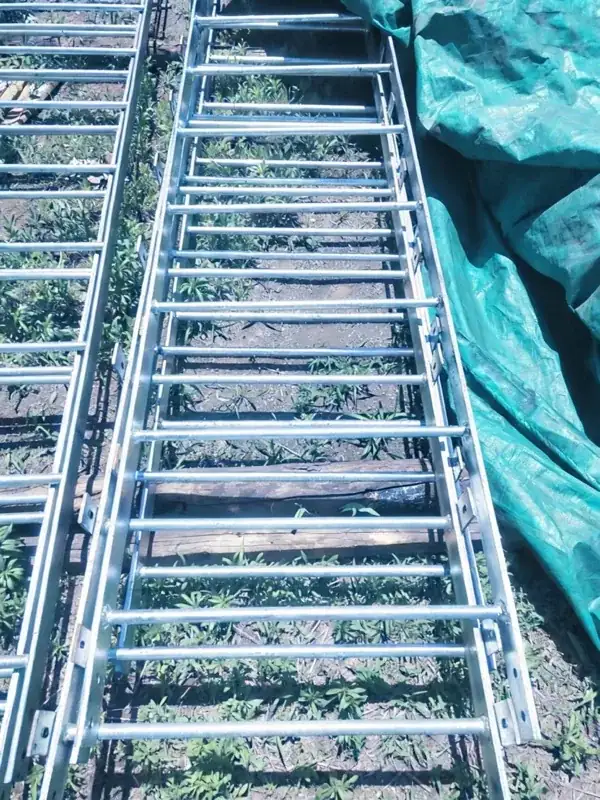
Compliance starts before the ladder ships. Every batch is sample-pulled for weld strength on a tensile rig, not just eyeballed. Each order leaves with material certificates, weld reports, and load-test data — the paperwork an inspector asks for. Need a service eye on site? Our inspection and service fixed ladder line is built around it.
The factory holds ISO 9001:2015. Third-party inspection by SGS, TÜV, or Bureau Veritas is available on request, and we have shipped to 50+ countries since 2003. Buying direct means no middleman markup and no guesswork — you talk to the engineers who weld the ladder. Buyers are welcome to audit the plant in person.
One job from our records: a water utility in Australia ordered vertical fixed ladders with ladder safety systems for a tank farm. We supplied SS316 throughout for chloride resistance, with batch load-test reports. The site cleared its local fall-protection audit on the first visit.
Specifying an OSHA fixed ladder? Send your height, the standard, and the fall-protection method. We return a drawing, a load rating, and a factory-direct quote. Talk to our engineers, or compare the fixed ladder safety system and vertical fixed access ladder ranges.