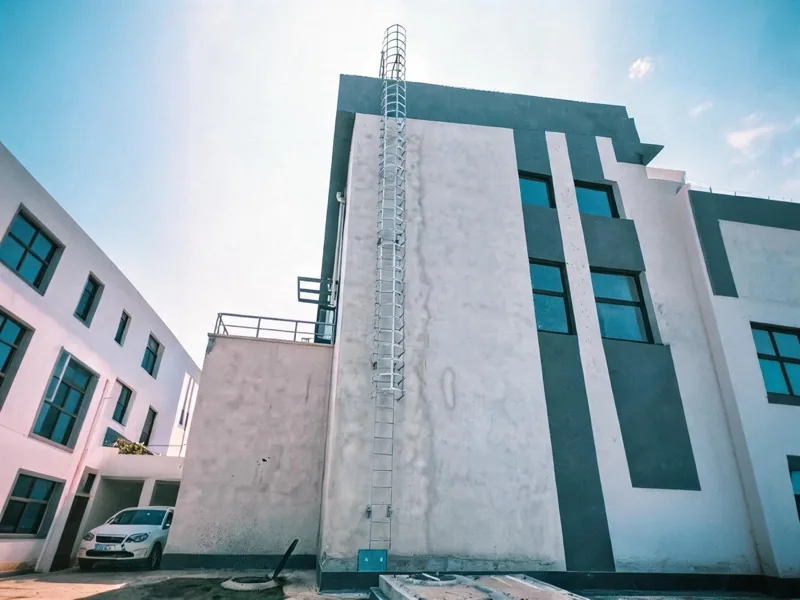
How long does a roof ladder last? A well-built steel roof ladder lasts 15–25 years, and a hot-dip galvanized Q235B unit on a dry inland roof often runs past 25. The real number turns on four things: the steel grade, the coating thickness in microns, the air the ladder lives in, and whether anyone maintains it. In our factory we build to that lifespan on purpose — here is how the math works and when a ladder is genuinely done.
Short version: a galvanized roof ladder in Q235B is the budget choice and lasts decades inland; stainless SS304 or SS316 lasts longer in salt and chemicals. Coating and care move the number either way.
1. How Long Does a Roof Ladder Last on Average?
For a fixed steel roof access ladder, plan on 15–25 years of service life. A galvanized Q235B carbon-steel ladder on a dry inland roof commonly clears 25 years. The same ladder in coastal salt air may need replacing closer to 12–15. Stainless changes the picture again — SS304 and SS316 can outlast the building they are bolted to.
| Material + finish | Typical environment | Service life |
|---|---|---|
| Q235B + hot-dip galvanized (70–85 µm) | Dry inland industrial | 20–25+ yr |
| Q235B + hot-dip galvanized (70–85 µm) | Coastal / humid | 12–18 yr |
| SS304 | Food, pharma, humid | 25–40 yr |
| SS316 | Coastal / chemical | 30–40+ yr |
From a recent job: a cement plant in North Africa ordered 60 caged Q235B roof ladders with 85 µm hot-dip galvanizing back in 2009. On a 2024 audit visit the original coating still measured above 55 µm and not one unit had been replaced — 15 years in, in dusty but dry air.
2. What Factors Affect a Roof Ladder's Lifespan?
Five levers decide how long a roof ladder lasts. We weigh all five before quoting a spec.
- Steel grade. Q235B carbon steel relies on its coating for protection. SS304 resists most atmospheres on its own; SS316, with added molybdenum, holds up in salt and chemicals.
- Coating thickness. Measured in microns. A thicker zinc layer buys more years — covered in detail below.
- Atmosphere. Following the ISO 9223 corrosivity categories, a dry C2 inland site is gentle; a C5 coastal or industrial site eats zinc several times faster.
- Load and use frequency. A ladder climbed daily by maintenance crews wears rungs and fixings faster than one used twice a year. We rate rungs to a defined load in kN so repeated use does not fatigue them early.
- Install quality. Galvanic corrosion at the wrong fixings, or a drilled hole left bare, starts rust no coating spec can stop. OSHA 1910.23 and EN ISO 14122-4 set the geometry; correct fixings set the lifespan.
3. How Does the Coating Affect Lifespan?
For carbon-steel ladders, the coating is the clock. Hot-dip galvanizing (HDG) lays down a zinc layer that corrodes in place of the steel underneath. The thicker the zinc, the longer the ladder lasts.
We specify 70–85 µm HDG as standard for outdoor roof access on Q235B. As a working rule from the galvanizing standards, zinc loses roughly 1 µm per year in a clean inland (C2) atmosphere, and 4–8 µm per year in aggressive coastal or industrial air. Do the arithmetic: 80 µm of zinc gives decades inland but far fewer years on the coast.
| Finish | Typical thickness | Life (inland C2) | Life (coastal C4/C5) |
|---|---|---|---|
| Hot-dip galvanized | 70–85 µm | 25+ yr | 10–15 yr |
| Duplex (HDG + powder coat) | 85 µm + topcoat | 40+ yr | 20–30 yr |
| SS304 (uncoated) | — | 30+ yr | 20–30 yr |
| SS316 (uncoated) | — | 40+ yr | 30+ yr |
Every batch leaves our line with the coating thickness measured and logged, and that reading goes on the material certificate that ships with the order.
4. How Does Maintenance Affect Lifespan?
Maintenance is the cheapest way to add years. A galvanized ladder rinsed and inspected on schedule can outlast an identical neglected one by a decade. The work is simple: clear debris, wash off salt and grime, touch up coating nicks with a zinc-rich repair paint, and re-torque loose fixings.
In our factory we tell customers to inspect twice a year, and again after any storm. Catch a 2 mm coating scratch early and a dab of repair paint closes it; ignore it and you get a rust pit that spreads under the zinc. For the full routine, follow our roof ladder maintenance guide.
5. When Should You Replace a Roof Ladder?
Repair while the structure is sound; replace when it is not. These are the signs we tell inspectors to treat as stop conditions:
- Through-rust on a stringer or rung. Surface rust cleans up; rust that has eaten through the section does not. Replace it.
- Coating spent over large areas. When the zinc is gone and the steel is bleeding orange across a span, recoating is rarely economic.
- Loose, cracked, or pulled fixings. If the ladder moves against the wall, its anchorage has failed — a fall risk under OSHA 1910.23.
- Bent or fatigued rungs. A rung that flexes under a single climber no longer meets its kN rating.
- No cage or fall protection on a tall climb. If the ladder predates current EN ISO 14122-4 or BS 4211 rules, replacement is the safe upgrade.
When in doubt, get it inspected. A failed roof ladder is a fall hazard, not a maintenance line item.
Built to Last: How We Engineer for Lifespan
We are the manufacturer, not a trader, so the spec that leaves our floor is the spec you climb on — no middleman swapping the coating to shave a cost. Every Dengtai roof ladder ships with material certificates, weld reports, and load-test data, and the plant is ISO 9001:2015 certified. We run batch tensile tests on each steel lot and log the galvanizing thickness per unit. Third-party verification through SGS, TÜV, or Bureau Veritas is available on request, and we export to 50+ countries. Want to see the dip tank and the QC bench before you buy? We welcome factory audits.
Roof Ladder Lifespan FAQs
How long does a roof ladder last?
A steel roof ladder typically lasts 15–25 years. A hot-dip galvanized Q235B ladder on a dry inland roof often passes 25 years; coastal salt air shortens that, and stainless SS304 or SS316 lasts longer still.
How long does a galvanized roof ladder last?
With 70–85 µm of hot-dip zinc, expect 25+ years inland and roughly 10–15 years in harsh coastal air, because zinc corrodes faster there. Keeping it clean and touching up nicks extends both figures.
Does a stainless steel roof ladder last longer than galvanized?
Yes. SS304 commonly lasts 30+ years and SS316 longer again in salt or chemical exposure, because the metal resists corrosion without relying on a sacrificial coating.
When should I replace my roof ladder?
Replace it when a stringer or rung has through-rust, the coating is spent over large areas, fixings are loose or cracked, or rungs are bent. Any one of these is a fall risk under OSHA 1910.23.
Need the bigger picture first? Start with our complete roof ladder guide covering types, standards, sizing, and selection — then send us your height, load, and standard for a factory-direct quote.