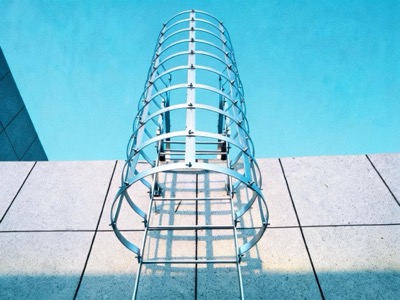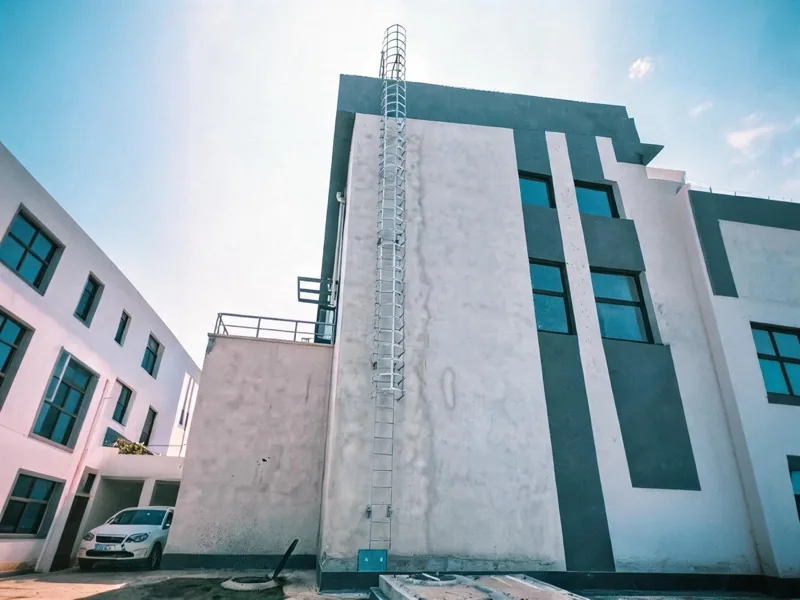
What is a cage ladder? A cage ladder is a fixed vertical ladder fitted with a curved steel guard — the safety cage — that wraps around the climber. The cage is built from hoops and vertical straps. It catches a slip before it turns into a fall. We weld these every week at our 8,000 m² factory in Shijiazhuang, and buyers ask the same thing first: what makes a ladder a cage ladder, and when do you actually need one?
This guide answers that in plain terms. Start with the definition, then the parts, the standards, the metal, and the jobs these ladders do. Read it once, and you can specify the right cage ladder with confidence.
What Is a Cage Ladder, Exactly?
A cage ladder is a permanent steel ladder ringed by a back guard of steel hoops. The hoops form a tube around the climb. If a worker leans back, the cage stops the body and steadies it. Strip the guard away and you have a plain vertical fixed ladder. Add it back, and you have a cage ladder — also called a caged ladder or a safety ladder cage.
Engineer's note: the word "cage" describes the guard, not the climb itself. People mix up the ladder cage with the ladder. The ladder carries the weight. The cage manages a fall. Both must be rated, and on our floor both are proof-tested before they ship.
Anatomy of a Cage Ladder: Rails, Rungs and Hoops
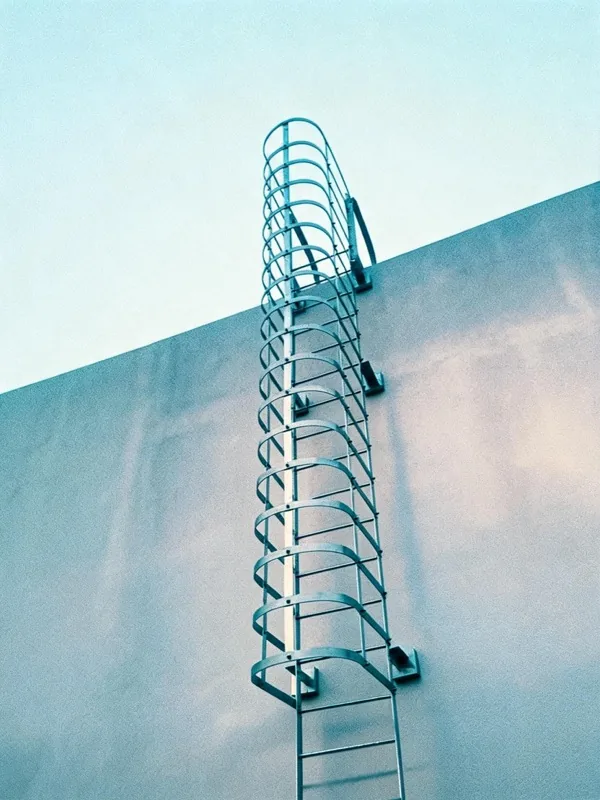
Take a cage ladder apart and the parts list is short. Each part has a job. Each has a number we hold to.
- Vertical rails (stringers) — Q235B steel flat bar, or SS304/SS316 for coastal and washdown sites.
- Rungs — round or serrated bar at 300 mm pitch, anti-slip on every step.
- Standoff brackets — hold the ladder about 200 mm off the wall for toe clearance.
- Hoops — the curved rings of the safety cage, spaced no more than 1,500 mm apart under EN ISO 14122-4.
- Vertical straps — flat bars that tie the hoops together, evenly set around the inside.
- Cage opening — the climbing space, kept at 650–800 mm clear so a body fits but cannot fall through.
We cut the rails, weld the rungs at a set pitch, then form and fit the hoops. A single rung is proof-tested to a 1.5 kN point load. The cage starts roughly 2.2 m above the base, so a short start is not boxed in needlessly. See the same parts on our ladder safety cage system.
How the Safety Ladder Cage Protects You
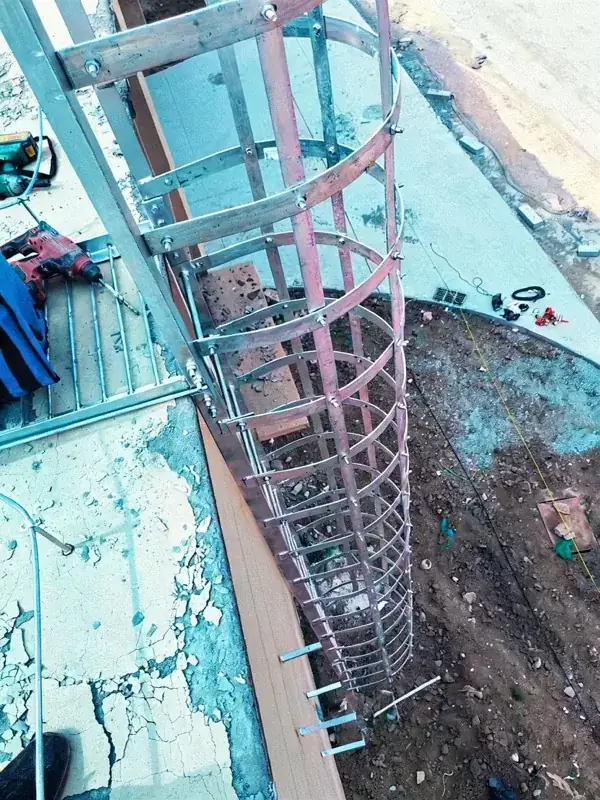
A safety ladder cage does not arrest a fall like a harness does. It works by geometry. The hoops keep the climber close to the rungs, so there is little room to topple backward. If a foot slips, the back of the cage is right there to lean into. That margin buys the seconds a worker needs to regain a grip.
Two standards shape the design. Know them before you specify.
- OSHA 1910.23 (United States) — cages were the long-standing fix for fixed ladders above 24 ft (7.3 m). New ladders installed after 19 November 2018 over that height must use a personal fall-arrest or ladder safety system instead. Existing cages are allowed until 2036.
- EN ISO 14122-4 (Europe) — calls for fall protection where a climb passes 3 m, with cage hoops spaced no wider than 1,500 mm.
Does every ladder need a cage? No. Short climbs under the height threshold do not. Tall new builds in the US now lean toward fall-arrest rails, which is what OSHA prefers today. For many plants outside the US, a cage still meets the local code and the budget. Ask the question early, and we route the design the right way.
Materials and Types: From Q235B to a Vertical Cage Ladder
The metal decides the price and the life of the ladder. We build in three grades, and the choice follows the site.
| Grade | Best for | Finish |
|---|---|---|
| Q235B carbon steel | Indoor and general industrial use | Hot-dip galvanized 70–85 µm |
| SS304 stainless | Washdown and food plants | Brushed or pickled |
| SS316 stainless | Coastal and chemical sites | Brushed or pickled |
Types follow the job too. A fixed cage ladder is welded as one unit for a new structure. A retrofit (bolt-on) cage adds a guard to a ladder that is already in place. A vertical cage ladder is the straight, no-step run you see on tanks and silos. We galvanize carbon steel to 70–85 µm as standard, and the full assembly is rated to its duty load before dispatch. Compare ready builds on our vertical fixed access ladder and caged roof access ladder pages.
Where a Ladder Cage Earns Its Keep
A ladder cage shows up wherever people climb high, often, in the open. The list is steady across industries.
- Chemical plants — reactor platforms and pipe racks, usually in SS316 against fumes.
- Water treatment — storage tanks and clarifiers, where SS304 shrugs off constant wet.
- Warehousing — roof plant, mezzanines and silos, in galvanized Q235B.
- Power and utilities — transformer bays, stacks and gantries that crews check on a schedule.
One job from our records: a water utility in ordered SS304 vertical cage ladders for a new tank farm. We shipped material certificates and load-test reports with every batch. The site cleared its safety audit on the first visit. See more installs on our applications page.
Buying a Cage Ladder Factory-Direct
Buying direct cuts the trading-company markup and the guesswork. You talk to the engineers who weld the ladder, not a middleman with a catalogue. That is how we have shipped to 50+ countries since 2003.
Every order ships with the paperwork an inspector asks for: material certificates, weld reports, and load-test data. The factory holds ISO 9001:2015. Third-party inspection by SGS, TÜV, or Bureau Veritas is available on request, and buyers are welcome to audit the plant in person.
Specifying a job? Send your height and your standard. Our team returns a drawing, a load rating, and a factory-direct quote. Start with the cage ladder guide, then talk to our engineers or check the FAQ.