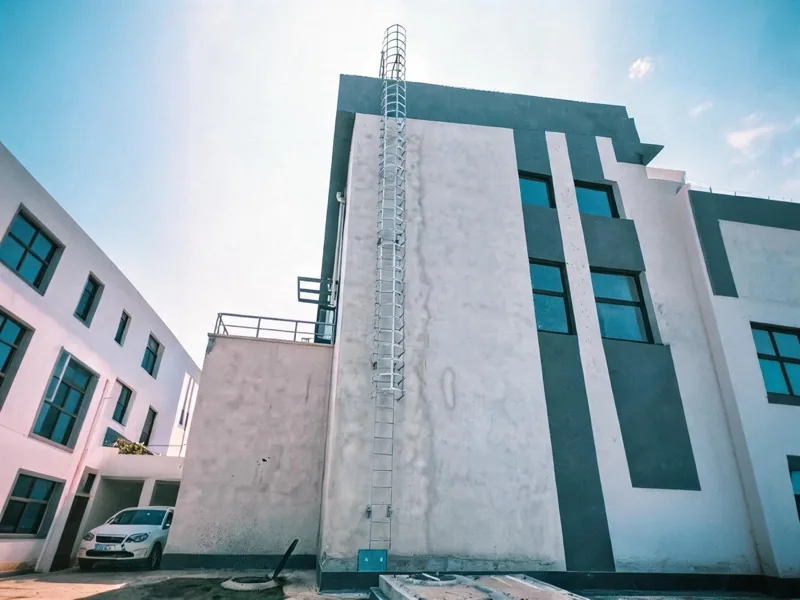
A cage ladder inspection checklist keeps a climber safe and an auditor satisfied. The cage adds parts a plain ladder never has: hoops, vertical bars, and a tight entry. Each one can fail. Each one is on this list. This is the routine our QC engineers run before a caged unit leaves our 8,000 m² Shijiazhuang factory, and the one we hand clients for in-service checks. Every line maps to OSHA 1910.23 or EN ISO 14122-4. We have built caged steel access since 2003, ISO 9001:2015 certified.
Work the list top to bottom. Daily checks are quick and need no tools. The annual check is a competent-person job with a torque wrench and a coating gauge. Record both. An undocumented check counts as no check.
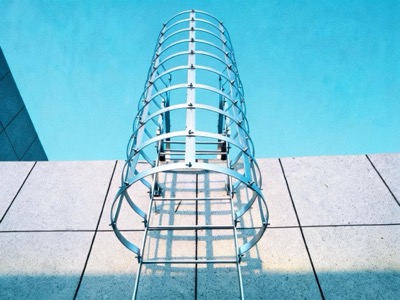
1. Pre-Use & Daily Visual Checks: The Cage Ladder Safety Inspection
This ladder safety inspection takes under five minutes. No tools needed. A failure here pulls the ladder out of service. Tag it, and do not climb.
- ☐ Rungs clear of ice, mud, oil and debris.
- ☐ No bent, cracked or missing rungs; anti-slip surface still biting.
- ☐ Side rails free of cracks at the welds; no rust bleeding through the coating.
- ☐ Cage hoops undamaged and square; every hoop bolt present.
- ☐ Entry and exit clear, with nothing stowed inside the cage.
- ☐ Anchor brackets tight to the wall, no daylight behind the plate.
A two-minute look beats a ten-metre drop. Our crews tag any failure the moment they spot it.
2. Cage & Hoop Inspection Points
The cage is the part most people skip. It is also the part that catches a fall. So check every hoop and bar, not just the rungs.
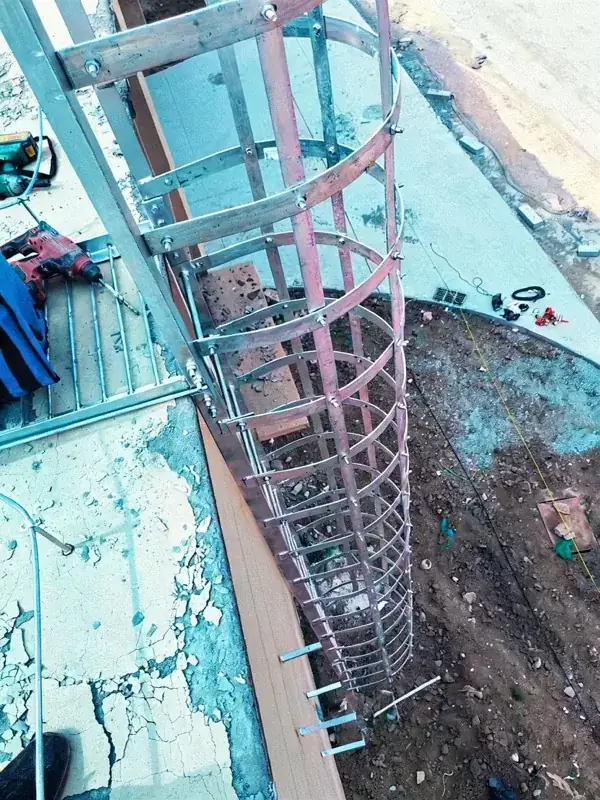
- ☐ Hoop vertical spacing holds within 1,200 mm, evenly stepped.
- ☐ Hoop inner clearance sits in the 685–760 mm band for legacy OSHA cages.
- ☐ Vertical bars unbent and tied to every hoop.
- ☐ No sharp edges or burrs at the cage opening.
- ☐ Cage starts and stops at the right heights above floor and landing.
- ☐ EN ISO 14122-4 back-guard depth stays in the 650–800 mm range on export units.
A bent hoop narrows the climb space and snags clothing. Replace it; do not bend it back.
3. Structural, Weld & Coating Inspection
Steel fails at the welds and where the coating breaks. Look there first.
- ☐ Inspect weld toes for hairline cracks, especially rung-to-rail and hoop-to-bar joints.
- ☐ Probe rust at coating chips; surface bloom is fine, but section loss is not.
- ☐ Measure coating thickness with a gauge; we hot-dip galvanize Q235B to 70–85 µm.
- ☐ On SS304 or SS316 cages, check for tea-staining and dissimilar-metal contact.
- ☐ Test anchors for movement under load; a loose plate spreads stress to the welds.
- ☐ Confirm the grade matches the cert — Q235B for galvanized, SS304/SS316 for marine air.
An engineer's habit: tap a suspect weld and listen. A dull note often means a crack under the paint.
4. OSHA 1910.23 & EN ISO 14122-4 Inspection Criteria
These are the osha ladder inspection requirements that decide pass or fail. Measure against the code, not by eye.
- ☐ Rung spacing uniform and no more than 300 mm (12 in).
- ☐ Side rails extend 1,070 mm (42 in) above the landing.
- ☐ Cage hoop spacing within 1,200 mm on legacy caged units.
- ☐ New installs over 7.3 m (24 ft): personal fall-arrest, not a cage, under the OSHA 1910.28 phase-out.
- ☐ EN ISO 14122-4 rest platforms and back-guard spacing met for export.
Read the clause-by-clause detail in our OSHA 1910.23 fixed ladder requirements guide and the EN ISO 14122-4 explainer.
5. Inspection Frequency & Documentation
An industrial ladder inspection runs on a schedule, not a hunch. A caged fixed ladder needs three tiers of check.
- ☐ Daily — the visual checks in section 1, by the user.
- ☐ Periodic — a quarterly walk-down for corrosion and loose bolts.
- ☐ Annual — a competent-person check with torque wrench, coating gauge and a proof load.
Like any fixed ladder inspection, the paper matters as much as the climb. Keep a file per ladder.
- ☐ Material certificates for the Q235B, SS304 or SS316 stock.
- ☐ Weld reports and welder qualifications.
- ☐ Load-test data; in our factory we proof a sample rung to a 1.5 kN point load per batch.
- ☐ A dated inspection log with the inspector's name and findings.

Buying factory-direct means no middleman holds these papers back. We ship every order with the full document pack, and third-party inspection by SGS, TÜV or Bureau Veritas is available on request. The same records have cleared first-visit safety audits across 50+ countries. Factory audits are welcome on site.
One example, anonymised: a chemical plant ordered caged tank-access ladders and cleared its first third-party audit with zero non-conformances on the cage spacing and weld reports.
6. Signs of Failure: When to Repair or Replace
Some defects you fix on site. Others end the ladder's service life. Use this rule of thumb.
- ☐ Surface rust, intact section — clean and recoat.
- ☐ Loose or elongated bolt holes — re-engineer the anchor, do not just retighten.
- ☐ Bent cage hoop or deformed rung — replace the affected section.
- ☐ Cracked weld or section loss — take it out of service and replace.
When repair is not worth it, talk to the people who built it. Send your height and standard, and we return a drawing, a load rating and an inspection plan with the quote. For new cage hardware, see our ladder safety cage system and caged roof access ladder. For the plain-ladder version of this routine, use our fixed ladder inspection checklist.