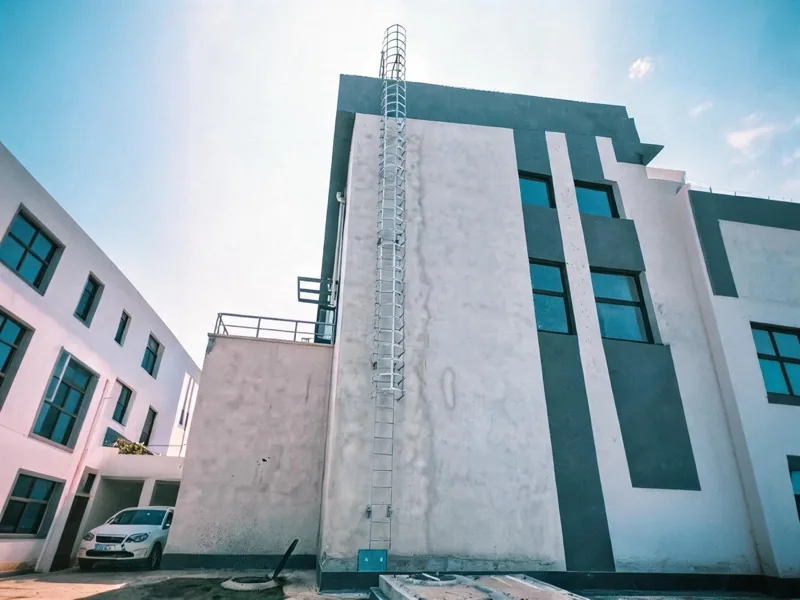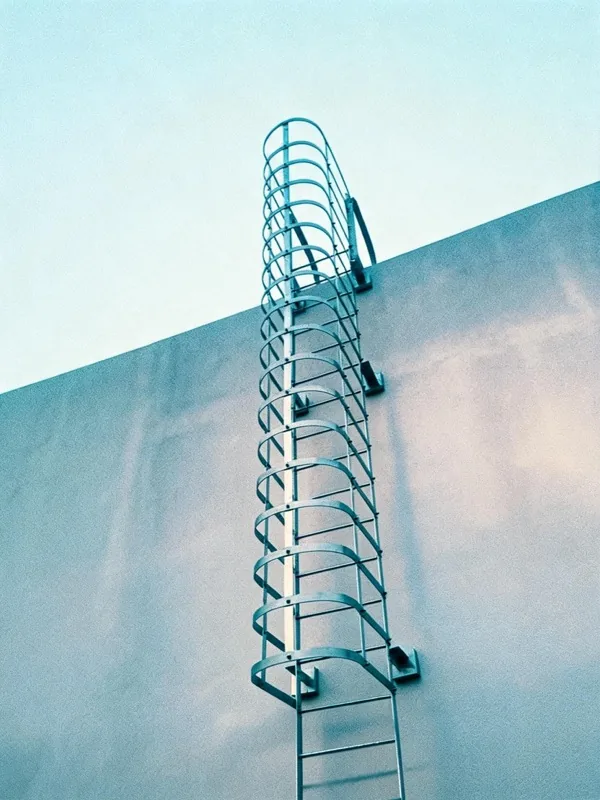
This guide shows you how to install a cage ladder that meets OSHA 1910.28 and EN ISO 14122-4. We build these ladders ourselves. Dengtai is a factory-direct manufacturer, ISO 9001:2015 certified since 2003, and our crews fit caged ladders on export jobs across 50+ countries. The steps below come from our installation engineers, not a generic checklist. Get the hoop spacing, the anchor load, and the coating right, and the cage outlasts the building it serves.
Before you start, settle one point: in the United States a cage no longer counts as fall protection on its own. OSHA 1910.28(b)(9) phases hoop cages out on tall fixed ladders, and new ladders need a personal fall arrest or ladder safety system. In the EU, EN ISO 14122-4 still allows a back-guard cage within a defined geometry. Read the rule for your market first. For the full background, see [what is a cage ladder](/blog/cage-ladder-what-is/).
/images/product_caged-ladders_gallery01_detail.webp1. Tools and Materials Needed
Sort the kit before anyone climbs. A clean cage ladder install starts on the ground.
- Cage hoops and vertical guard bars in Q235B carbon steel, or SS304 for wet and coastal sites - M12 anchor bolts: SS304 for outdoor runs, hot-dip galvanized for dry interiors - Cordless drill with the right masonry or steel bit for your substrate - Calibrated torque wrench, spirit level, chalk line, and tape - Full-body harness, lifeline, and edge protection
Standard hoop material is Q235B. For chemical plants and marine air we switch to SS304, or SS316 where salt load is heavy. In our factory we dry-fit every cage on the floor and number each hoop before it ships. That number saves an hour of guesswork on site.
2. Pre-Installation Site Survey and Code Clearance
Measure first. Drill later.
Walk the full climb and record three things: total height, the substrate at each fixing point, and the space behind the ladder. EN ISO 14122-4 wants a clear climbing zone behind every rung. OSHA 1910.23 sets the side clearance. Check both against the table below.
| Check | Value | Reference | |---|---|---| | Rung spacing (centres) | 250-300 mm | EN ISO 14122-4 | | Clearance behind rung | 150 mm min | EN ISO 14122-4 | | Side clearance each side | 75 mm min | OSHA 1910.23 | | Cage start height above base | 2.2-3.0 m | EN ISO 14122-4 | | Hoop vertical spacing | 1500 mm max | EN ISO 14122-4 |
Confirm the climb line is clear of pipe runs and cable trays. Mark every fixing point before a single section goes up. If the run passes the trigger height for fall arrest, plan the rail or lifeline now, not after the cage is bolted. For the OSHA detail, read [OSHA fixed ladder requirements](/blog/osha-fixed-ladder-requirements/).
3. Step-by-Step Installation
This is the part most installs rush. Take it in order.
1. Fix the two stringers from the top down. Set M12 standoff brackets first, then offer up the ladder and bolt each point. Torque to the drawing value, not by feel: 60 N-m is typical for M12 into structural concrete. 2. Check the rung spacing holds 250-300 mm from the first rung to the last. An uneven top rung is a trip point. 3. Mount the cage hoops onto the stringers, starting at the marked base height. Keep the vertical spacing even. 4. Run the vertical guard bars between hoops and bolt them at each ring. The bars stop a falling climber from leaving the cage. 5. Tie the top hoop into the platform or landing so the cage is continuous to the step-off.
Each wall bracket on our caged ladders is rated to 6 kN, a 2:1 margin over the 3 kN minimum we test to. For a unit that ships pre-assembled, see our [ladder safety cage system](/products/ladder-safety-cage-system/). On rooftops, the [caged roof access ladder](/products/caged-roof-access-ladder/) lands the cage straight onto the parapet.
/images/product_caged-ladders_features_tank_project.webp4. Load Testing and Inspection
A cage is only as good as its anchors. Prove them.
Hand-load the top brackets and feel for movement. Then torque-check every M12 bolt against the spec sheet. In our factory we pull-test a sample from every batch to failure on our own rig, and we keep the load test data on file. SGS or TUV witnessed tests are available when a client needs third-party proof. Check the coating last: hot-dip galvanizing should read 85-140 um, above the 85 um floor most specs ask for. Brush zinc-rich paint over any edge you drilled on site, the same day.
/images/home_qc_img_inspection.webpOnce the cage is up, run a first inspection and log it. Our [cage ladder inspection checklist](/blog/cage-ladder-inspection/) covers the points an auditor looks for.
5. Common Installation Mistakes and How to Avoid Them
We see the same five errors on jobs we are called back to fix.
| Mistake | What goes wrong | The fix | |---|---|---| | Treating the cage as fall protection | Fails OSHA 1910.28 on tall climbs | Add a fall arrest or ladder safety system | | Uneven hoop spacing | Gaps a climber can fall through | Mark spacing before bolting any hoop | | Snug-tight anchors | Brackets work loose under load | Torque to the drawing, then re-check | | Galvanizing scratched on site | Rust starts at the cut edge | Brush zinc-rich paint the same day | | Cage stops short of the platform | Open gap at the step-off | Tie the top hoop into the landing |
Avoid these and the install passes first time. The cage geometry is set by the standard, not by preference.
6. Factory Support and Documentation
Buying direct changes what lands on your desk.
Every order ships with the documents that prove the build: material certificates, weld inspection reports, and load test data. No middleman sits between you and the line, so the paperwork comes straight from the people who welded it. Clients are welcome to audit the factory in person, and we host inspection visits before shipment.
Project example
Still weighing the spend against a guardrail or rail system? Our [cage ladder cost guide](/blog/cage-ladder-cost/) breaks down the price drivers. If you have fitted a standard fixed ladder before, the sequence rhymes with our [fixed ladder install guide](/blog/fixed-ladder-install/).