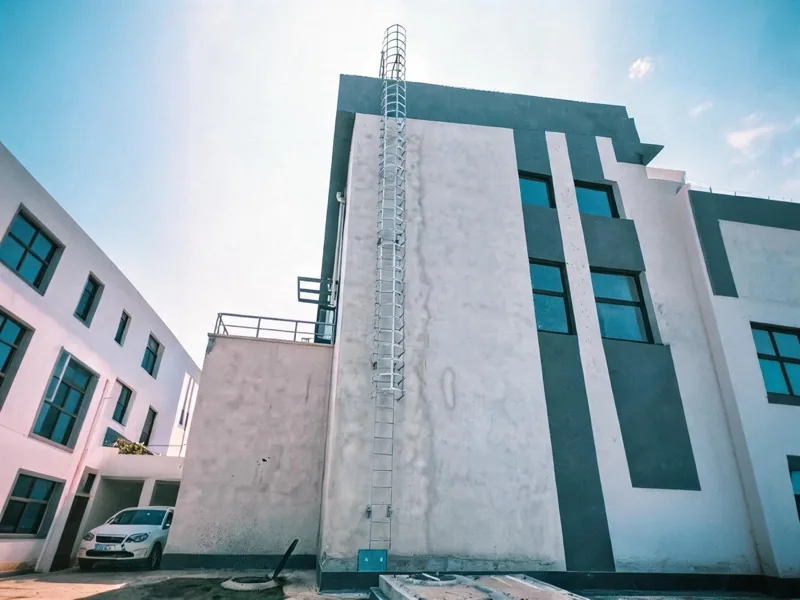
A fixed ladder with safety cage is the classic EN route for guarding a vertical climb. The EN ISO cage ladder requirements that govern it sit in EN ISO 14122-4 — Safety of machinery: Permanent means of access to machinery, Part 4: Fixed ladders. We weld cage ladders to it every week at our 8,000 m² Shijiazhuang factory.
This guide reads the cage clause by clause, in millimetres. It is built for EU buyers who need the geometry right the first time. Where the standard gives a figure, we give it. Where a value needs checking against the 2016 text for your build, we flag it.
EN ISO 14122-4 Scope: What It Covers
EN ISO 14122-4 is Part 4 of a four-part family. The family covers permanent access to machinery. Part 4 is the part you cite for any cage ladder.
- Part 1 — choice of access and general rules (EN ISO 14122-1).
- Part 2 — working platforms and walkways.
- Part 3 — stairs, stepladders and guard-rails.
- Part 4 — fixed ladders, including the safety cage.
The cage is one of two fall-protection routes inside Part 4. The other is a guided fall arrester. The standard treats the cage as a guard, not a true arrester. A cage limits a fall; it does not stop one the way a guided sleeve does.
Engineer's note: read Part 1 before Part 4. Part 1 tells you whether a fixed ladder is even the right choice. New to the topic? Start with what a cage ladder is.
Cage Dimensions & Spacing Requirements
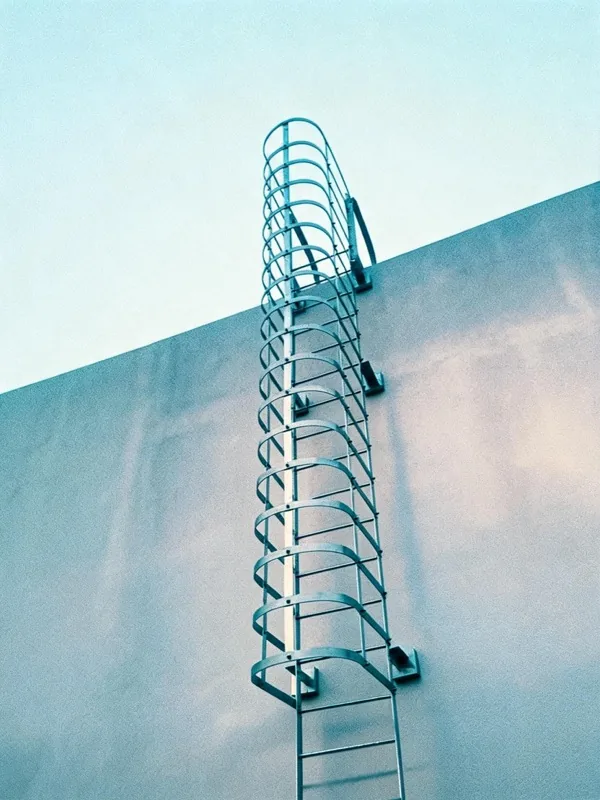
The geometry is the backbone of any vertical ladder with safety cage. Get the millimetres right and the caged access ladder passes on shape. Here are the core figures for the cage itself.
| Cage parameter | EN ISO 14122-4 value | Dengtai standard build |
|---|---|---|
| Cage trigger (fall height) | fall height over 3000 mm needs fall protection | cage fitted above 3000 mm |
| Guard-hoop vertical spacing | max 1500 mm apart | ≤ 1500 mm |
| Cage clearance (rung to back of hoop) | 650 to 800 mm | 700 mm |
| Cage start height above base | approx 2200 to 3000 mm | ≈ 2500 mm |
| Longitudinal bars around hoop | min 5, evenly spaced | 5 bars, even pitch |
The hoop spacing is the figure buyers check first. Hoops stay no more than 1500 mm apart up the run. Vertical bars tie the hoops into a basket that catches a slip.
Cage clearance is the second figure. The back of the hoop sits 650 to 800 mm off the rung line. Tighter than that and a worker scrapes; wider and the basket stops working.
Material & Load Requirements
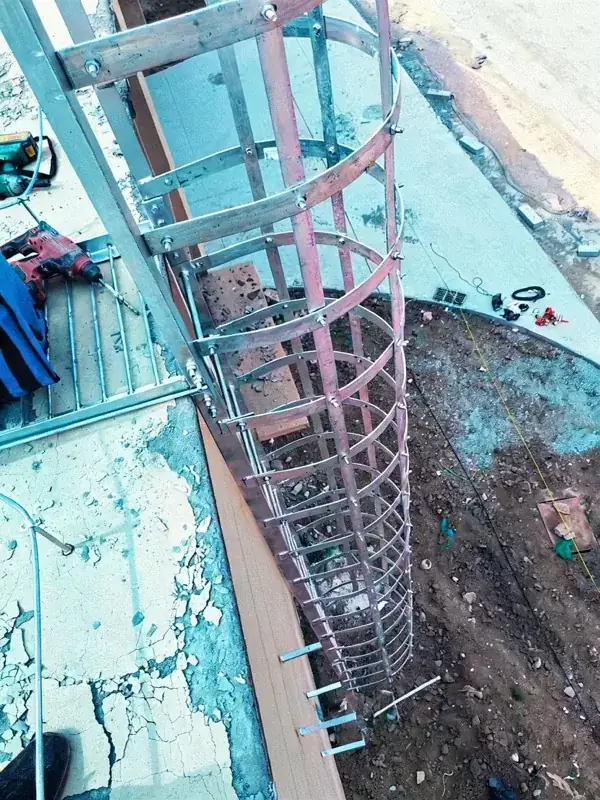
EN ISO 14122-4 sets the shape. Material and finish are where a factory earns its keep. We pick the grade to the site.
- Q235B structural steel — our default for most EU industrial cage ladders.
- SS304 — for washdown, food, and damp sites.
- SS316 — for coastal and high-chloride exposure.
The parent steel runs to EN 10025 for structural sections. Coating follows the grade. Hot-dip galvanizing sits at 70 to 85 µm as our standard. The thickness is gauged, not guessed.
Loads are where fabrication shows. Each rung takes a point load without permanent set. The design value is around 1.5 kN at mid-rung. We proof-test rungs on a rig, sampled per batch. Every batch is pulled on a tensile test, not just eyeballed.

EN ISO vs OSHA: Key Differences
This is where EU and US codes split. Same fixed vertical ladder with safety cage, two rule sets.
| Point | EN ISO 14122-4 (EU) | OSHA 1910.23 (US) |
|---|---|---|
| Cage trigger | fall height over 3000 mm | height over 24 ft (7.3 m) |
| Cage status | accepted guard option | phasing out for new ladders |
| Units | millimetres | inches / feet |
EN ISO keeps the cage on the table. OSHA steers new tall ladders toward a guided fall arrester instead. Exporting to North America? Read our OSHA cage ladder requirements guide for that code.
Compliance Checklist for EU Buyers
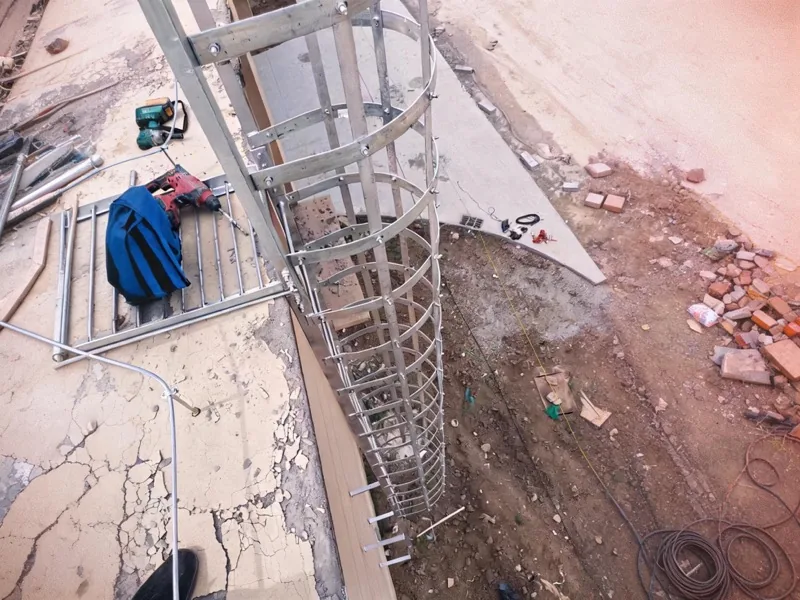
A cage that looks right can still fail an audit on paper. Ask for the documents up front. Here is the short list we ship with every EU order.
- Material certificates — mill certs for the Q235B, SS304, or SS316 used.
- EN test reports — rung load and weld pull results, sampled per batch.
- Declaration of Conformity — the DoC where the ladder forms part of machinery under 2006/42/EC.
- Coating records — gauged galvanizing thickness in µm.
Site case: a EU plant ordered caged access ladders for a tank farm. We supplied SS316 hoops for chloride resistance, with batch load-test reports. The site cleared its access audit on the first visit.
How We Build EN ISO-Compliant Cage Ladders
The factory holds ISO 9001:2015. We have shipped to 50+ countries since 2003. Every cage ladder leaves the plant with material certificates, weld reports, load-test data, and an EN Declaration of Conformity where it applies.
Third-party inspection by SGS, TÜV, or Bureau Veritas is available on request. Buying direct means no middleman markup and no guesswork. You talk to the engineers who weld the cage. Buyers are welcome to audit the plant in person.

Specifying a fixed ladder with safety cage to EN ISO 14122-4? Send your height, the fall-protection method, and the material. We return a drawing, a load rating, and a factory-direct quote. Talk to our engineers, or compare the caged fixed access ladder, ladder safety cage system, and roof access ladder with cage ranges.