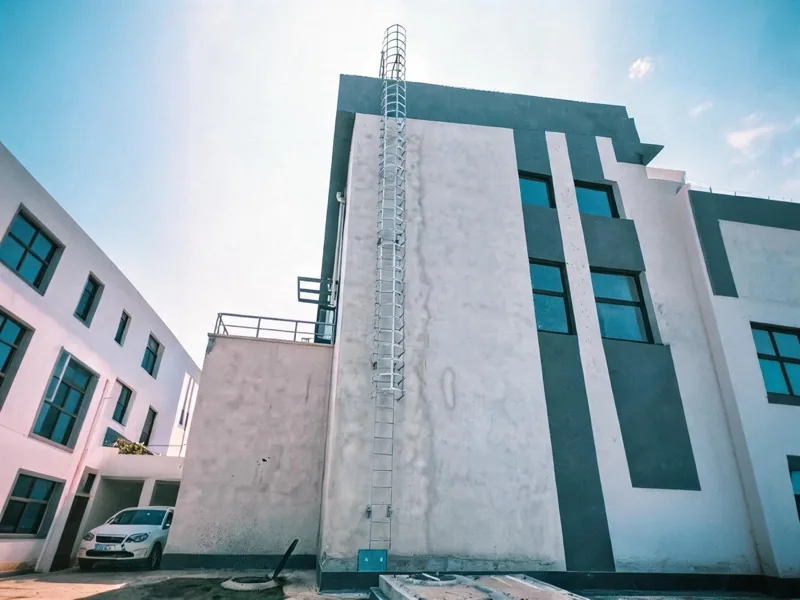
Cat ladder safety on a sloped roof comes down to three things: the anchor, the climber's technique, and the grip underfoot. Get those right and a pitched-roof climb is routine. Get them wrong and gravity does the rest. This guide is written from the welding bay, not a brochure. We have built and shipped roof cat ladders to 50+ countries since 2003, and the rules below are the ones we hold our own kit to.
The work splits into clear parts. First the hazard most people underrate, then the standards that govern it, then anchoring, technique, materials, and a pre-use check. For the wider picture on choosing a ladder, see our roof cat ladder buying guide. To fit one step by step, read how to install a cat ladder on a sloped roof.
1. Why Slope Walking Is the #1 Cat Ladder Roof Hazard
Most falls do not happen on the ladder. They happen in the step between the roof edge and the first rung, out on the open slope. That short walk is the real cat ladder roof hazard. A wet tile, a gust, a loose foot — and there is nothing to catch you.
Our installers see the same pattern on audit after audit. The ladder itself is sound. The fall risk sits in the unprotected approach. Three factors stack up:
- Pitch. Past 20° a boot slides before it grips. Past 45° you cannot stand without a hold.
- Surface. Wet metal, moss, and frost cut traction to almost nothing.
- No fall line. Without an anchor line, one slip becomes a ground fall.
Engineer's note: we tell every customer to plan the anchored walk to the ladder first, then the climb. The climb is the easy part.
2. OSHA 1910.23, EN ISO 14122-4 & the Cat Ladder Safety Cage Rule
Safety codes are not red tape. They are failure data turned into numbers. Match the code to where the ladder ships.
- OSHA 1910.23 (US). Sets rung spacing, clearances, and the height where fall protection becomes mandatory.
- EN ISO 14122-4 (EU). Governs fixed access ladders, a rung pitch of 250–300 mm, and guard requirements.
- BS 4211 (UK). Covers permanent access ladders and safety hoops on tall runs.
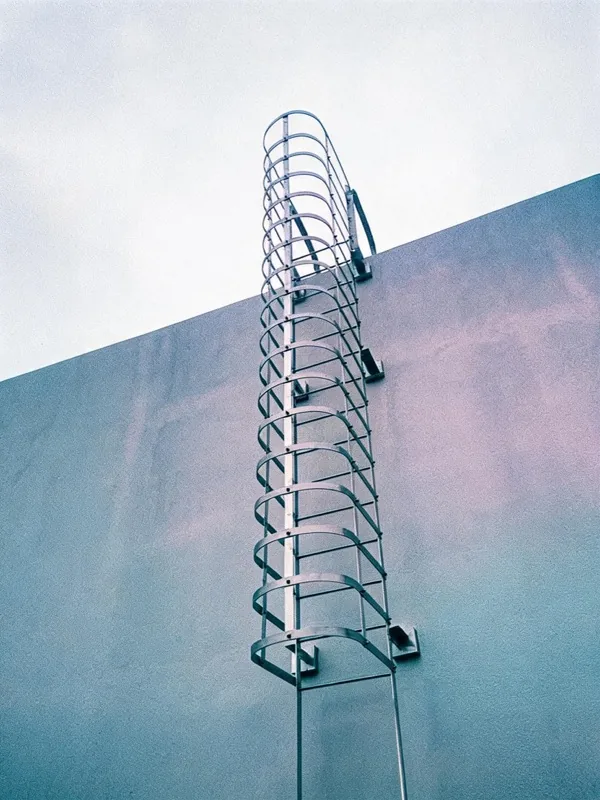
Here is the rule people miss. A cat ladder safety cage — the hooped guard around the climber, sometimes just called a cat ladder cage — is not optional once the climb runs high. Under OSHA 1910.23, a fixed ladder over 24 ft (7.3 m) needs a cage or a personal fall arrest system. Newer rules push toward fall arrest on the tallest runs. EN ISO 14122-4 sets its own guard height triggers.
Short roof runs may not need a cage. But the moment the climb passes the threshold, a cat ladder safety cage or anchor-line system is mandatory — not a nice-to-have. Tell us the destination market and the height, and the drawing reflects the right rule.
3. Anchoring a Roof Cat Ladder on a Sloped Roof
The anchor is the whole game. A roof cat ladder is only as safe as the steel it bolts into. Fix to structure — purlin, rafter, or concrete deck — never to the roof skin.
- Ridge hook. Seat it over the apex so the top pull rides the strongest point.
- Spread the load. Share the climb across standoff brackets; no single anchor should carry it.
- Right fixings. M10–M12 stainless bolts sized to the substrate, torqued to the drawing figure.
- Prove it. Pull-test a sample of anchors to the rated kN before anyone climbs.
We rate our brackets to a stated kN load and pull-test to that number in the factory. The measured anchor rating for this kit is. Every order ships with the weld report and load-test data, so the inspector reads proof, not a promise.
4. Safe Slope-Walking Technique & Fall Protection
Good gear fails with bad technique. Here is how our crews move on a pitch.
- Clip first, climb second. Connect the harness to a certified anchor line before you leave the edge.
- Three points of contact. Two hands and a foot, or two feet and a hand — always three on the ladder.
- Face the rungs. Climb and descend facing the ladder. Carry no tools in your hands; use a hoist line.
- One climber per section. Loading two people doubles the rung stress.
Fall protection is the backstop, not the plan. The anchor line catches a slip; the technique stops the slip happening. A self-closing safety gate at the landing closes the gap where tired climbers step wrong. For roofs that suit a fixed access ladder instead, read our roof ladder safety requirements.
5. Slip-Resistant Material & Coating for Cat Ladder Safety
Grip and corrosion are cat ladder safety problems as much as anchoring is. A smooth, rusting rung is a fall waiting for rain.
- Steel grade. Galvanized Q235B for inland roofs, SS304 for humid or coastal sites, SS316 within a few kilometres of salt water.
- Anti-slip rungs. Serrated or grooved treads so a wet boot still bites. Smooth round bar is the wrong choice on a roof.
- Coating thickness. Hot-dip galvanizing at 70–85 µm is the outdoor baseline. Thinner zinc rusts early and the grip goes with it.
/images/product_cat-ladders_gallery04_mixed_stack.webp
Engineer's note: we batch-test each steel lot with a tensile pull before it reaches the welding bay, so the metal under your boot is already proven. Pick the grade for the site, not the budget. For the full grade-by-environment breakdown, see our roof cat ladder guide.
6. Pre-Use Inspection & Load-Test Checklist for a Roof Cat Ladder
Run this before first use, then on a set schedule. Skip none of it. A roof cat ladder that passed last year can fail this winter.
- Anchors. Re-torque a sample. Look for movement, rust bleed, or a backed-out bolt.
- Rungs. Check spacing holds 250–300 mm and that treads are still serrated, not worn smooth.
- Welds. Scan stringer-to-rung joints for cracks or surface rust.
- Coating. Touch up any chipped galvanizing before bare steel takes hold.
- Cage and gate. Confirm the cat ladder safety cage, hoops, and self-closing gate are sound.
- Load test. Re-prove the anchors to their rated kN after any roof work nearby.
Our quality system runs on ISO 9001:2015, and third-party verification through SGS, TÜV, or Bureau Veritas is available on request. We also welcome factory audits — come walk the welding bay and watch a batch get pulled to load. We sell factory-direct, with no middleman between the welding bay and your roof. See the kit on our roof cat ladder product page.
From a recent job: a maintenance contractor in re-fitted roof cat ladders with serrated SS304 rungs and proper anchor lines. The trigger was a near-miss audit, and the next inspection cleared on the first pass.
Cat Ladder Safety FAQs
Is a cat ladder safe on a steep roof?
Yes, when it is anchored to structure, fitted with serrated rungs, and used with a harness on a certified anchor line. The roof pitch sets how many anchor points and what fall protection you need.
When does a cat ladder need a safety cage?
Under OSHA 1910.23, a fixed ladder over 24 ft (7.3 m) needs a cat ladder safety cage or a personal fall arrest system. EN ISO 14122-4 sets its own guard triggers. Match the rule to your market.
What stops slipping on a roof cat ladder?
Serrated or grooved rungs, a hot-dip galvanized coating at 70–85 µm, and three points of contact on every climb. Smooth rungs and worn coating are the usual culprits.
What standards cover cat ladder safety?
OSHA 1910.23 in the US, EN ISO 14122-4 in the EU, and BS 4211 in the UK. We build to whichever standard your destination market names.