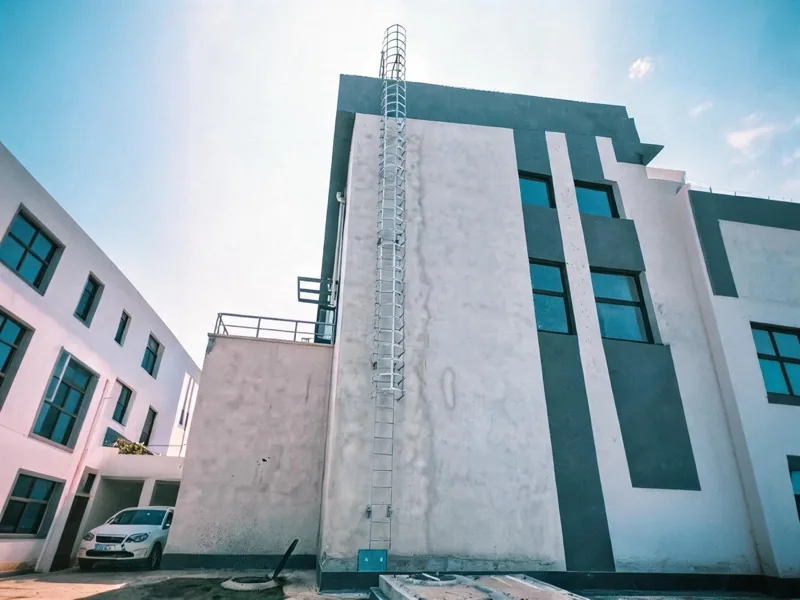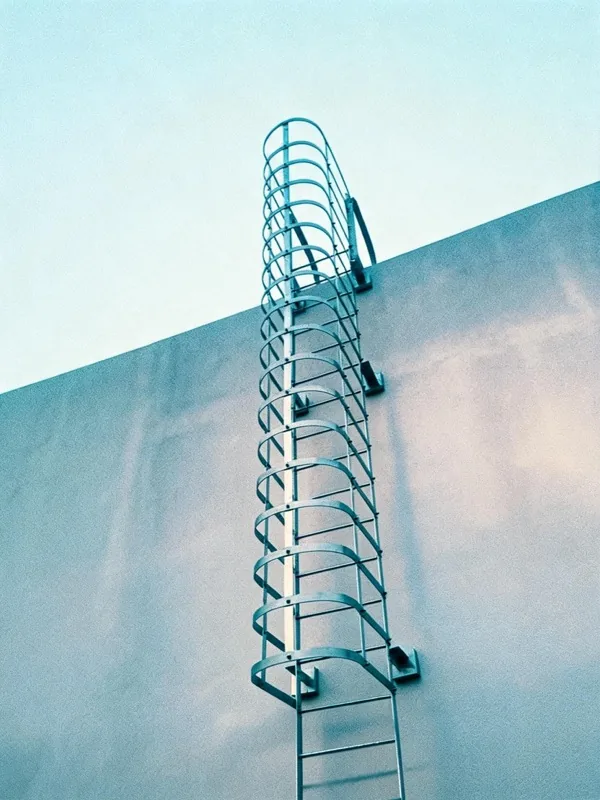
Roof ladder safety requirements come from two main rule sets: OSHA 1910.23 in the United States and EN ISO 14122-4 across Europe. Get them right and a fixed roof access ladder clears inspection on the first visit. Get them wrong and the ladder fails the audit, or worse, someone falls. This guide reads each standard clause by clause, then lists the cage rules, fall protection, anchor loads, and coatings we build to on our own factory floor. We are a factory-direct steel ladder manufacturer, ISO 9001:2015 certified since 2003, with an 8,000 m² plant in Shijiazhuang. New to the topic? Start with our roof ladder guide, then come back here for the compliance detail.
Before the clause-by-clause read, here is the side-by-side. Some buyers search for safety roof ladder fittings or roof safety ladders; the rules below apply to any fixed roof access ladder, whatever the label. Two regions, one goal: a climb nobody falls off.
| Requirement | OSHA 1910.23 (US) | EN ISO 14122-4 (EU) |
|---|---|---|
| Rung spacing (centres) | 10–14 in (250–355 mm) | 225–300 mm |
| Clear width between rails | ≥ 16 in (406 mm) | ≥ 400 mm |
| Back clearance (rung to wall) | ≥ 7 in (178 mm) | ≥ 150 mm |
| Fall-protection trigger | climb > 24 ft (7.3 m) | fall height > 3 m |
| Rung point load | ≥ 250 lb (≈ 1.1 kN) | defined point load per clause 4 |
OSHA 1910.23 Requirements
OSHA 1910.23 sets the geometry for fixed ladders in US workplaces. Three numbers matter most.
- Rung spacing: 10 to 14 inches between centrelines, kept even from the bottom rung to the top.
- Clear width: at least 16 inches between the side rails.
- Back clearance: at least 7 inches from the rung centreline to the structure behind it, so a boot fits.
Each rung has to carry a single concentrated load of at least 250 lb (about 1.1 kN) without permanent set. We build to that floor and then test well past it. On every OSHA-spec order we run a rung pull test on a sample unit and keep the load test data on file.
One detail installers miss: an uneven top rung is the fastest way to fail an inspection. In our factory we jig every rung to the same pitch before welding, so the spacing reads identical top to bottom on a tape measure.
EN ISO 14122-4 Requirements
EN ISO 14122-4 is the European standard for permanently fixed access ladders. The geometry sits close to OSHA but the numbers are metric and a little tighter in places.
- Rung spacing: 225 to 300 mm, equal across the flight.
- Clear width: 400 mm minimum between the stringers.
- Back clearance: 150 mm minimum behind each rung for grip.
- Single flight: long climbs need a rest platform; the standard limits how far you climb before a landing, so tall runs get split.
For UK projects we also cross-check the layout against BS 4211, which covers permanently fixed ladders and their fall-protection fittings. Where a client exports to several markets, we draw the ladder to the strictest of the applicable codes so one build ships everywhere.
Standard material is Q235B carbon steel. For coastal or chemical plants we move to SS304, and to SS316 where salt or wash-down is constant.
Cage Requirement
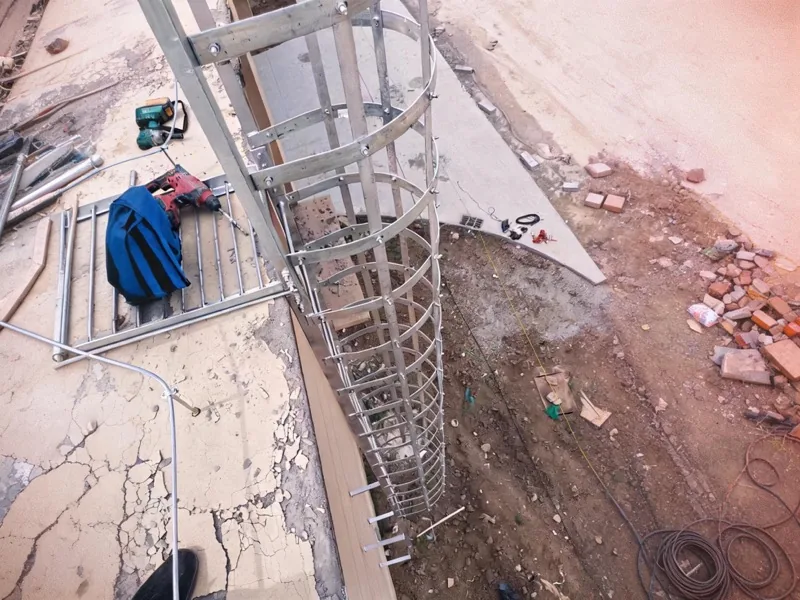
The cage rule is where the two standards now diverge, and it trips up a lot of buyers.
Under EN ISO 14122-4, a safety cage (or a guard) is required once the fall height passes 3 m, unless the ladder uses a rail or fall-arrest system instead. The cage starts roughly 2.2 to 3 m off the ground and runs to the top, with hoops on a fixed pitch.
Under OSHA the picture changed in 2018. For fixed ladders taller than 24 ft (7.3 m), a cage on its own is no longer accepted as fall protection on new installs. Ladders put in on or after 19 November 2018 need a ladder safety system or a personal fall-arrest system. Existing cages are being phased out, and by 18 November 2036 every fixed ladder over 24 ft must carry one of those systems. So a cage is still useful as a guide and a barrier, but in the US it no longer counts as the fall-protection answer by itself.
When a project does call for a caged climb, our Caged Roof Access ladder ships with hoops, vertical straps, and a bolt pattern pre-drilled to your roof pitch. We tell US clients upfront when a cage alone will not pass, so the order is right the first time.
Fall Protection
Fall protection is the part of the standard that actually saves a worker. A cage manages the climb; a fall-arrest system stops the drop.
- Ladder safety system: a vertical rail or cable running the length of the climb, with a sliding sleeve the worker clips to. This is the OSHA-preferred answer for tall fixed ladders.
- Personal fall-arrest system (PFAS): harness, lanyard, and a rated anchor at the top.
- EN approach: a guided type fall arrester on a rigid or flexible anchor line, sized to the climb.
Whatever the system, it lives or dies on its anchor. A rail rated for an arrest force is useless bolted into a thin gutter edge. That is why the next clause matters most.
Anchor & Load (kN)

Both standards require every anchor point on a fixed ladder to carry a defined load. This is the step most failed audits trace back to.
Each top bracket on our roof ladders is designed to hold 6 kN, which leaves a 2:1 margin over the 3 kN minimum we pull-test to. We use M12 through-bolts, torqued to the figure on the drawing, never by feel. For a fall-arrest anchor the rating climbs higher again, because an arrest force is a shock load, not a static one.
Here is the factory process behind those numbers:
- We sample pull-test brackets from every production batch to failure on our own rig.
- The load test data goes on file and ships with the order.
- Third-party witnessed tests by SGS or Bureau Veritas are available when a client needs independent proof.
Coating (µm)
A roof ladder sits in rain, frost, and UV for decades. The coating decides whether it lasts five years or thirty.
Our standard finish is hot-dip galvanizing at 85 to 140 µm, comfortably above the 85 µm floor most specs ask for. Two factory habits make the difference:
- We galvanize after fabrication, never before, so every cut edge, drilled hole, and weld stays sealed.
- For SS304 and SS316 units we passivate the ground welds, since a polished weld with no passivation is the first spot to pit.
When you drill on site you break the zinc layer, so brush a zinc-rich paint over each scratched zone the same day. For marine and offshore decks we quote SS316 rather than galvanized steel, because salt beats zinc in the long run.
Build It Right, Ship It With Proof
Roof ladder safety requirements are not a single rule; they are a stack of clauses on geometry, cages, fall protection, anchor load, and coating. Meet the strictest code that applies to your site and the ladder passes anywhere.
Every order leaves our line with the paperwork that proves the build: material certificates, weld inspection reports, and load test data. No middleman sits between you and the factory, so the pricing and the documents come direct. We export roof access ladders to 50+ countries, and clients are welcome to audit the line in person.
Need the build checked against your code? See the Caged Roof Access ladder spec, or read the full roof ladder guide for types, components, and load tables.