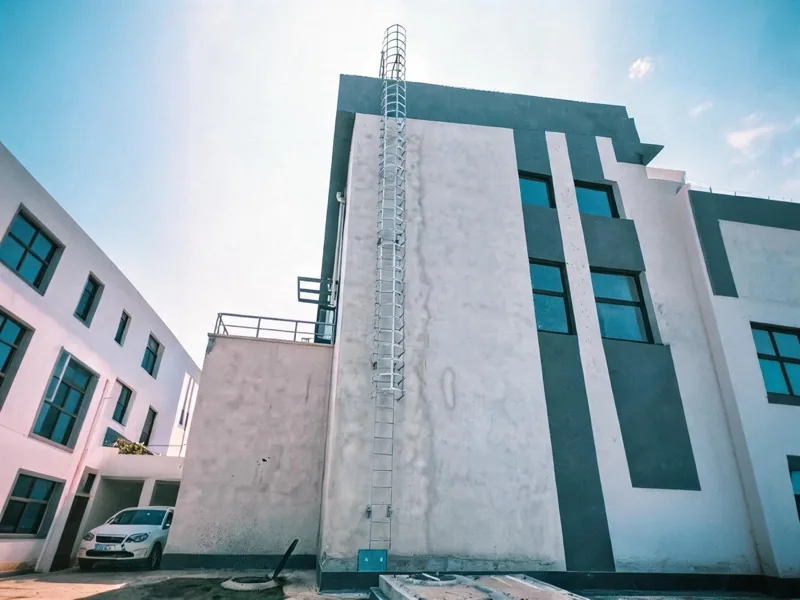
This roof ladder buying guide is the checklist our engineers run before quoting any fixed roof access ladder. Five things decide whether a ladder lasts twenty years or rusts out in three: what to look for, the steel grade, the safety features, the after-sales paperwork, and how the price actually stacks up. Work through them in order and a cheap spec will not catch you out. The goal is to pick the best roof ladders for your site and tell the genuinely cheapest roof ladders from the ones that only look cheap on the quote.
We build these ladders in Shijiazhuang and ship them to 50+ countries, so the advice below comes from the welding bay, not a catalogue. For the wider picture — types, standards, sizing — start with our complete roof ladder guide, then come back here to buy smart.
1. What to Look For: The 7-Point Checklist
Before you compare prices, compare specs. Run every quote against these seven points.
- Standard it answers to. Ask which code the design meets — OSHA 1910.23, EN ISO 14122-4, or BS 4211. A ladder with no named standard is a red flag.
- Steel grade, stated. Q235B carbon steel, SS304, or SS316 — it belongs on the drawing, not hidden behind "high-quality steel".
- Rung load rating in kN. A real engineer gives you a number. Ours are tested, not estimated.
- Coating thickness in µm. Hot-dip galvanizing at 70–85 µm is the outdoor baseline; thinner zinc means a shorter life.
- Cage or fall-arrest above the height threshold. Past the climb height set in OSHA 1910.23 you need one or the other.
- Fixing and wall-clearance detail. Mounting brackets, rung spacing in mm, and the gap to the wall all need a drawing.
- Documents on delivery. Material certificates, weld reports, and load-test data — included, not "available later".
Engineer's note: on our factory floor we reject a stringer if the galvanizing pools or skips, because a thin patch is where the first rust bloom starts. Hold your supplier to the same eye.
2. Material: Q235B, SS304, or SS316?
The metal is the single biggest line item and the one buyers get wrong most often. Match the grade to the site, not the budget.
- Q235B carbon steel, hot-dip galvanized. The workhorse for inland industrial roofs. Galvanized at 70–85 µm it shrugs off normal weather for years. Cheapest to buy.
- SS304 stainless. A step up for food, pharma, and humid sites where carbon steel would stain or pit. Costs more per kilogram, needs no coating.
- SS316 marine-grade. The right call within a few kilometres of salt water or near chemical exposure. Highest material cost, longest life in a hostile climate.
| Grade | Best for | Relative material cost |
|---|---|---|
| Q235B + galvanized (70–85 µm) | Inland industrial roofs | $ lowest |
| SS304 | Food, pharma, humid air | $$ |
| SS316 | Coastal, chemical exposure | $$$ |
Each steel lot we cut gets a batch tensile test before it reaches the welding bay, and the mill certificate travels with the order. If a supplier cannot name the grade and show the cert, treat the quote as guesswork.
3. Safety Features That Are Not Optional
Roof access is fall-risk work. The safety spec is the one place you should never trade down.
- Compliant cage or fall-arrest. Above the height threshold in OSHA 1910.23 you fit a hooped cage to EN ISO 14122-4 or a certified fall-arrest rail. One or the other is mandatory.
- Anti-slip rungs. Serrated or grooved rungs, not smooth bar, so a wet boot still grips.
- Rung load tested to a stated kN. We load-test to the figure on the drawing and keep the report on file.
- Self-closing safety gate at the landing. Cheap to add, and it closes the gap at the top where most falls happen.
- Correct rung spacing and side clearance in mm. Out-of-spec spacing fails an audit fast.
Get these on the drawing before you compare prices. A ladder that skips them is not cheaper — it is unfinished.
4. After-Sales: Paperwork and Backing
A roof ladder is only as good as the file that comes with it. This is where factory-direct earns its keep.
- Material certificates for the exact steel lot — not a generic sheet.
- Weld reports per unit, so your inspector sees who welded what.
- Load-test data proving the rung rating in kN.
- ISO 9001:2015 quality system behind the production line.
- Third-party testing through SGS, TÜV, or Bureau Veritas, on request.
We include the first three with every order at no extra charge, and we welcome factory audits — come walk the welding bay before you commit. If you are weighing suppliers, our guide on where to buy roof ladders covers how to vet a manufacturer against a trader.
5. Price Comparison: Reading the Real Number
Two quotes for "a roof ladder" can differ by half, and the gap is usually spec, not margin. Compare like for like.
- Material grade and coating — Q235B galvanized against SS304 or SS316 is not the same product.
- Cage and gate included or extra — a bare-ladder price looks cheaper until the cage is added back.
- Documents and testing — if certs and load tests are billed separately, add them in.
- Trader markup against factory-direct — buying from the manufacturer skips the reseller margin.
As the manufacturer we quote ex-works with no middleman, so the number you see is mill and fabrication cost. For a full breakdown of what drives the figure, read how much a roof ladder costs. A like-for-like galvanized Q235B ladder typically lands at before cage, coating, and freight; stainless and caged climbs move up from there.
From a recent job: a logistics operator in the UAE ordered 80 caged roof access ladders in galvanized Q235B for distribution-centre roofs. We batch-tested each steel lot, shipped weld reports per unit, and the lot cleared their third-party audit on the first pass — the volume also pulled the per-unit price down.
Roof Ladder Buying FAQs
What should I check first in a roof ladder buying guide?
Start with the named standard (OSHA 1910.23, EN ISO 14122-4, or BS 4211) and the stated steel grade. If a quote skips either, it is guesswork.
Which material is best for a roof ladder?
Galvanized Q235B for inland roofs, SS304 for humid or food sites, SS316 for coastal and chemical exposure. Match the grade to the environment, not the budget.
Do I need a safety cage?
Above the climb-height threshold in OSHA 1910.23 you need a cage to EN ISO 14122-4 or a certified fall-arrest system. One of the two is mandatory.
Is factory-direct cheaper than a trader?
Usually. Buying from the manufacturer removes the reseller margin, and material certificates, weld reports, and load-test data come included.