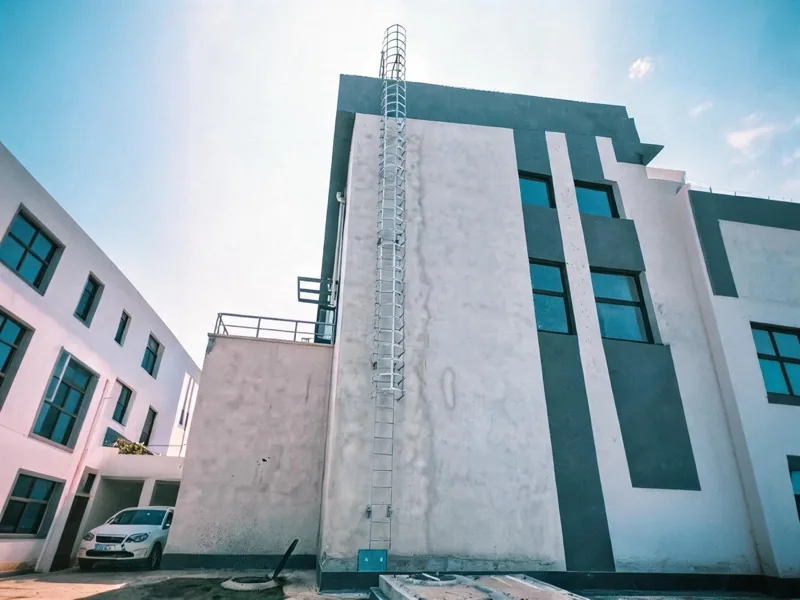
So, what is cat ladder roof access, exactly? A roof cat ladder is a plain vertical steel ladder, fixed to a wall or roof structure, that lets a worker climb onto a roof and back down the same way. No cage. No platform. Just rungs and side rails bolted in place for short, repeatable climbs.
We weld these most weeks at our 8,000 m² factory in Shijiazhuang, and the first question buyers send is almost always this one. This page gives the short definition, the parts, the standards, and where a cat ladder sits against other roof access options.
Definition: What Is Cat Ladder Roof Access?
A roof cat ladder is a fixed, near-vertical access ladder mounted to a building so people can reach a roof safely and leave the same route. In our workshop we cut the side rails from Q235B structural steel, or SS304/SS316 stainless when the site is coastal or gets washed down, then weld the rungs at a set pitch. The result is a load-rated path, not a leaned-up portable ladder.
The name is a clue. It is lean, light, and meant for a quick climb — the way a cat takes a wall. Under about 3 m it is often all a roof needs.
How It Differs from a Standard Roof Ladder
People mix up a cat ladder with a general roof ladder, but the difference matters when you order. A cat ladder is the simplest form: a bare vertical ladder for low heights. A fixed roof access ladder is the heavier daily-duty version, rated for repeat loads and longer runs.
Once a climb passes the height where fall protection is required, you step up again to a caged roof access ladder with hoops or a rail system. So the three are a ladder of their own: cat ladder for short climbs, fixed for daily use, caged for tall runs. Pick by height and the fall-protection rule on your site.
Key Components & Materials
Strip a roof cat ladder down and the parts list is short:
- Side rails (stiles) — Q235B steel flat bar; SS304 or SS316 for marine and washdown sites.
- Rungs — round or serrated bar at 300 mm pitch, anti-slip on every step.
- Mounting brackets — wall- or floor-fixed, sized for the calculated load.
On load, we proof-test a typical rung to a 1.5 kN point load and the assembly to its rated duty. Hot-dip galvanizing runs 70–85 µm by default, with powder coat over zinc when colour matters. Every batch is sample-pulled for weld strength before it leaves the floor. Spec sheets and ratings sit on the roof cat ladder product page.
Standards & Safety
A compliant roof cat ladder is built to a published code, not a guess. The common three:
- OSHA 1910.23 — North America. A cage or fall-arrest system is required once the climb passes about 24 ft (7.3 m).
- EN ISO 14122-4 — Europe. Sets rung spacing, clearances, and rail geometry.
- BS 4211 — the UK fixed-ladder standard for permanent access.
Where a landing is involved, walk-through handrails extend 1,070 mm above the opening for a safe transfer onto the deck. Tall job? It is no longer a cat ladder — move to cat ladders for roofs with a cage.
Typical Applications
Cat ladders for roofs turn up wherever someone needs a quick, reliable way up. Factories and warehouses use them to service HVAC and roof plant. Telecom and solar crews reach rooftop kit the same way. Property teams fit them for gutter and inspection access.
One example from our records: a manufacturing group in Southeast Asia ordered a batch of SS304 cat ladders for washdown areas of a new plant, supplied with material certificates and load-test reports per batch, and the line cleared its local safety audit on the first visit.
Why Choose a Factory-Direct Roof Cat Ladder
Buying direct from the factory cuts the trading-company markup and the guesswork. You talk to the engineers who weld it, not a middleman reading a catalogue. That is how we have shipped to 50+ countries since 2003.
Every order ships with the paperwork an inspector asks for: material certificates, weld reports, and load-test data. The factory holds ISO 9001:2015, and third-party inspection by SGS, TÜV, or Bureau Veritas is available on request. Buyers are welcome to audit the line in person.
Specifying a project? Send your roof height and standard, and our team returns a drawing, a load rating, and a factory-direct quote. Talk to our engineers or browse the roof access FAQ.