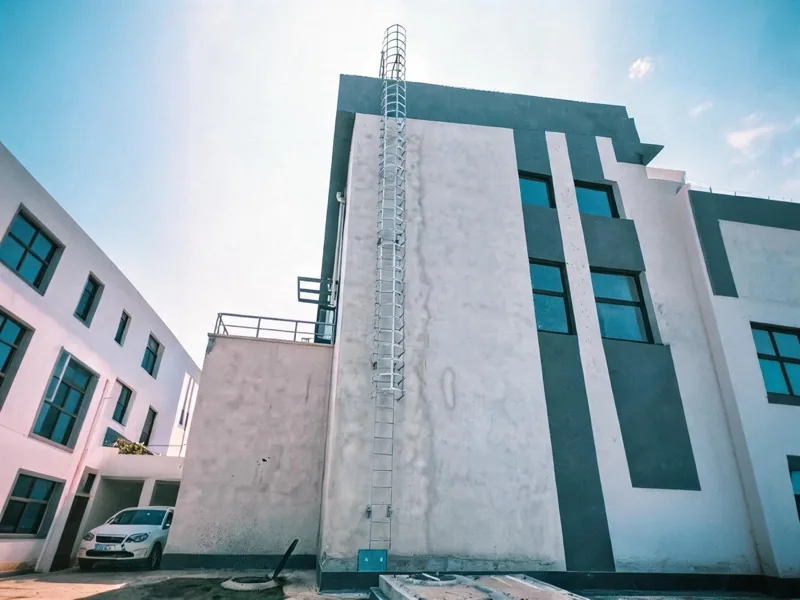
A roof ladder inspection is the cheapest insurance you will ever buy against a fall from height. Run it right and a worn rung or a cracked weld gets caught on the ground, not under load. This roof ladder inspection checklist is the exact sequence our quality team uses before a unit leaves the line, and the one we hand clients for in-service checks. We are a factory-direct steel ladder maker, ISO 9001:2015 certified since 2003, and every item below maps to OSHA 1910.23 or EN ISO 14122-4.
/images/home_qc_img_inspection.webpWork the list in order. Daily and weekly checks are visual and take minutes. The annual inspection is a competent-person job with tools. Keep a record of both, because an undocumented inspection counts as no inspection at all.
1. Daily / Weekly Checks
A site user can do these in under five minutes, no tools needed.
- [ ] Rungs clear of ice, mud, oil, and debris - [ ] No visible bends, cracks, or missing rungs - [ ] Anchor brackets sit tight against the wall, no daylight behind the plate - [ ] Safety hoop or cage undamaged, all bolts present - [ ] Anti-slip rung surface still biting, not worn smooth - [ ] No rust bleeding from welds or bolt heads
Anything that fails a daily check takes the ladder out of service until it is fixed. We tell crews to tag it, not climb it. A two-minute look beats a ten-metre drop.
2. Annual Inspection
This is the deep check. A competent person, a torque wrench, and a coating gauge.
- [ ] Torque-check every anchor bolt to the figure on the drawing (M12, not "by feel") - [ ] Measure the galvanizing thickness with a coating gauge; flag anything under 85 um - [ ] Load-check the top brackets — ours are designed to 6 kN, a 2:1 margin over the 3 kN minimum - [ ] Inspect every weld for hairline cracks, undercut, or porosity - [ ] Confirm rung spacing is still even, 250–300 mm centres - [ ] Check stainless units (SS304 / SS316) for pitting at ground welds; re-passivate if needed
In our factory we pull-test a sample from every batch to failure on our own rig before shipping, so the as-built load is on file. For UK installations, cross-check the in-service condition against BS 4211 as well.
3. OSHA Inspection Criteria
These are the hard numbers an inspector measures against. Carbon-steel ladders are Q235B; corrosive sites get SS304 or SS316.
| Criterion | Pass value | Standard | |---|---|---| | Rung spacing (centres) | 250–300 mm | EN ISO 14122-4 | | Clear ladder width | min 400 mm | EN ISO 14122-4 | | Standoff from wall (toe clearance) | min 150 mm | OSHA 1910.23 | | Single-anchor design load | 6 kN (3 kN min) | OSHA 1910.23 | | Cage / hoop start height | per local rule above climb height | OSHA 1910.23 | | Galvanizing thickness | min 85 um | EN ISO 1461 |
Read it as a gate, not a wish list. One failed line fails the ladder.
4. Documentation
An inspection you cannot prove did not happen. Keep these on file for every unit.
- Material certificates (Q235B, SS304, or SS316 mill certs) - Weld inspection reports - Load test data from the batch pull-test - Coating thickness readings - Dated inspection sheets, signed by the competent person
Every order we ship carries its material certificates, weld reports, and load test data. Third-party proof is available too — SGS or TÜV witnessed pull tests on request. Our ISO 9001:2015 system keeps the batch records traceable, and we export to 50+ countries.
5. Signs of Failure
Catch these early. The left column is what the inspector sees; the right column is what to do.
| Symptom | Likely cause | Action | |---|---|---| | Rust bleeding through coating | Galvanizing below 85 um or breached on site | Re-coat with zinc-rich paint; re-measure | | Hairline crack at a weld toe | Fatigue or undercut weld | Take out of service; re-weld and re-test | | Bracket loose, daylight behind plate | Under-torqued or pulled anchor | Re-torque or re-anchor; pull-test | | Bent or springy rung | Overload or impact | Replace the rung; check the load history | | Pitting on stainless welds | Lost passivation on SS304 / SS316 | Clean and re-passivate |
When two or more of these show up together, treat the whole ladder as suspect, not just the part you can see.
We are the factory, so there is no middleman between you and the people who built and tested the ladder. Material certificates, weld reports, and load test data come direct, and clients are welcome to audit the line in person.
For the full specification, load tables, and hoop options, see our [roof ladder hub](/roof-ladder/). New to the product? Start with [what a roof ladder is](/blog/roof-ladder-what-is/). Fitting a new unit? Our [installation guide](/blog/roof-ladder-install/) covers anchoring and the sign-off safety check. For a permanently mounted, pre-drilled unit, see our [Fixed Roof Access ladders](/products/fixed-roof-access-ladder/).