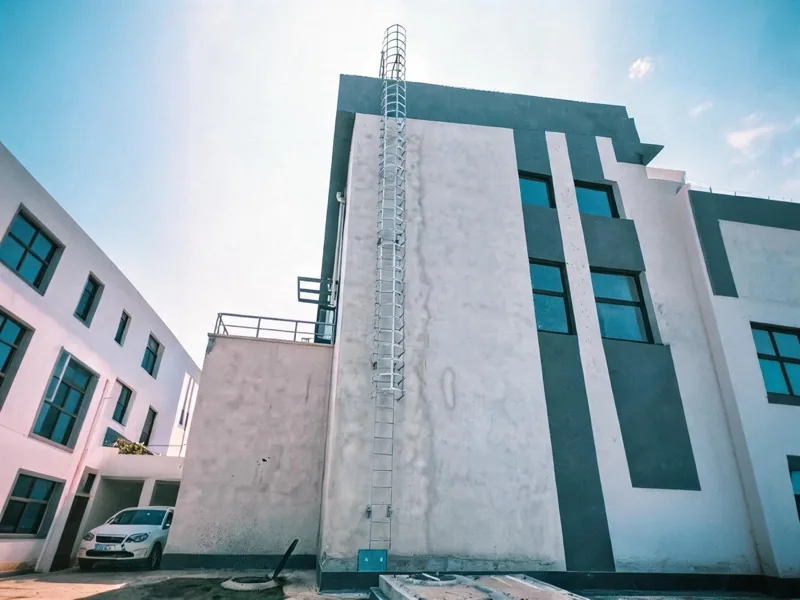
Roof ladder specifications are where a safe climb is won or lost. Get the steel grade, load rating, coating, and rung spacing right, and the ladder outlives the roof. Get them wrong, and you fail an audit. This sheet lays out the numbers we quote every week from our Shijiazhuang workshop, an ISO 9001:2015 plant that ships factory-direct to 50+ countries.
No trader markup, no guesswork. Every figure below comes off a real shop drawing, backed by material certificates, weld reports, and load test data.
1. Materials: Q235B, SS304, SS316
Three grades cover almost every order.
- Q235B carbon steel — the workhorse. Yield strength 235 MPa, hot-dip galvanized for outdoor roofs. Strong, affordable, and fine for most dry or sheltered climbs.
- SS304 stainless — for coastal sites, food plants, and washdown areas. It resists rust without a coating.
- SS316 stainless — adds molybdenum for chloride and marine exposure. Chemical plants and offshore decks specify it.
In our factory we cut Q235B for roughly 80% of roof ladder orders and reserve SS304 or SS316 for corrosive duty. Every batch is mill-certified, with the heat number kept traceable back to the coil.
2. Load Ratings (kN)
A fixed ladder is rated by the force a single rung and the stringers can take. The headline numbers:
- Each rung carries a 1.5 kN concentrated point load without permanent set, per EN ISO 14122-4.
- OSHA 1910.23 expects every rung, cleat, and step to support at least 250 lb (about 1.1 kN) as a single concentrated load.
- Stringers are sized so the stile assembly resists climbing and fall-arrest reactions with a safety margin.
We pull a sample from each production batch and run a tensile and rung-load test before the lot leaves the floor. Anything that misses spec gets scrapped, not shipped.
3. Coating: Hot-Dip Galvanizing (μm)
Coating thickness decides how long a carbon-steel ladder survives outdoors. We galvanize to EN ISO 1461.
- Standard hot-dip galvanizing: 70–85 μm average zinc coating, the band most roof ladders land in.
- Aggressive or coastal exposure: we lift the spec to 85–115 μm for longer service life.
- Powder-coat or duplex finishes are available over the zinc when colour or extra protection matters.
Coating thickness is checked with a magnetic gauge at several points, and the readings go into the QC log that travels with the order.
4. Rung Spacing and Dimensions (mm)
Geometry is where compliance is most often missed. The figures we build to:
- Rung spacing: 250–300 mm centre-to-centre, kept uniform top to bottom (EN ISO 14122-4).
- Clear width between stringers: 400–600 mm; 400 mm is the practical minimum for a comfortable climb.
- Rung diameter: typically 20–30 mm round or square bar with a slip-resistant surface.
- Toe clearance behind the rung: at least 150 mm so a boot sits fully on the rung.
- Safety cage, where the climb height triggers one: hoops at about 1500 mm vertical pitch.
Get the rung spacing uniform and the toe clearance right, and the rest of the design tends to fall into place.
5. Standard Compliance: OSHA 1910.23 and EN ISO 14122-4
Which standard applies depends on where the ladder ships.
- North America: OSHA 1910.23 plus ANSI A14.3 govern fixed-ladder geometry, cages, and fall protection.
- Europe and most export markets: EN ISO 14122-4 sets rung spacing, loads, and access dimensions; BS 4211 covers permanent ladders in the UK.
A short example. A food-processing client in Germany ordered 42 SS304 roof access ladders for a new line. They needed EN ISO 14122-4 sign-off and SGS-witnessed load tests. We supplied the full document pack — material certificates, weld maps, coating logs, and test reports — and the batch cleared the third-party audit on the first visit.
That is the point of nailing the roof ladder specifications before steel is cut: the paperwork has to match the part. We welcome factory audits, and material certificates, weld reports, and load-test data ship with every order.
Need these roof ladder specifications matched to your roof and local code? Send your drawings or rough dimensions and our engineers will spec the grade, load rating, coating, and rung layout — factory-direct, no middleman.