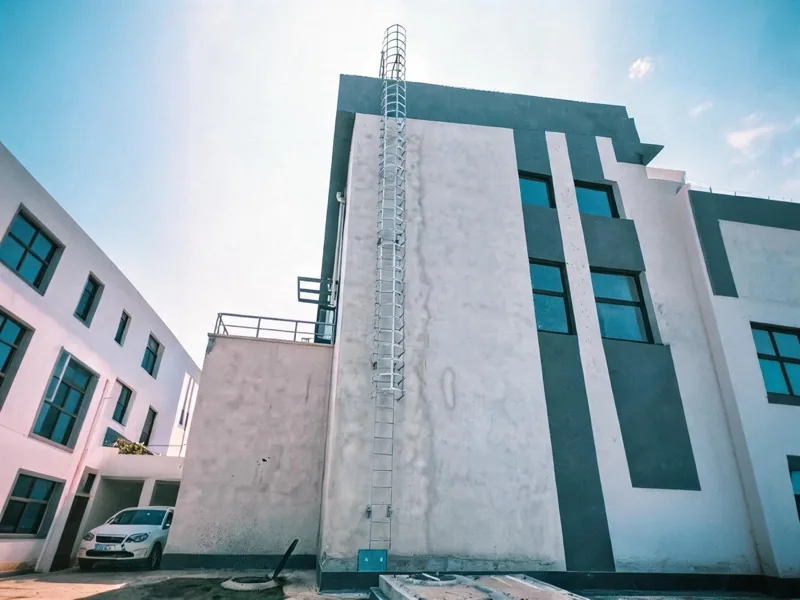
Roof ladder weight capacity is the maximum load a fixed roof ladder can carry safely — the climber, their tools, and the dynamic shock of the climb — without permanent deformation or failure. Get it wrong and the ladder either fails an audit or, worse, fails a person.
This page is the technical answer to the buyer question we hear most: how much weight can a roof ladder actually hold? We build these ladders at our 8,000 m² factory in Shijiazhuang, so the numbers below come from the standards we design to and the load tests we run on the floor — not a brochure. For the wider picture, start with the complete roof ladder guide.
Load Ratings: What the kN Numbers Mean
A load rating is a single concentrated force, stated in kilonewtons (kN), applied at the worst point on the ladder. One worker of average mass plus tools sits near 1.1 kN, which is why the major standards cluster their minimums right around that figure.
- OSHA 1910.23 — each rung must hold a single concentrated load of at least 250 lb (about 1.11 kN), applied at its centre.
- EN ISO 14122-4 — rungs are designed and proof-tested to a 1.5 kN vertical point load, with stringers checked for the combined climber-and-deflection case.
- BS 4211 — the UK standard for permanent access ladders, with comparable rung and stile loading plus cage and rest-platform rules.
| Standard | Min. rung load | Scope |
|---|---|---|
| OSHA 1910.23 | 250 lb / 1.11 kN | North America, fixed ladders |
| EN ISO 14122-4 | 1.5 kN | Europe, machinery access |
| BS 4211 | 1.5 kN | UK, permanent ladders |
In our workshop the rated capacity is set by rung material and pitch. Standard rungs are 20–25 mm Q235B bar at 300 mm pitch; SS304 or SS316 when the site is coastal or washed down daily. Our published working capacity per rung is proof-tested above the EN ISO 14122-4 minimum of 1.5 kN.
Safety Factor: Why Rated Load Is Not Breaking Load
The rated capacity is never the point where steel snaps. A safety factor sits between the two. ANSI A14.3 and the EN framework both build in a margin, so a ladder rated for daily use still keeps reserve strength against a missed inspection, a corroded weld, or two people on the climb at once.
Fixed steel ladder design typically targets a safety factor of at least 4 against ultimate load. A rung verified to a 1.5 kN working load is therefore engineered to survive well beyond that before it yields. At our factory we apply a design safety factor and record it on the load-test report that ships with the order.
Live Load vs Dead Load
Two loads act on every roof ladder, and the engineer sizes for both.
- Dead load — the permanent self-weight of the ladder, cage, and brackets. Constant and easy to predict.
- Live load — people, tools, and the dynamic shock of climbing or a fall arrest. Variable, and the figure the rung rating is built around.
The dynamic part is the catch. A static 1.1 kN climber can briefly impose much more through a stumble or a hard step, so we size brackets and welds for the live load with the safety factor stacked on top. Dead load barely moves the calculation; live load decides it.
How We Test Weight Capacity in the Factory
A rating only means something once it is verified. Here is the sequence on our floor:
- Cut and weld a sample from the same Q235B or SS304 batch as the production run.
- Apply the rated point load to a single rung with a calibrated hydraulic ram, then hold and check for permanent set.
- Hot-dip galvanize to 70–85 µm, or powder coat over zinc, and log the coating thickness.
- Pull-test welds on a sample from every batch and record the result.
The output is a load-test report, a material certificate, and a weld report — the exact paperwork an inspector or a third party such as SGS or Bureau Veritas will ask to see. The factory holds ISO 9001:2015, and we have shipped verified ladders to 50+ countries since 2003.
What Weight Capacity Do You Need?
One worker, light maintenance? A standard rung rating to OSHA 1910.23 or EN ISO 14122-4 covers it with room to spare.
Two climbers or heavy tooling? Tell us the higher live load up front so we size rungs, brackets, and welds for it rather than the single-person minimum.
A tall climb over ~7.3 m? OSHA 1910.23 pushes you toward a cage or a fall-arrest system — see our caged ladders. For the standards and components behind these thresholds, the roof ladder standards guide walks through each one.
Still unsure which rating your roof needs? Send us the height, the governing standard, and how the ladder will be used. Our engineers return a drawing, a load rating, and a factory-direct quote with no middleman markup. Talk to our engineers, check the load-rating FAQ, or arrange a factory audit — buyers are welcome on site.