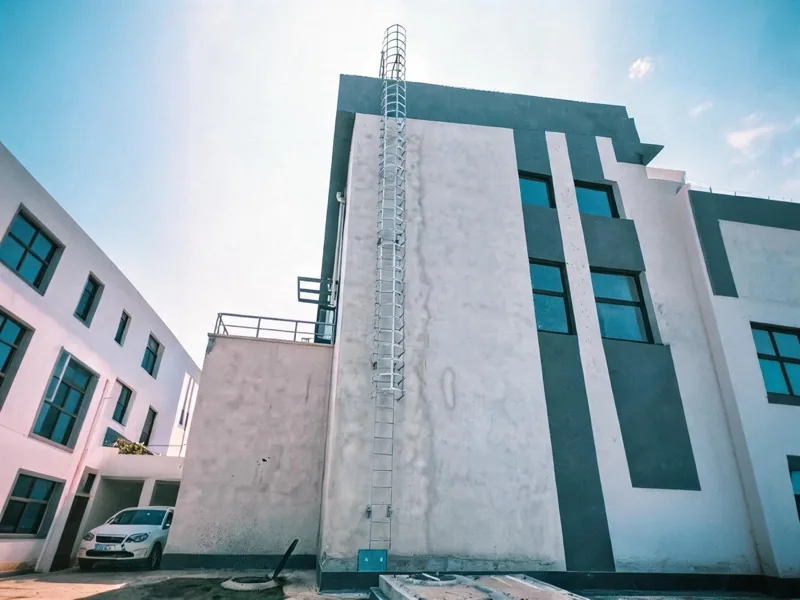
Fixed ladder maintenance is what keeps a vertical access ladder safe for the 20-plus years it stays bolted to a wall, tank, or silo. We build these ladders at our 8,000 m² Shijiazhuang plant, ISO 9001:2015 certified since 2003, and ship them to 50+ countries. The routine below is the same fixed ladder inspection our QC engineers run on every batch before galvanizing. We rewrote it as an on-site fixed ladder maintenance checklist you can actually follow. Every step maps to OSHA 1910.23 and EN ISO 14122-4, so a maintained ladder still meets the standard it was built to.
/images/product_fixed-steel-ladders_specs_steel_detail.webpMaintenance Frequency: Set It by Exposure
Do not run fixed ladder maintenance on the calendar alone. A ladder on a coastal chemical plant corrodes faster than one in a dry inland warehouse, so it earns a tighter cycle.
| Check | Inland / dry site | Coastal / chemical site | Reference | |---|---|---|---| | Routine visual check | Every 6 months | Every 3 months | EN ISO 14122-4 | | Cleaning & corrosion treatment | Every 6 months | Quarterly | — | | Coating / galvanizing inspection | Annual | Every 6 months | coating spec | | Hardware & weld inspection | Annual | Every 6 months | OSHA 1910.23 | | Load & safety-cage check | Every 2 years | Annual | EN ISO 14122-4 |
Print the six checks below and tick them off on site. This is the ladder maintenance checklist our own line uses.
1. Routine Visual Checks
Start every fixed ladder inspection with a slow walk-down, top to bottom. Look, do not just glance.
- [ ] Rungs: none bent, cracked, or loose at the weld - [ ] Stiles: no buckling, no fresh rust bloom on the Q235B steel - [ ] Clear width holds at 400 mm; rung spacing stays 250–300 mm per EN ISO 14122-4 - [ ] Wall standoff: 150 mm minimum clearance behind each rung - [ ] Cage hoops and fixings: square, tight, no missing bolts
An uneven rung is a trip point, and inspectors flag it fast. In our factory the same walk-down runs on every batch before galvanizing. A trained eye takes about five minutes per ladder.
2. Cleaning & Corrosion Treatment
Dirt is not cosmetic. Leaf litter, bird mess, and salt film trap moisture against the steel and start corrosion right at the rung-to-stile welds.
Use a soft brush, fresh water, and a mild detergent. Skip acidic cleaners on galvanized steel; they strip the zinc you want to keep. For SS304 or SS316 ladders, wipe salt deposits off early to stop tea-staining before it sets. Rinse, dry, then re-check the coating underneath.
3. Coating / Galvanizing Inspection
Our standard finish is hot-dip galvanizing at 85–140 μm, applied after fabrication so every cut edge and drilled hole stays sealed.
Check for white rust, scratches down to bare steel, and edge wear. Where the zinc is broken to raw metal, brush zinc-rich paint over the spot the same day. A coating-thickness gauge reading below about 85 μm across a wide area means schedule a re-coat, not a touch-up. Compare any field reading to the as-built coating report that shipped with the ladder.
/images/product_fixed-steel-ladders_gallery02_parts.webp4. Hardware & Weld Inspection
OSHA 1910.23 expects each anchor to carry a defined point load, and a loose bracket throws that out.
Torque-check every anchor bolt with a calibrated wrench. We use M12 bolts in stainless or hot-dip galvanized; replace any with thread corrosion rather than re-torquing. Then read the welds. Surface rust on a weld is cosmetic. A crack across the weld toe is not — flag it for repair.
On our line, every batch gets a sampled tensile test on the rung-to-stile weld before it ships. The as-built weld data stays on file for you to check against.
/images/home_qc_img_inspection.webp5. Load & Safety-Cage Check
This is where the fixed ladder inspection requirements get specific. OSHA 1910.23 sets a 113 kg (250 lb) minimum design load per rung and governs cage and rest-platform spacing. EN ISO 14122-4 covers the same ground for European sites.
- [ ] Each rung holds its rated point load with no permanent set - [ ] Safety cage starts at the right height and stays square - [ ] Rest platforms sit within the standard's maximum climb interval - [ ] Anchor pull-test on the top fixings shows no movement
If the ladder runs above the height that triggers fall-protection, confirm the cage or a fall-arrest rail still meets spec. When in doubt, send us the original load-test data and we will read it with you.
6. When to Repair vs Replace
Repair the small stuff. Replace the ladder when the structure is the problem.
**Repair** is fine for: minor coating chips, surface rust, a single loose bolt, a re-torque.
**Replace** — do not patch — when:
- A stile has lost wall thickness to pitting and drops below its rated section - A rung is cracked or bent (a bent rung is not a paint job) - A weld shows a crack, not just surface rust - Coating loss is widespread and the bare steel is already pitting
Q235B with heavy pitting loses load capacity you cannot read off the surface. Photograph it, pull the original load-test sheet, and ask before you climb.
Field note
We keep the build records for every order, so any ladder we shipped can be checked against its original certificates years later. No middleman handles your paperwork — material certificates, weld reports, and load-test data come straight from the factory. Clients are welcome to audit the line in person.
For full load tables, cage options, and the complete fixed ladder specification, see our [fixed ladder guide](/blog/fixed-ladder-what-is/). Pair this schedule with the [OSHA 1910.23 fixed ladder requirements](/blog/osha-fixed-ladder-requirements/) for the full compliance picture.
Need a unit built to maintain easily? See our [vertical fixed access ladder](/products/vertical-fixed-access-ladder/), [caged roof access ladder](/products/caged-roof-access-ladder/), or book our [fixed ladder inspection & service](/products/inspection-service-fixed-ladder/).