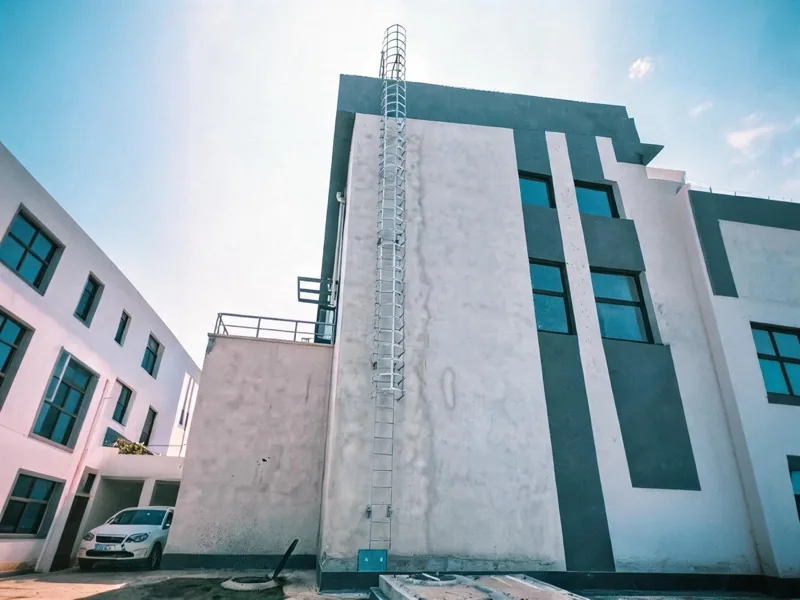
Cage ladder maintenance is the difference between a safety cage that guards a climber for 20 years and one that quietly rusts into a liability. We weld these caged ladders at our 8,000 m2 plant in Shijiazhuang, ISO 9001:2015 certified since 2003, and ship them to 50+ countries. The routine below is the same cage ladder inspection our QC engineers run on every batch before galvanizing. We rewrote it as a field schedule a site crew can actually follow. Every check ties back to OSHA 1910.23 and EN ISO 14122-4, so a maintained ladder still meets the standard it shipped under.
/images/product_caged-ladders_features_tank_project.webpWhy Cage Ladder Maintenance Matters
A plain fixed ladder has welds at the rungs. A cage ladder adds dozens more: hoop-to-rail joints, vertical guard bars, and the carrier brackets that tie the cage to the structure. Every extra joint is one more place corrosion and fatigue can start. That is why cage ladder maintenance is its own job, not a footnote to general metal ladder maintenance.
Three things fail on a neglected cage, and they fail in this order.
- **Corrosion** creeps into the hoop-to-rail welds first, where water sits after rain. - **Fastener fatigue** loosens the carrier brackets as the cage flexes under climbers, wind, and thermal cycling. - **Fall-protection integrity** is lost last and worst: a hoop that has rusted thin no longer arrests a slip the way EN ISO 14122-4 assumes it will.
In our shop we treat the cage as the part most likely to be ignored on site and most expensive to fix wrong. Good safety ladder maintenance starts by taking the cage as seriously as the rungs.
Routine Maintenance Schedule
Do not run cage ladder maintenance on the calendar alone. A ladder on a coastal chemical plant corrodes faster than one in a dry inland warehouse, so it earns a tighter cycle. Set the interval by exposure, then hold to it.
| Check | Inland / dry site | Coastal / chemical site | Reference | |---|---|---|---| | Routine visual + cage walk-down | Every 6 months | Every 3 months | EN ISO 14122-4 | | Cleaning & corrosion treatment | Every 6 months | Quarterly | - | | Coating / galvanizing inspection | Annual | Every 6 months | coating spec | | Fasteners, welds & cage-hoop check | Annual | Every 6 months | OSHA 1910.23 | | Load & full cage integrity test | Every 2 years | Annual | EN ISO 14122-4 |
Print this and use it as your ladder maintenance checklist on site. Tick each row, date it, and file it. The records are what turn routine access ladder maintenance into a defensible audit trail.
/images/product_caged-ladders_specs_components.webpCorrosion & Coating Care
Coating is the first line of defence, and on a cage there is a lot of it to watch. Our standard finish is hot-dip galvanizing at 85-140 um, applied after fabrication so every cut edge, drilled hole, and hoop weld stays sealed. Some clients spec a powder topcoat over the zinc for colour or extra build.
Walk the cage and look for three things: white rust, scratches down to bare steel, and edge wear on the hoops where ladders get knocked by loads. Where the zinc is broken to raw metal, brush zinc-rich paint over the spot the same day. A coating-thickness gauge reading below about 85 um across a wide area means schedule a re-coat, not a touch-up. Compare any field reading to the as-built coating report that shipped with the ladder.
For SS304 or SS316 cages, the rules change. Stainless does not need galvanizing, but it tea-stains in salt air. Wipe deposits off early with fresh water and a soft cloth before staining sets into the grain. Skip acidic cleaners on galvanized steel completely; they strip the zinc you are trying to protect. This is the part of metal ladder maintenance crews most often get backwards.
Fasteners, Welds & Cage-Hoop Integrity
This is the heart of cage ladder maintenance, and it is where a generic ladder maintenance checklist stops being enough.
Start with the fasteners. Torque-check every carrier bracket and hoop bolt with a calibrated wrench. We use M12 bolts in stainless or hot-dip galvanized. Replace any bolt with thread corrosion rather than re-torquing it, because a corroded thread reads tight and holds nothing. A loose bracket lets the whole cage rack sideways, and that motion fatigues the next bolt along.
Then read the welds and hoops.
- [ ] Hoop-to-rail welds: no cracks across the weld toe (surface rust on a weld is cosmetic; a crack is not) - [ ] Vertical guard bars: straight, evenly spaced, none sprung loose - [ ] Hoop spacing holds the design pitch; clear climbing envelope stays within EN ISO 14122-4 - [ ] Carrier brackets pull tight to the wall with no movement on a hand test - [ ] Q235B rails show no buckling or deep pitting behind the cage
OSHA 1910.23 sets a 113 kg (250 lb) minimum design load per rung, and the cage must keep its protective geometry under load. On our line every batch gets a sampled tensile test on the rung-to-stile weld before it ships, and the as-built weld data stays on file for you to check against years later.
/images/home_qc_img_inspection.webpInspection Records & Documentation
A maintained cage you cannot prove is maintained will still fail an audit. Every cage ladder inspection should produce a dated record: who checked it, what they found, what they fixed, and the coating and torque readings they took.
Keep these on file alongside the documents that shipped with the ladder:
- Material certificates for the Q235B, SS304, or SS316 stock - Weld reports and the sampled tensile-test data - The original load-test sheet and as-built coating report - Any third-party certificates from SGS, TUV, or Bureau Veritas
We keep the build records for every order, so a ladder we shipped can be matched to its original certificates long after install. That is the quiet advantage of buying factory-direct: no middleman sits between you and the paperwork. Material certificates, weld reports, and load-test data come straight from the line, and clients are welcome to audit the factory in person.
When to Repair vs Replace
Repair the small stuff. Replace the cage, or the ladder, when the structure itself is the problem.
**Repair** is fine for: minor coating chips, surface rust on a weld, a single loose bolt, a sprung guard bar you can re-seat, a re-torque.
**Replace** - do not patch - when:
- A hoop has rusted thin or cracked through; it no longer arrests a fall - A rail has lost wall thickness to pitting and drops below its rated section - A weld shows a crack across the toe, not just surface rust - Carrier brackets are corroded at the anchor and the cage moves under load - Coating loss is widespread and the bare Q235B is already pitting
Heavy pitting strips load capacity you cannot read off the surface. Photograph it, pull the original load-test sheet, and ask before anyone climbs.
Field note
For the full picture, read [what a cage ladder is](/blog/cage-ladder-what-is/) before you set a schedule, pair this routine with the [cage ladder inspection checklist](/blog/cage-ladder-inspection/), and if you are fitting a new unit see [how to install a cage ladder](/blog/cage-ladder-install/) so it is built to maintain easily.
Need a cage built for a long, low-maintenance life? See our [caged fixed access ladder](/products/caged-fixed-access-ladder/), our bolt-on [ladder safety cage system](/products/ladder-safety-cage-system/), or a [roof access ladder with cage](/products/roof-access-ladder-with-cage/) - all welded to Q235B or stainless spec and shipped with full documentation.