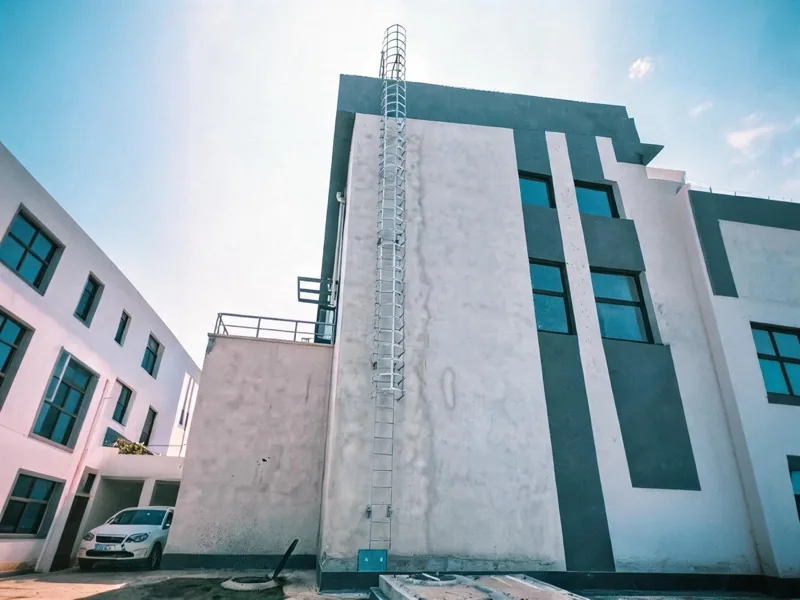
A custom roof ladder starts where the catalogue stops. When the climb height is odd, the load rating is unusual, or the roof edge sits at an awkward angle, a stock ladder will not fit — and forcing it through is how an access point fails inspection. This guide walks the path we take on the factory floor, from the first shop drawing to the crate on the truck, told through the kind of jobs that land on our benches.
We are Dengtai, a factory-direct steel ladder manufacturer. Every roof ladder we build to spec follows the same engineering route, whether it is one unit or a hundred. Here is how a custom roof ladder comes together.
1. Why Go Custom (And When a Stock Ladder Won't Do)
Most roofs do not match a catalogue drawing. Here is when we tell a client to stop forcing a stock unit and order to spec.
- Non-standard height. A fixed climb past the height trigger in OSHA 1910.23 needs a cage or a fall-arrest line. Stock kits rarely land on your exact rise, so the cage hoop spacing ends up wrong.
- Unusual load rating. If your spec calls for a rung load above the standard rating in kN — say, for crews carrying tools — the stringer gauge and rung diameter change.
- Tight or angled access. Parapet offsets, walkway transitions, and roof hatches all shift the geometry. A custom roof ladder is built around the obstruction, not in spite of it.
- Mixed standards. A plant exporting equipment may need one ladder to satisfy OSHA 1910.23 and EN ISO 14122-4 at once. We design to the stricter of the two.
In our shop the rule is simple: if the drawing does not match the roof, the roof wins. We redraw.
2. The Design Process: How We Engineer Yours
Every custom roof ladder runs the same five steps. None of them get skipped.
- Site data in. We need total climb height (mm), required rung load (kN), the standard you answer to, material grade, and quantity. A photo or sketch of the mounting point saves a round trip.
- Shop drawing out. Our engineers return a stamped drawing — rung pitch, stringer section, cage hoop spacing, and a fixings schedule. You approve it before any steel is cut.
- Fabrication. We cut, drill, and weld to the approved drawing. Welds are done by coded welders, and each batch gets a weld report.
- Testing. Every batch is sampled for a tensile test on the steel lot, and load-critical welds are checked. Third-party verification through SGS, TÜV, or Bureau Veritas is available on request.
- Finish and ship. Hot-dip galvanizing at 70–85 µm for outdoor steel, or a duplex system for coastal air. We often ship knock-down to save container space; your crew bolts it up from our drawings.
The plant is ISO 9001:2015 certified, so each step leaves a paper trail. You get material certificates, weld reports, and load-test data with the order — not after you ask.
3. Material Choices: Q235B, SS304, or SS316
Material is the first thing we lock down, because it drives both price and lifespan. Three grades cover almost every custom roof ladder we ship.
| Grade | Best for | Notes |
|---|---|---|
| Q235B carbon steel | Inland industrial roofs | Hot-dip galvanized at 70–85 µm. The budget baseline. |
| SS304 stainless | Food, pharma, humid sites | Shrugs off washdown chemicals and condensation. |
| SS316 marine-grade | Coastal and chemical exposure | Holds up to salt air where carbon steel would pit. |
Configuration matters as much as the grade. A fixed roof access ladder is the workhorse for straight climbs. Above the OSHA 1910.23 height trigger we move to a caged roof access ladder built to EN ISO 14122-4. For a low-profile pitched-roof climb, a roof cat ladder sits flat against the slope. Where access comes up through the roof itself, we match the climb to a roof hatch ladder opening.
4. Example Projects (Anonymized)
Specs make more sense next to real jobs. The cases below are anonymized, and the figures need a final check against our records before publishing.
Food processing, Northern Europe. The brief was a washdown-rated climb in SS304, caged to EN ISO 14122-4, for a line of roof access points. We ran batch tensile tests on each steel lot and shipped weld reports per unit, and the lot cleared the client's audit on the first pass.
Water treatment, Australia. The site needed caged roof access ladders in SS304 across a cluster of tank farms. Knock-down shipping kept the freight down, and local crews assembled the units from our stamped drawings.
Logistics warehouse, Middle East. This was a galvanized Q235B run with a non-standard rise to clear a parapet. The cage hoop spacing was redrawn twice before the client signed off.
We export to 50+ countries and welcome factory audits — come see the welding bay before you commit.
5. Lead Time and Pricing
Two questions land in every enquiry: how long, and how much.
- Lead time. Custom drawing turnaround is usually. Fabrication after drawing approval runs, plus galvanizing and freight.
- Pricing. Material grade is the biggest line item, then height, cage, and finish. Ex-works pricing lands at. As the manufacturer we quote with no middleman markup — you pay mill and fabrication cost, not a reseller's margin.
To get a same-day ex-works quote, send five things: climb height (mm), rung load (kN), the standard (OSHA 1910.23, EN ISO 14122-4, or BS 4211), material grade, and quantity. Want the full picture first? Start with our complete roof ladder guide.
Custom Roof Ladder FAQs
What information do you need to quote a custom roof ladder?
Five things: total climb height in mm, required rung load in kN, the standard you answer to, material grade (Q235B, SS304, or SS316), and quantity. A photo of the mounting point helps.
Can a custom roof ladder meet both OSHA and EN ISO standards?
Yes. When a ladder must satisfy OSHA 1910.23 and EN ISO 14122-4 together, we design to the stricter requirement of the two and document the compliance.
Which material should I choose for a custom roof ladder?
Q235B galvanized for inland roofs, SS304 for food, pharma, or humid sites, and SS316 for coastal or chemical exposure. We will recommend a grade from your site conditions.
Do custom ladders include test documentation?
Yes. Every order ships with material certificates, weld reports, and load-test data. Third-party testing through SGS, TÜV, or Bureau Veritas is available on request.