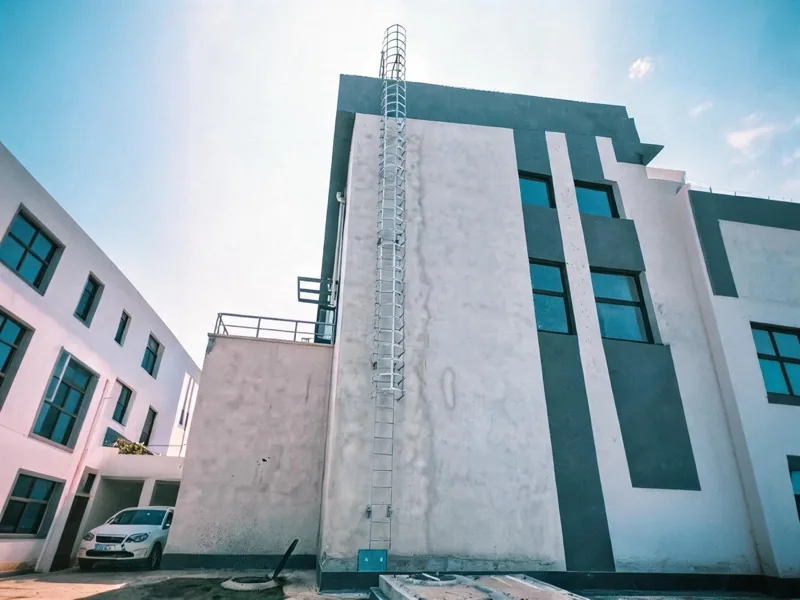
A custom fixed ladder design begins where the standard catalogue ends. When the climb runs too tall, the bay sits too narrow, or the air turns corrosive, a stock unit stops fitting. This guide is built around one real job, then the engineering route we run for every bespoke order.
We are Dengtai, a factory-direct steel ladder maker in Shijiazhuang. We have built to spec since 2003, and we export to 50+ countries. Here is how we turn a tricky access point into a finished ladder.
1. When You Need a Custom Fixed Ladder Design
Most sites do not match a drawing in a catalogue. Here is when we tell a buyer to order to spec instead of forcing a stock ladder.
- Non-standard height. A fixed climb above the trigger in OSHA 1910.23 needs a cage or a fall-arrest line. Stock kits rarely hit your exact rise, so the geometry drifts.
- Restricted or angled access. Parapets, walkways, and tight bays shift the layout. We build around the obstruction, not against it.
- Special load rating. If your rung load runs above the usual rating in kN, the stringer gauge and rung diameter both change.
- Corrosive environment. Coastal salt air or washdown chemicals push the choice from Q235B toward SS304 or SS316.
In our factory, we usually redraw rather than compromise. If the drawing fights the site, the site wins.
2. Case Study: Facility,
Specs read better next to a real job. The case below is anonymized, and every figure is checked against our records before it ships.
plant. The client needed caged climbs to reach a row of process tanks. Total rise was mm per unit, with a rung load rated at kN. We specified SS304 for the washdown zone and hot-dip galvanized Q235B at 70–85 µm for the dry runs.
/images/product_fixed-steel-ladders_features_factory_scene.webp
Every steel lot was sampled for a tensile test, and load-critical welds were checked. The batch shipped with weld reports per unit. We build this kind of run for clients in 50+ countries.
3. Our Custom Design Process — Site Survey to Install
Every custom fixed ladder design runs the same route. We skip no step.
- Site survey in. We need total climb height (mm), rung load (kN), the standard you answer to, material grade, and quantity. A photo of the mounting point saves a trip.
- Material call. In our factory, we usually pick Q235B galvanized for inland plants, SS304 for food and humid sites, and SS316 for coastal or chemical air. The grade drives both price and lifespan.
- Shop drawing out. Our engineers return a stamped drawing — rung pitch, stringer section, cage spacing, and a fixings schedule. You sign it before we cut steel.
- Fabrication. Coded welders weld to the approved drawing. Each batch carries a weld report.
- Testing. We sample every batch for a tensile test on the steel lot. Load-critical welds are checked too.
- Finish and ship. Hot-dip galvanizing lands at 70–85 µm; a duplex coat suits coastal air. We often ship knock-down to save container space.
The plant is ISO 9001:2015 certified, so each step leaves a paper trail.
4. Standards That Shape a Custom Design
A bespoke ladder still answers to the same rules as a stock one. We design to whichever standard governs your site, and to the stricter one when two apply.
- OSHA 1910.23 (United States). Above the height trigger, you choose a cage or a personal fall-arrest system. We help weigh the two. See our OSHA 1910.23 requirements breakdown.
- EN ISO 14122-4 (Europe). Sets rung pitch, clearances, and cage geometry for permanently fixed ladders. Read the EN ISO 14122-4 guide.
- BS 4211 (United Kingdom). Covers permanently fixed ladders on buildings, including landing and hoop spacing.
Cage versus fall-arrest. Cages cost less up front. A fall-arrest line costs more but climbs faster and suits tall runs. We size the choice to your height and budget.
Every order ships with material certificates, weld reports, and load-test data — not after you ask. Third-party checks through SGS, TÜV, or Bureau Veritas are available on request. New to the topic? Start with our fixed ladder guide.
5. Common Customizations We Deliver
Most briefs land in a handful of patterns. Here are the ones our benches see most.
- Mezzanine and platform access. A custom access ladder for a mezzanine often pairs with a short walkway run and a platform offset.
- Caged tall climbs. A custom safety ladder with an integrated cage suits exposed runs above the OSHA trigger.
- Marine builds. A custom vertical ladder in SS316 holds up where salt air would pit carbon steel. See the vertical fixed access ladder.
- Inspection and service runs. A custom inspection ladder for a gantry needs tight clearances; the inspection / service fixed ladder is the base.
- Wall-fixed climbs. A custom wall mounted ladder frees up floor space; start from the wall mounted fixed ladder.
- Heavy coatings. A custom industrial ladder in a chemical plant may need a film past 85 µm. We spec the coating thickness to the exposure.
- Fall-protection retrofits. We add rails and lines to match the fixed ladder safety system.
6. Why Buy a Custom Design Factory-Direct
Two things decide a custom order: who builds it, and who stands behind it.
- No middleman. We are the manufacturer. You pay mill and fabrication cost, not a reseller's margin.
- Certified process. The plant holds ISO 9001:2015. Third-party testing runs through SGS, TÜV, or Bureau Veritas.
- Proven reach. We export to 50+ countries and have built to spec since 2003.
- Open doors. We welcome factory audits. Come see the welding bay before you commit.
Send five things for a same-day ex-works quote: climb height (mm), rung load (kN), the standard (OSHA 1910.23, EN ISO 14122-4, or BS 4211), material grade, and quantity.
Custom Fixed Ladder FAQs
What do you need to quote a bespoke fixed ladder?
Five things: total climb height in mm, rung load in kN, the standard you answer to, material grade (Q235B, SS304, or SS316), and quantity. A photo of the mounting point helps.
Can one custom ladder meet OSHA and EN ISO at once?
Yes. When a ladder must satisfy OSHA 1910.23 and EN ISO 14122-4 together, we build to the stricter rule and document it.
Which material suits my site?
Q235B galvanized for inland plants, SS304 for food and humid sites, SS316 for coastal or chemical air. We recommend a grade from your conditions.
Do custom ladders ship with test paperwork?
Yes. Every order includes material certificates, weld reports, and load-test data. Third-party testing through SGS, TÜV, or Bureau Veritas is available on request.