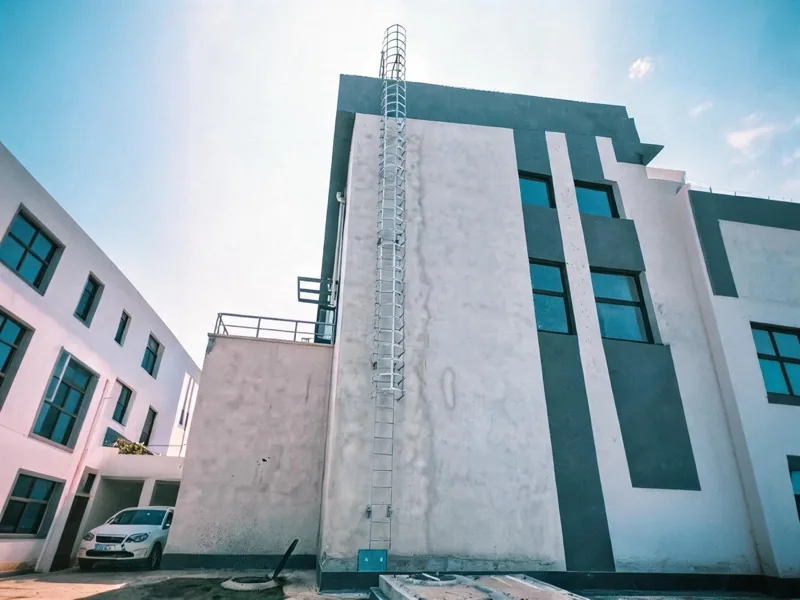
Do I need a roof ladder? If anyone climbs onto your roof more than a couple of times a year — to service HVAC units, clean gutters, inspect a membrane, or reach plant — the honest answer is usually yes. A fixed roof ladder turns a risky, improvised climb into a load-rated, code-compliant route.
This is a decision guide, not a sales pitch. We weld roof access ladders every week at our 8,000 m² factory in Shijiazhuang, and the same five questions settle almost every order. Work through them below and you will know whether you need a roof ladder, what standard it has to meet, and roughly what it should cost.
When Is a Roof Ladder Required?
Start with frequency and height. A one-off climb to a low single-storey roof can sometimes be handled with a portable ladder and a spotter. Repeat access changes the maths fast.
Three questions decide it:
- How often? Monthly or more, and a permanent ladder pays for itself in saved setup time and lower risk.
- How high? Above roughly 3 m a leaning portable ladder gets unstable, and a fall turns serious.
- Who climbs? If contractors, inspectors, or insurers use the access, they expect a fixed ladder built to a named standard.
In our workshop we see the same pattern: the trigger is rarely one dramatic factor. It is the quiet repetition — the maintenance crew making the same awkward climb twice a month. Once that pattern is clear, a fixed ladder stops being optional. If you are still deciding which type fits, our cornerstone guide on what a roof ladder is compares each configuration.
Building Code Triggers
Codes turn judgement into a hard requirement. Three standards cover most of the projects we ship.
- OSHA 1910.23 (United States) — governs fixed ladders. Past about 24 ft (7.3 m) of climb the rule requires a cage or a personal fall-arrest system, and ladders must support a 250 lbf concentrated load.
- EN ISO 14122-4 (Europe) — sets rung spacing, side-rail strength, and the 1,070 mm walk-through extension at the landing.
- BS 4211 (United Kingdom) — covers permanently fixed ladders, safety hoops, and rest platforms.
If your roof carries fixed plant, your local building code almost certainly mandates a compliant route to reach it. The wording varies by jurisdiction; the intent does not. Planned, repeatable access beats an improvised climb. We cut the side rails from Q235B structural steel, switch to SS304 or SS316 for coastal and washdown sites, and hot-dip galvanize to 70–85 µm so the ladder still meets spec after years outdoors.
Alternative Access: Is There a Better Option?
A fixed ladder is not the only way up. Before you commit, weigh the alternatives honestly.
- Cat ladder — the simplest fixed option for short vertical climbs under 3 m. Low cost, quick install.
- Roof hatch ladder — best when access comes from inside the building, landing safely at a hatch with walk-through handrails.
- Fixed roof access ladder — the daily-use workhorse for repeat maintenance.
- Caged ladder — once the climb passes the OSHA cage threshold, or for tanks and silos.
- Mobile platform (MEWP) or scaffold — sensible for a one-off job, but rental and setup costs stack up fast on a roof you visit monthly.
The rule of thumb we give buyers: rent for a single visit, build for a routine. If the roof sits on your maintenance schedule, a fixed ladder almost always wins on cost and safety across twelve months. The full product range lists load ratings side by side.
Cost vs Benefit: Running the Numbers
This is where the decision usually settles. A fixed steel roof ladder is a modest one-time cost set against years of repeat access.
One example from our order book: a beverage manufacturer in Southeast Asia had been renting a boom lift each month to service rooftop chillers. Over a year that rental ran to several times the price of a permanent caged ladder. They ordered SS304 caged ladders from us, with material certificates and per-batch load-test reports, and recovered the cost inside the first year — while passing their site safety audit on the first visit.
When you compare, count the full picture: rental and labour for temporary access, downtime, and the liability of an unguarded climb. Against that, a fixed ladder is proof-tested to a 1.5 kN point load on the rungs and rated for daily duty. The numbers tend to favour building, not renting, the moment access becomes routine. For a detailed breakdown, see our guide on how much a roof ladder costs.
Expert Advice: What Our Engineers Tell Buyers
Three things we say on almost every enquiry:
- Specify the standard first. Tell us OSHA 1910.23, EN ISO 14122-4, or BS 4211 up front. It drives geometry, cage requirements, and price — and it keeps your auditor satisfied.
- Ask for the paperwork. Every order should ship with material certificates, weld reports, and load-test data. If a supplier cannot produce them, walk away.
- Buy factory-direct. Talking to the engineers who weld the ladder, with no middleman, means the load rating and drawing are right before any steel is cut.
We have shipped roof access to 50+ countries since 2003, the factory holds ISO 9001:2015, and independent inspection by SGS or Bureau Veritas is available on request. Buyers are welcome to audit the workshop in person.
Still unsure whether you need a roof ladder? Send your roof height and the code you work to. Our team returns a drawing, a load rating, and a factory-direct quote. Talk to our engineers or browse the roof ladder FAQ.