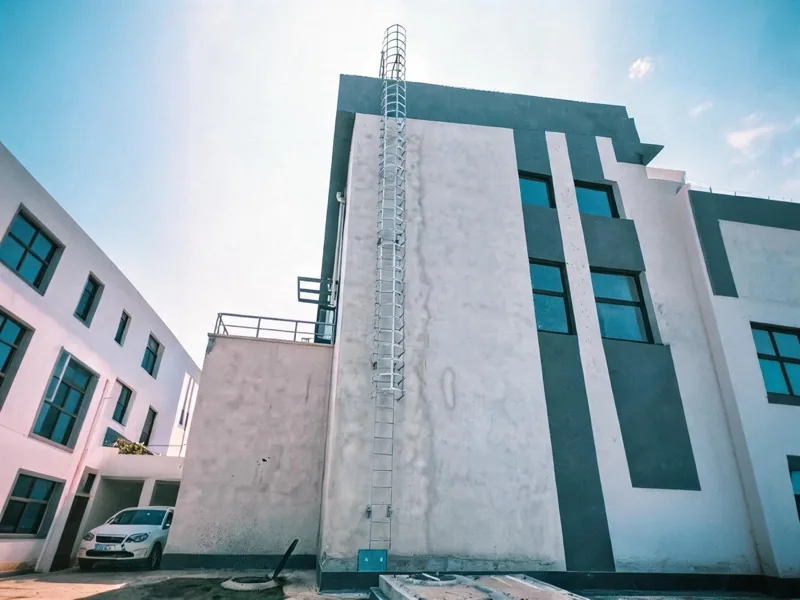
Weighing up fixed ladder alternatives? A standard fixed ladder — what OSHA calls a vertical ladder — is the default for industrial access. It is rarely the only safe option. This guide compares the practical vertical ladder alternatives the way we size them on the factory floor: ship ladders, alternating tread stairs, caged ladders, and full industrial stairs. For the fundamentals, see our fixed ladder guide.
The right pick comes down to three things. How high is the climb? How often is it used? Which code governs the site — OSHA 1910.23, EN ISO 14122-4, or BS 4211? Answer those three and the shortlist gets short fast.
1. Why Look Beyond a Standard Fixed Ladder
Three pressures push buyers toward fixed ladder alternatives. The first is fall risk. A vertical climb above roughly 7.3 m triggers OSHA 1910.23 fall-protection rules, and the old safety-cage allowance is giving way to ladder safety systems. The second is ergonomics — nobody carrying tools should be on a vertical ladder. The third is traffic. Daily climbs wear crews out on rungs.
In our factory, we typically ask one question first: will someone climb this with both hands free? If not, a ladder is the wrong tool. One of the access ladder alternatives below will fit better.
2. Fixed Ladder Alternatives at a Glance
Here is how the main industrial ladder alternatives stack up against a standard fixed ladder. Use it as a shortlist. Then send us the height and the code and we return a firm spec.
| Option | Pitch angle | Footprint | Typical load | Governing standard | Relative cost |
|---|---|---|---|---|---|
| Fixed (vertical) ladder | 75–90° | Smallest | ~1.5 kN rung | OSHA 1910.23 / EN ISO 14122-4 | $ (lowest) |
| Ship ladder | 50–70° | Small | 3.0–5.0 kN tread | OSHA 1910.25 / EN ISO 14122-3 | $$ |
| Alternating tread stair | 56–68° | Small | ~4.0 kN tread | OSHA 1910.25 | $$ |
| Caged fixed ladder | 90° | Smallest | ~1.5 kN rung | OSHA 1910.23 / EN ISO 14122-4 | $$ |
| Industrial stair | 30–45° | Largest | 5.0 kN+ | OSHA 1910.25 / EN ISO 14122-3 | $$$ (highest) |
When clients ask for access ladder alternatives that save floor space, the ship ladder and the alternating tread stair are the two we quote most.
3. Ship Ladder vs Fixed Ladder
The most common swap is a fixed ladder vs a ship ladder. A fixed ladder climbs at 75–90° on rungs. A ship ladder sits back at 50–70° with open treads, so you walk down facing out, not in. That single change cuts most ladder falls.
Weigh the ship ladder pros and cons before you switch. On the plus side: easier descent, a handrail on both sides, and treads instead of rungs. On the minus side: more footprint and more steel, so more cost. Among ship ladder alternatives, the alternating tread stair packs a steeper climb into the same floor area.
Rule of thumb from our shop: short climb, tight budget, light traffic — keep the vertical fixed access ladder. Daily traffic, tools, or a fall-protection brief — move up to a ship ladder or stair. We proof-test a typical rung or tread either way.
4. Alternating Tread Stair & Caged Ladder Options
An alternating tread ships ladder — the staggered-step design often called an alternating tread stair — is the space-saver. The offset treads let the pitch climb to about 68° while the user still walks, not climbs. It suits plant rooms and tight retrofits where a full stair will not fit.
Where code still allows a vertical climb, a caged ladder or a fall-arrest line keeps a tall fixed ladder compliant. We build the cage from Q235B hoops, or fit a rail system when the spec calls for it. For moving across a roof or platform once you are up, pair a short ladder with a walkway.
5. Compliance & Material Spec Comparison
Every option here answers to a standard. Vertical and caged ladders follow OSHA 1910.23 and EN ISO 14122-4. Ship ladders, alternating tread stairs, and industrial stairs follow OSHA 1910.25 and EN ISO 14122-3. UK projects often cite BS 4211 for the guarding. Get the governing code on the order and the geometry is half-decided.
Materials drive the rest. We cut stiles and stringers from Q235B as standard, and switch to SS304 or SS316 for coastal, food, or washdown sites. Hot-dip galvanizing runs 70–85 µm. Rungs sit at a 300 mm pitch. We proof-test a typical rung to a 1.5 kN point load. We also pull batch tensile samples from every steel lot, so the certificate matches the bar that shipped.
6. How to Choose, and Why Factory-Direct
Match the option to the duty. Rare, short climb: a vertical ladder. Daily climb with tools: a ship ladder or alternating tread stair. Tall climb under current code: a caged ladder or a ladder safety system. Heavy two-way traffic: a full stair.
From a recent job: a beverage producer needed daily tank-room access. Crews could not use a tall vertical ladder, so we replaced the original vertical ladder runs with SS304 ship ladders feeding a walkway. Batch tensile tests ran on each steel lot, and weld reports shipped per unit.
Whatever you land on, buying factory-direct removes the trader markup. You talk to the engineers who weld it, not a middleman. Every order ships with material certificates, weld reports, and load-test data. The plant holds ISO 9001:2015, and third-party inspection through SGS, TÜV, or Bureau Veritas is available on request. We have shipped steel access to 50+ countries since 2003.
Not sure which of these vertical ladder alternatives fits your site? Send your climb height and the standard you answer to. Browse the full product range, check the industry applications we build for, or talk to our engineers — factory audits are welcome any time.