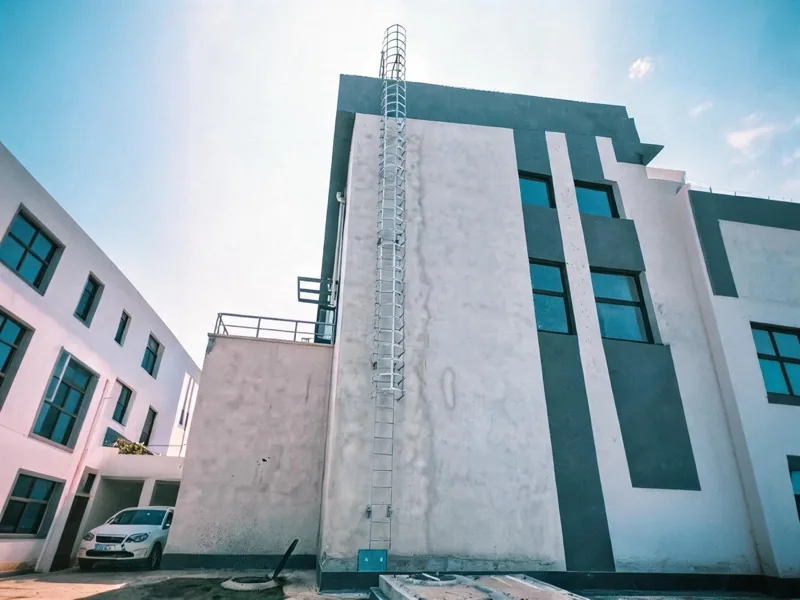
Is a roof ladder safe? Yes — a fixed roof ladder is safe when it is engineered to a published standard such as OSHA 1910.23 or EN ISO 14122-4, built from rated steel, and load-tested before it ships. The danger is never the idea of a roof ladder; it is a ladder that skips the geometry, the welds, or the paperwork that prove it.
We weld roof ladders every week at our 8,000 m² factory in Shijiazhuang. The phrase buyers type into a search box is blunt — is roof ladder safe — and they deserve a blunt answer backed by data. This guide gives it the way an engineer would: the common worries first, then the standards, the design details, the tests we run, and what the field record shows.
Common Concerns
Is a roof ladder safe to climb every day?
A fixed roof ladder is built for exactly that — repeat, daily access. We cut the side rails from Q235B structural steel, or SS304 stainless on coastal and washdown sites, then weld the rungs at a fixed 300 mm pitch so every step lands where your foot expects it. Bolted to the structure and rated for duty, it gives crews safe ladder access to roof level — a planned route, not a leaned-up afterthought.
What makes a roof ladder unsafe?
Three things, in our experience. Uneven or worn rung spacing, so the climb stops feeling predictable. Missing fall protection above the height where a cage or arrest system is required. And no documentation — if nobody can produce a material certificate or a load-test report, the ladder is unproven, whatever it looks like.
Are fixed roof ladders safer than portable ladders?
For rooftop access, yes. A portable ladder shifts, leans, and depends on the angle someone sets it at. A fixed roof ladder is bolted in place, engineered to a load, and inspected on a schedule. That is why plant and maintenance teams move to an easy access roof ladder once a roof gets climbed regularly. The roof ladder basics guide breaks down the types.
Safety Standards (OSHA & EN)
Which safety standards apply to a roof ladder?
Geography decides the rulebook. OSHA 1910.23 governs fixed ladders in North America. EN ISO 14122-4 is the European standard for permanent means of access to machinery. BS 4211 covers fixed ladders in the UK. Each one sets rung pitch, side-rail strength, clearances, and the height at which fall protection becomes mandatory. We build to whichever your project names.
When does a roof ladder need a safety cage?
Under OSHA 1910.23, a fixed ladder taller than roughly 24 ft (about 7.3 m) needs a cage or a personal fall-arrest system. On a caged ladder we space the roof ladder safety cage hoops no more than 1,200 mm apart and run them continuously up the climb. Below that threshold a plain fixed ladder is compliant, but we still recommend reviewing the full requirement in our roof ladder safety requirements guide.
Design Features
What design features make a roof ladder safe?
Safety lives in the details, and they are short to list:
- Anti-slip rungs — round or serrated bar at a fixed 300 mm pitch, grip on every step.
- Walk-through handrails — extended 1,070 mm above the landing so the transfer onto the roof has something to hold.
- Cage hoops — on caged versions, spaced no more than 1,200 mm apart.
- Rated steel — Q235B for general use, SS304 or SS316 where corrosion or washdown is a factor.
- Durable coating — hot-dip galvanizing at 70–85 µm, with powder coat over zinc when colour matters.
In our workshop the rule is simple: the geometry follows the standard, and the coating is sized for the environment, not the catalogue. A ladder that looks fine but corrodes in two years was never safe.
Testing & Certification
How do you test that a roof ladder is safe?
We proof-test a typical rung to a 1.5 kN point load and the full assembly to its rated duty. Every batch is sample-pulled for weld strength before it leaves the floor — we do not certify a run on the strength of the first weld alone. The factory holds ISO 9001:2015, and independent inspection by SGS, TÜV, or Bureau Veritas is available on request.
What documents prove a roof ladder is safe?
Three travel with every order: material certificates tracing the steel to its grade, weld reports, and load-test data. That is the paperwork an auditor opens first. An engineer still asking is roof ladder safe for a specific site really means one thing — will it hold the load and clear the audit? The documents answer both. Because we ship factory-direct to 50+ countries with no middleman in between, you talk to the people who welded the ladder, not a trader reading a spec sheet.
Real Safety Record
What does the field record show?
One example from our files: a logistics operator in the Gulf region ordered 40 caged roof ladders for a new distribution hub. We supplied SS304 throughout for the climate, with per-batch material certificates and load-test reports. The installation cleared its local safety audit on the first visit — no rework, no second inspection.
So, is roof ladder safe as a long-term answer? Across our export work since 2003, the pattern holds: ladders built to standard, tested per batch, and documented tend not to come back. The ones that fail an audit are almost always the undocumented ones.
Specifying a roof now? Send your height and the standard you work to, and our team returns a drawing, a load rating, and a factory-direct quote. Talk to our engineers, read the roof ladder FAQ, or arrange a factory audit — buyers are welcome on site.