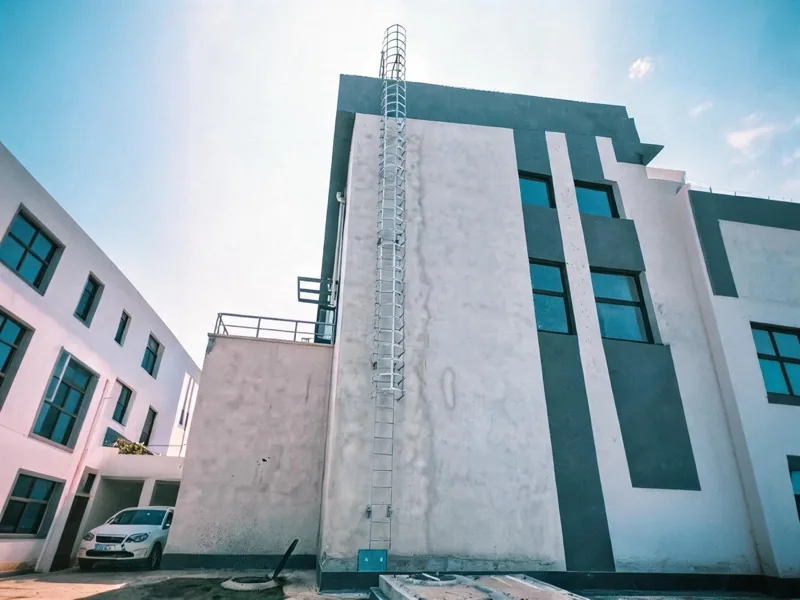
Looking at roof ladder alternatives? A fixed vertical ladder is the default for rooftop access, but it is not always the right call. Depending on climb height, how often crews go up, and what the local code demands, a different layout can be safer, faster to use, or cheaper to maintain. This guide compares four practical roof ladder alternatives against a standard fixed ladder, the way we weigh them on the factory floor before quoting. For the full background, see our roof ladder guide.
Quick framing first. The choice almost always comes down to three questions: how high is the climb, how often is it used, and which standard governs the site — OSHA 1910.23, EN ISO 14122-4, or BS 4211. Get those three straight and the right option usually picks itself.
1. Cat Ladder vs Fixed Ladder
The most common swap is between a cat ladder and a full fixed ladder. Both are vertical, both bolt to the structure, but they suit different duty.
- Roof cat ladder — a plain vertical ladder for short, occasional climbs, typically under 3 m. We cut the stiles from Q235B flat bar, weld rungs at a 300 mm pitch, and hot-dip galvanize to 70–85 µm. Light, quick to fit, lowest cost.
- Fixed roof access ladder — the workhorse for daily or repeated use, rated for higher loads and taller runs. Once the climb passes the OSHA 1910.23 threshold of about 7.3 m, it needs a cage or a fall-arrest system, which is where the caged roof access ladder comes in.
Rule of thumb from our shop: short climb, light traffic, tight budget — cat ladder. Tall climb, daily traffic, code-driven fall protection — fixed or caged. We proof-test a typical rung to a 1.5 kN point load either way, and SS304 replaces Q235B when the roof sits in coastal or washdown air.
2. Roof Walkway (Cat Walk)
A walkway is not a climbing tool — it is the alternative once you are already on the roof and need to move across it. Where a ladder gets you up, a walkway keeps you safe along a fragile or sloped roof surface. We build them in galvanized Q235B grating with a guardrail at 1,100 mm, designed to the same EN ISO 14122 family that covers the ladders.
Pair a short cat ladder with a walkway and you often replace a longer, more expensive ladder run plus a separate work platform. For plant rooms with HVAC strung across a roof, that combination is what we quote most.
3. Roof Hatch Ladder
When access comes up through the roof deck rather than over a parapet, a roof hatch ladder is the clean answer. It lands at a roof hatch with walk-through handrails extending 1,070 mm above the opening, so the transfer onto the deck is guarded on both sides.
This option shines indoors and on flat commercial roofs: the climb stays inside the building, out of the weather, and the hatch seals the opening when it is shut. We supply these in Q235B as standard, SS304 for food and pharma sites, with the hatch curb and ladder engineered as one assembly.
4. External Staircase
For heavy daily traffic, tools, or anyone who should not be on a vertical ladder, an external steel staircase beats every ladder option for comfort and safety. The trade-off is footprint and cost — a stair needs landings, a larger structure, and more steel.
We specify stairs to EN ISO 14122-3 with a rise and going that keep the pitch around 30–45 degrees, guardrails at 1,100 mm, and serrated treads for grip. When a client tells us a roof is serviced every shift, we steer them here rather than to a ladder, even though the ladder quotes cheaper. Long term, the stair is the lower-risk buy.
5. Roof Access Comparison Table
Here is how the four roof ladder alternatives stack up against a standard fixed ladder. Use it as a shortlist, then send us the height and code for a firm answer.
| Option | Best for | Typical height | Relative cost | Governing standard |
|---|---|---|---|---|
| Roof cat ladder | Short, occasional climbs | Under 3 m | $ (lowest) | OSHA 1910.23 / EN ISO 14122-4 |
| Fixed / caged ladder | Tall, repeated climbs | 3 m and up | $$ | OSHA 1910.23 / EN ISO 14122-4 |
| Roof walkway | Moving across the roof | n/a | $$ | EN ISO 14122-2 |
| Roof hatch ladder | Through-deck indoor access | Up to ~6 m | $$ | EN ISO 14122-4 |
| External staircase | Heavy daily traffic, tools | Any | $$$ (highest) | EN ISO 14122-3 |
From a recent job: a beverage producer in the Middle East could not put crews on a tall vertical ladder for daily tank-room access, so we swapped the original ladder spec for a short hatch ladder feeding an SS304 walkway. We ran batch tensile tests on each steel lot and shipped weld reports per unit.
Whatever you land on, buying factory-direct removes the trader markup — you talk to the engineers who weld it, not a middleman. Every order ships with material certificates, weld reports, and load-test data, the plant holds ISO 9001:2015, and third-party inspection through SGS, TÜV, or Bureau Veritas is available on request. We have shipped roof access to 50+ countries since 2003.
Not sure which alternative fits your roof? Send your climb height and the standard you answer to. Browse the full product range, read the roof ladder guide, or talk to our engineers — factory audits are welcome any time.
Roof Ladder Hire vs Buying Factory-Direct
Sites running a one-off job sometimes ask about roof ladder hire. Renting suits a single afternoon on a low pitch. For anything that stays on the building, the maths flips fast — a hired unit comes back two or three times and you have paid for a permanent ladder without owning one. We quote factory-direct, no middleman, and ship the material certificates, weld reports, and load-test data with every order, so a bought Q235B or SS304 run lands cheaper than repeat hire on most projects.
Roof Space Ladders for Interior Access
Not every climb is outdoors. Roof space ladders — the folding loft units that drop from a ceiling hatch — cover attic and plant-void access from inside the building. They answer to EN 14975 rather than EN ISO 14122-4. In our factory we build the fixed steel runs and through-deck units; for folding loft sets we spec to the same 1.5 kN rung proof-load we test our own ladders to.