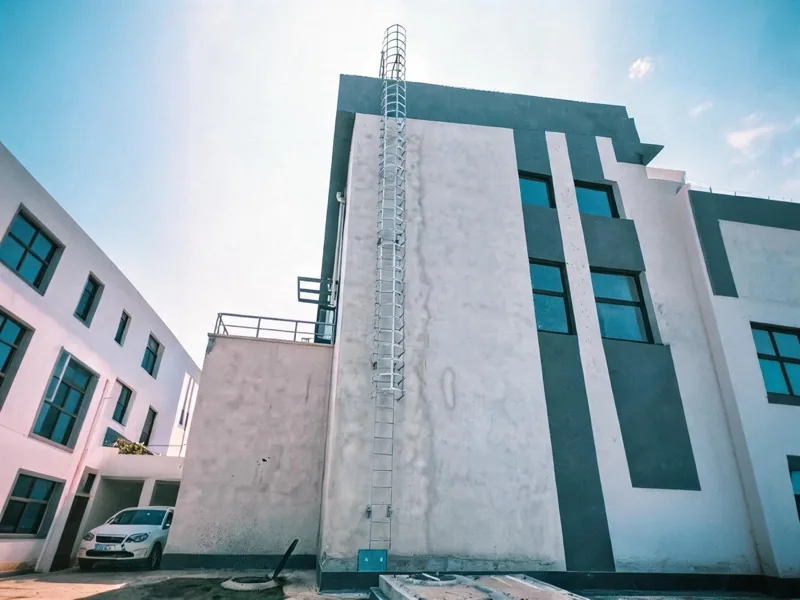
Roof ladder pros and cons come down to a simple trade: a fixed roof ladder buys you durable, code-compliant, repeatable roof access, and it asks for upfront cost, anchored installation, and a maintenance habit in return. We weld these ladders every week, so this is the honest version — what a fixed roof ladder is genuinely good at, and where it will cost you.
This is written as a straight comparison, not a sales page. If a roof ladder is wrong for your building, we would rather tell you and point you at an alternative access product. Start with what a roof ladder actually is if the term is new to you, then weigh the four pros and three cons below.
The Pros of a Roof Ladder
Four advantages do most of the heavy lifting: durability, safety, custom fit, and factory-direct supply. Here is what each one means in steel, not adjectives.
Durability
A fixed roof ladder is welded steel, not a folding consumer ladder. We build the stiles and rungs in Q235B for painted or hot-dip galvanized work, and in SS304 or SS316 where coastal salt or chemical washdown is a factor. Galvanized coating is applied on our line, thick enough to shrug off years of weather. The rungs carry a working load rated per our load tables. In our factory, we usually steer outdoor buyers toward hot-dip galvanizing over paint. Touch-up paint chips at the bolt holes first, and that is exactly where rust starts.
Safety
This is the strongest argument for a fixed roof ladder. Built to OSHA 1910.23, EN ISO 14122-4, or BS 4211, the geometry is fixed: rung spacing, side clearance, and the cage or fall-arrest threshold are all defined, not guessed. A leaning extension ladder gives you none of that. We cover the cage-height rules and clearances in the safety requirements guide, and the wider question of whether roof ladders are safe gets its own article.
Custom Fit
Roofs are rarely standard. A fixed ladder is cut to your parapet height, your offset, and your landing — down to the millimeter. Need a walkthrough handrail at the top, or a self-closing gate instead of a chain? That is a drawing change, not a problem. See real examples in the custom roof ladder guide.
Factory-Direct Supply
Buying from the factory means no middleman markup and no guesswork on paperwork. As an ISO 9001:2015 certified maker shipping to 50+ countries, we send material certificates, weld reports, and load-test data with the order. On a recent export job, we supplied galvanized Q235B roof access ladders, and the buyer's third-party inspector signed off the rung load test before the containers shipped. You are welcome to audit the factory yourself.
The Cons of a Roof Ladder
No honest comparison skips the downsides. Three are worth planning for: cost, installation, and maintenance.
Cost
A fixed, code-built steel ladder costs more upfront than a portable ladder you lean against the wall — that is the plain truth. You are paying for steel, welding, coating, and certification, not just rungs. The payback is lifespan and not failing an audit. We break down what drives the number in the roof ladder cost guide.
Installation
A roof ladder has to be anchored — to masonry, steel, or a structural wall — and that means a fixing survey and the right anchors for the substrate. It is not a five-minute job. Done wrong, the strongest ladder in the world is still unsafe. Our installation guide walks through anchor selection and torque.
Maintenance
Steel outdoors needs a light routine: an annual look at the welds, the anchors, and the coating, plus touch-up where it is scratched. It is modest, but it is not zero. Skip it for a decade near the coast and even SS304 will tea-stain. The maintenance guide has the full checklist.
Steel vs. Lightweight Roof Ladders
Buyers sometimes ask about lightweight roof ladders in aluminum instead of steel. An aluminum roof ladder weighs less and resists corrosion without a coating, which suits low-load access and rooftops where craning heavy steel sections is awkward. The trade-off is strength and code coverage: for caged climbs or heavy daily duty under OSHA 1910.23 or EN ISO 14122-4, we still specify Q235B or stainless. In our factory, we reach for lightweight roof ladders only when the load case and the standard both allow it.
The Verdict
For permanent, repeated roof access on a commercial or industrial building, a fixed roof ladder wins on every metric that matters in an audit — and the cost, install effort, and upkeep are predictable, not hidden. If access is occasional and the height is low, a portable ladder may be enough. If the climb is tall or enclosed, look at a caged ladder or a cat ladder instead; for parapet-to-roof transitions, a roof access ladder is the closer fit.
Send us your roof height, parapet detail, and the standard you answer to. We return a drawing, a load rating, and the test paperwork — factory-direct, with the certificates in the box.