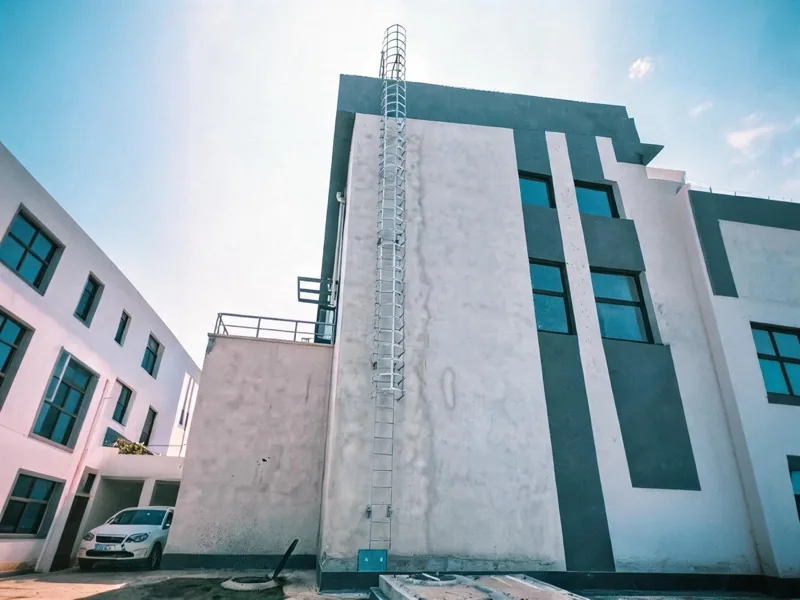
Knowing how to choose a roof ladder comes down to four questions answered in the right order: what the climb actually needs, which steel suits the site, what safety the height demands, and what the real price is once the spec is complete. Get the order right and you buy once. Get it wrong and you pay twice — in rework, a failed audit, or rust.
We weld these ladders in Shijiazhuang and ship them to 50+ countries, so the guidance here comes off the factory floor, not a sales sheet. For the full picture — types, standards, sizing — start with our complete roof ladder guide, and keep our roof ladder buying guide open as a checklist while you work through the steps below.
1. Assess Your Needs First
Before steel grade or price, pin down what the ladder has to do. Four answers shape every later decision.
- How high is the climb? Measure floor to landing in mm. Past the height threshold in OSHA 1910.23 the design changes — you move from a plain fixed run to a caged or fall-arrest climb.
- How often is it used, and by whom? A daily maintenance route and a once-a-year inspection access call for different rung wear and gate detail.
- What is the roof like? Flat industrial deck, pitched tile, or access through a hatch — each points to a different ladder type.
- Inland or coastal? The environment decides the steel grade later, so note it now.
Match the answers to the right product and you have narrowed the field before asking for a single price:
- Tall exterior climbs that pass the OSHA height line — a caged roof access ladder.
- Shorter, straight runs below the cage threshold — a fixed roof access ladder.
- Getting up and over a pitched or sloped roof — a roof cat ladder that spreads load across the slope.
- Access through a roof hatch — a roof hatch ladder sized to the opening.
Engineer's note: we ask for the climb height and the standard before anything else, because those two numbers decide half the drawing. Send them first and the quote comes back right the first time.
2. Choose the Material for the Site, Not the Budget
Ask one question: where will the ladder live? The answer sets the grade, and the grade is the biggest line on the quote.
- Inland, normal weather — Q235B carbon steel, hot-dip galvanized. Galvanized at 70–85 µm it holds up outdoors for years and costs the least to buy.
- Humid, food, or pharma sites — SS304 stainless. No coating to fail, cleans down easily, costs more per kilogram.
- Coastal or chemical exposure — SS316 marine-grade. The only safe call within a few kilometres of salt air; highest material cost, longest life where the climate is hostile.
| Where it lives | Grade to specify | Relative cost |
|---|---|---|
| Inland industrial roof | Q235B + galvanized (70–85 µm) | $ lowest |
| Humid / food / pharma | SS304 | $$ |
| Coastal / chemical | SS316 | $$$ |
Whatever the grade, ask for it by name on the drawing — "high-quality steel" tells you nothing. Every lot we cut runs a batch tensile test before it reaches the welding bay, and the mill certificate ships with the order.
3. Let the Height Decide the Safety Spec
Roof access is fall-risk work, and the safety features are set by code, not preference. Check these against the climb height you measured in step one.
- Cage or fall-arrest above the threshold. Past the climb height in OSHA 1910.23 you fit a hooped cage to EN ISO 14122-4 or a certified fall-arrest rail. One of the two, every time.
- Anti-slip rungs. Serrated or grooved, never smooth bar, so a wet boot still holds.
- Rung load proven in kN. A real number on the drawing, load-tested, with the report on file.
- Self-closing gate at the landing. It closes the gap at the top, where most falls happen, for very little cost.
- Rung spacing and side clearance in mm. Out-of-spec spacing fails an audit on sight.
If you are unsure which rules apply, our breakdown of roof ladder safety requirements walks through the height thresholds in plain terms. Lock the safety spec onto the drawing before you compare prices; a ladder that drops it is not cheaper, just unfinished.
4. Read the Real Number, Then Set the Budget
Two quotes for "a roof ladder" can differ by half. The gap is almost always spec, not margin, so compare like for like before you judge a price.
- Grade and coating — galvanized Q235B against SS304 or SS316 is not the same ladder.
- Cage and gate in or out — a bare-ladder figure looks cheap until the cage is added back.
- Documents and testing — if certificates and load tests are billed on the side, fold them in.
- Trader markup or factory-direct — buying from the maker skips the reseller margin.
As the manufacturer we quote ex-works with no middleman, so the figure you see is mill and fabrication cost — nothing hidden on top. A like-for-like galvanized Q235B ladder usually lands at before cage, coating, and freight; stainless and caged climbs rise from there. For a full breakdown of what moves the number, read how much a roof ladder costs.
From a recent order: a beverage plant in Southeast Asia moved a 60-ladder order from SS304 to galvanized Q235B for its inland sheds once we showed the site did not need stainless — same OSHA-compliant caged design, roughly a third off the material bill. We kept SS304 only for the wash-down area.
5. Five Questions to Ask Any Supplier
The last filter is the supplier. Put these five to anyone quoting, and the answers sort a manufacturer from a middleman fast.
- "Which standard does the design meet?" Expect OSHA 1910.23, EN ISO 14122-4, or BS 4211 by name. No named code is a red flag.
- "What steel grade, and can I see the mill certificate?" Q235B, SS304, or SS316 — stated, with paperwork.
- "What documents ship with the order?" Material certificates, weld reports, and load-test data should be included, not "available later".
- "Are you ISO 9001:2015 certified, and will you accept third-party testing?" SGS, TÜV, or Bureau Veritas on request says the supplier stands behind the work.
- "Can I audit the factory?" A maker says yes. We welcome factory audits — come walk the welding bay before you sign.
We answer all five with the first three documents included at no extra charge. If you are still weighing makers against traders, our guide on where to buy roof ladders covers how to vet one.
How to Choose a Roof Ladder: FAQs
What is the first step in choosing a roof ladder?
Measure the climb height in mm and note the standard you answer to. Those two numbers decide whether you need a plain fixed ladder or a caged climb, and they shape the rest of the spec.
Which material should I choose?
Match it to the site: galvanized Q235B inland, SS304 for humid or food areas, SS316 near the coast or chemicals. Spec the grade by name and ask for the mill certificate.
When do I need a safety cage?
Above the climb-height threshold in OSHA 1910.23 you need a cage to EN ISO 14122-4 or a certified fall-arrest system. One of the two is required.
Is buying factory-direct really cheaper?
Usually, because it removes the reseller margin, and material certificates, weld reports, and load-test data come included rather than billed on the side.