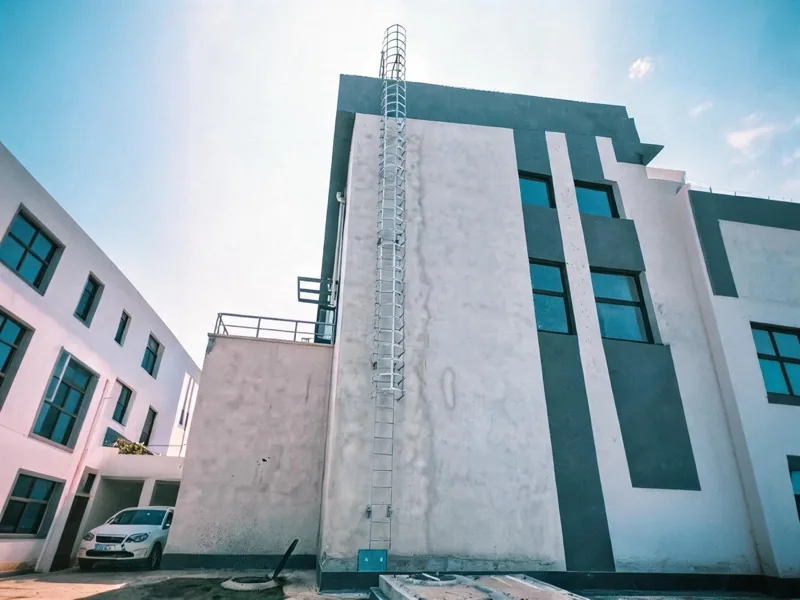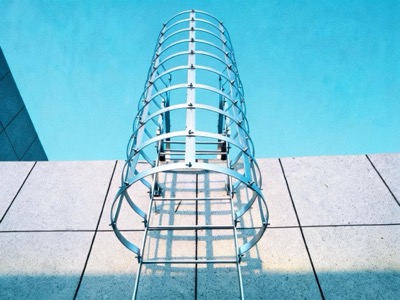
How long does a fixed ladder last? A well-built fixed steel ladder lasts 20 to 30 years, and many run longer. Hot-dip galvanized Q235B clears 20 to 25 years inland. Stainless SS304 and SS316 push past 30. The real number turns on four things: the steel grade, the coating thickness in microns, the air the ladder works in, and whether anyone inspects it. We are the factory, so we build to that lifespan on purpose. Here we answer the questions buyers actually ask.
Short version: a galvanized fixed ladder in Q235B is the value choice and lasts two to three decades inland. A durable fixed ladder in SS304 or SS316 lasts longer in salt and chemicals. For the bigger picture, see our full fixed ladder guide.
1. How Long Does a Fixed Ladder Last?
Plan on 20 to 30+ years for a fixed steel access ladder. A hot-dip galvanized Q235B unit on a dry inland site commonly reaches 25 years. The same ladder in coastal salt air may need replacing nearer 12 to 18 years. Stainless changes the math again. SS304 and SS316 often outlast the structure they are bolted to.
| Material + finish | Typical environment | Service life |
|---|---|---|
| Q235B + hot-dip galvanized (70–85 µm) | Dry inland industrial | 20–25+ yr |
| Q235B + hot-dip galvanized (70–85 µm) | Coastal / humid | 12–18 yr |
| SS304 | Food, pharma, humid | 25–40 yr |
| SS316 | Coastal / chemical | 30–40+ yr |
From a recent job: a food plant in Southeast Asia ordered 40 SS304 fixed ladders in 2012. At a 2024 audit, not one unit had been replaced, and the welds still passed dye-penetrant checks.
/images/product_fixed-steel-ladders_specs_steel_detail.webp
2. What Affects a Fixed Ladder's Service Life?
Five levers decide how long a fixed ladder lasts. We weigh all five before we quote a spec.
- Steel grade. Q235B carbon steel leans on its coating for protection. SS304 resists most atmospheres on its own. SS316, with added molybdenum, holds up in salt and chemicals.
- Coating thickness. Measured in microns. A thicker zinc layer buys more years, as the table below shows.
- Atmosphere. Using the ISO 9223 corrosivity grades, a dry C2 inland site is gentle. A C5 coastal or industrial site eats zinc several times faster.
- Load and use frequency. A ladder climbed daily wears rungs and fixings faster. We rate each rung to a defined load in kN, so repeated load cycles do not fatigue it early. Rung spacing and width follow the standard in mm.
- Install quality. Galvanic corrosion at the wrong fixings, or a drilled hole left bare, starts rust no spec can stop. OSHA 1910.23 and EN ISO 14122-4 set the geometry. Correct fixings set the lifespan.
3. How Do Coating and Material Choice Extend Lifespan?
For carbon-steel ladders, the coating is the clock. Hot-dip galvanizing lays down a zinc layer that corrodes in place of the steel beneath it. Thicker zinc means a longer life.
We specify 70–85 µm hot-dip galvanizing as standard for outdoor Q235B. As a working rule from the galvanizing standards, zinc loses about 1 µm a year in clean inland (C2) air. In aggressive coastal or industrial air, it loses 4–8 µm a year. Do the math: 80 µm of zinc gives decades inland but far fewer years on the coast. For chemical or salt exposure, a durable fixed ladder in SS304 or SS316 skips the coating clock entirely.
| Finish | Typical thickness | Life (inland C2) | Life (coastal C4/C5) |
|---|---|---|---|
| Hot-dip galvanized | 70–85 µm | 25+ yr | 10–15 yr |
| Duplex (HDG + powder coat) | 85 µm + topcoat | 40+ yr | 20–30 yr |
| SS304 (uncoated) | — | 30+ yr | 20–30 yr |
| SS316 (uncoated) | — | 40+ yr | 30+ yr |
Every batch leaves our line with the coating thickness measured and logged. That reading goes on the material certificate that ships with the order.
4. When Should You Replace or Repair a Fixed Ladder?
Repair while the structure is sound. Replace when it is not. A scheduled fixed ladder inspection catches the difference early. OSHA 1910.23 and EN ISO 14122-4 both treat these as stop conditions:
- Through-rust on a stile or rung. Surface rust cleans up. Rust that has eaten through the section does not. Replace it.
- Coating spent over large areas. When the zinc is gone and the steel bleeds orange across a span, recoating rarely pays.
- Loose, cracked, or pulled fixings. If the ladder moves against the wall, its anchorage has failed. That is a fall risk under OSHA 1910.23.
- Bent or fatigued rungs. A rung that flexes under one climber no longer meets its kN rating.
- No cage or fall protection on a tall climb. If the ladder predates current EN ISO 14122-4 rules, replacement is the safe upgrade.
Inspect twice a year, and again after any storm or impact. For the full routine, follow our fixed ladder inspection checklist, and check the geometry against the OSHA 1910.23 requirements and the EN ISO 14122-4 guide.
5. How Do We Build Fixed Ladders to Last?
We are the manufacturer, not a trader. The spec that leaves our floor is the spec you climb on, with no middleman swapping the coating to shave a cost. Every Dengtai fixed ladder ships with material certificates, weld reports, and load-test data. The plant is ISO 9001:2015 certified. We run batch tensile tests on each steel lot and log the galvanizing thickness per unit. Third-party verification through SGS, TÜV, or Bureau Veritas is available on request, and we export to 50+ countries. Want to see the dip tank and the QC bench first? We welcome factory audits.
/images/product_fixed-steel-ladders_features_factory_scene.webp
Building new access? Browse our vertical fixed access ladders, caged fixed ladders, and industrial warehouse fixed ladders, all built to the lifespan figures above.
Fixed Ladder Lifespan FAQs
How long does a fixed ladder last?
A fixed steel ladder typically lasts 20 to 30+ years. A hot-dip galvanized Q235B ladder on a dry inland site often passes 25 years. Coastal salt air shortens that, and stainless SS304 or SS316 lasts longer still.
How long does a steel ladder last when galvanized?
With 70–85 µm of hot-dip zinc, expect 25+ years inland and roughly 10 to 15 years in harsh coastal air, because zinc corrodes faster there. Cleaning it and touching up nicks extends both figures.
Does a stainless steel fixed ladder last longer than galvanized?
Yes. SS304 commonly lasts 30+ years, and SS316 longer again in salt or chemical exposure, because the metal resists corrosion without a sacrificial coating.
When should I replace my fixed ladder?
Replace it when a stile or rung shows through-rust, the coating is spent over large areas, fixings are loose or cracked, or rungs are bent. Any one of these is a fall risk under OSHA 1910.23.
Need the bigger picture first? Start with our complete fixed ladder guide covering types, standards, sizing, and selection. Then send us your height, load, and standard for a factory-direct quote.